

250
w. Schwarzacher
Shorter cycles have been called fourth- to sixth-order cycles or parasequences. Such fluctuations can have complex causes involving climate, tectonism and
sedimentation. The interaction between these can form self-oscillating systems
which can generate cycles. However, quasi-periodic cycles can only be generated
by systems with the stability of the solar system and for this reason Milankovitch
cycles are different.
3
Milankovitch Cycles
Milankovitch cycles are, by our definition, the result of changes in the earth's orbit. Such changes affect the amount of solar radiation received by the planet and
this in turn, determines the climate to a large extent. The relationship between
astronomical variables and climate is by no means simple, and various climatic
models have attempted to explore it, but the details are largely unknown. The astronomical variations and the resulting insolation changes can be calculated
with reasonable accuracy to at least 10 Ma BP (Berger and Loutre 1991).
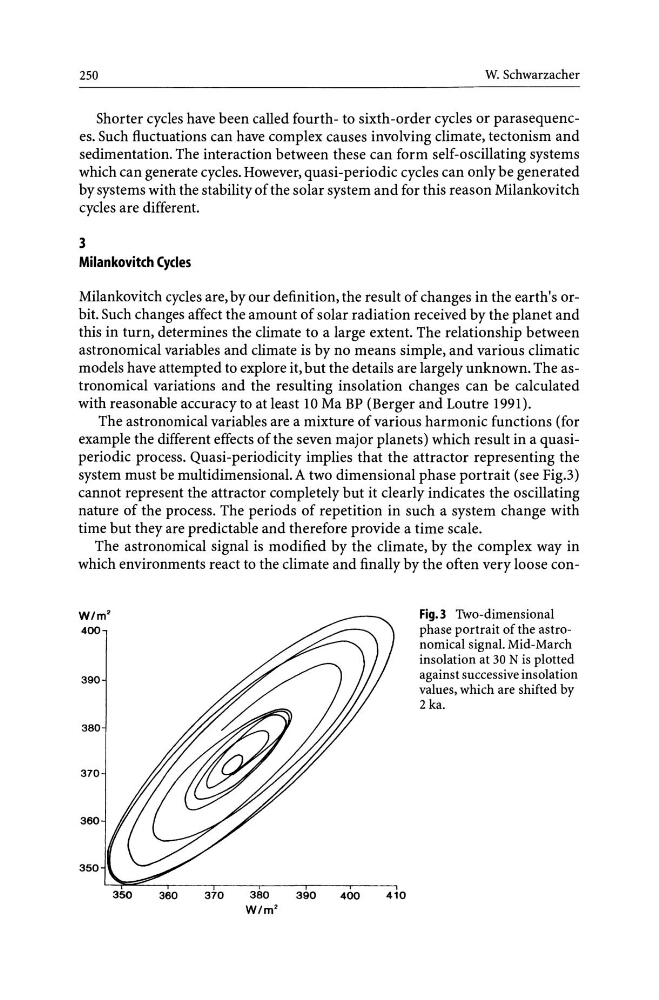
The astronomical variables are a mixture of various harmonic functions (for
example the different effects of the seven major planets) which result in a quasiperiodic process. Quasi-periodicity implies that the attractor representing the
system must be multidimensional. A two dimensional phase portrait (see Fig.3)
cannot represent the attractor completely but it clearly indicates the oscillating
nature of the process. The periods of repetition in such a system change with
time but they are predictable and therefore provide a time scale.
The astronomical signal is modified by the climate, by the complex way in
which environments react to the climate and finally by the often very loose conW/m 2
400
390
380
370
360
350
350
360
370
380
W/m2
390
400
410
Fig.3 Two-dimensional
phase portrait of the astronomical signal. Mid-March
insolation at 30 N is plotted
against successive insolation
values, which are shifted by
2 ka.
w. Schwarzacher
Shorter cycles have been called fourth- to sixth-order cycles or parasequences. Such fluctuations can have complex causes involving climate, tectonism and
sedimentation. The interaction between these can form self-oscillating systems
which can generate cycles. However, quasi-periodic cycles can only be generated
by systems with the stability of the solar system and for this reason Milankovitch
cycles are different.
3
Milankovitch Cycles
Milankovitch cycles are, by our definition, the result of changes in the earth's orbit. Such changes affect the amount of solar radiation received by the planet and
this in turn, determines the climate to a large extent. The relationship between
astronomical variables and climate is by no means simple, and various climatic
models have attempted to explore it, but the details are largely unknown. The astronomical variations and the resulting insolation changes can be calculated
with reasonable accuracy to at least 10 Ma BP (Berger and Loutre 1991).
The astronomical variables are a mixture of various harmonic functions (for
example the different effects of the seven major planets) which result in a quasiperiodic process. Quasi-periodicity implies that the attractor representing the
system must be multidimensional. A two dimensional phase portrait (see Fig.3)
cannot represent the attractor completely but it clearly indicates the oscillating
nature of the process. The periods of repetition in such a system change with
time but they are predictable and therefore provide a time scale.
The astronomical signal is modified by the climate, by the complex way in
which environments react to the climate and finally by the often very loose conW/m 2
400
390
380
370
360
350
350
360
370
380
W/m2
390
400
410
Fig.3 Two-dimensional
phase portrait of the astronomical signal. Mid-March
insolation at 30 N is plotted
against successive insolation
values, which are shifted by
2 ka.