

Climate Cycles and Climate Transitions . ..
237
P--rul
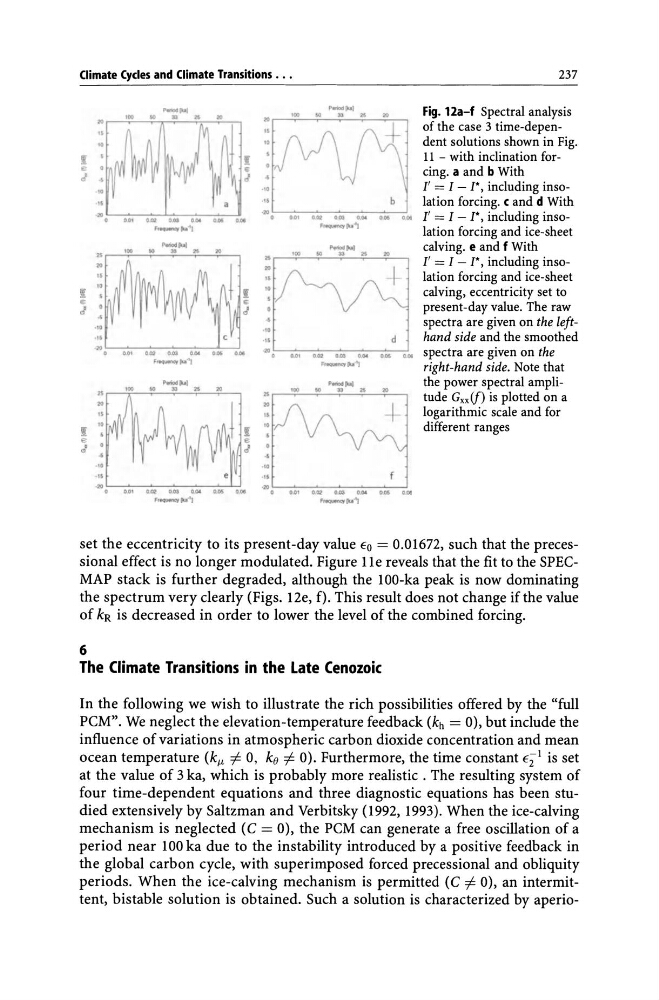
Fig. 12a-f Spectral analysis
'co
50
" . . '" of the case 3 time-dependent solutions shown in Fig.
11 - with inclination forcing. a and b With
."
l' = I - I*, including inso"
."
b
lation forcing. ( and d With
10
." •
o.(U
... . ... . .. l' = I - I*, including inso• .. , ... .'" ... , .. ...
f.:~~'11
F~JQ"I
lation forcing and ice-sheet
-fbi
calving. e and f With
'co
. . IS . . " I' = I - I*, including insolation forcing and ice-sheet
I
calving, eccentricity set to
. .
present-day value. The raw
J
spectra are given on the left."
d
hand side and the smoothed
.... . . . ... ... ... ... • ... ... . . . . .. . ... ... spectra are given on the
~~(II,I'II
F~[Q'-'I
right-hand side. Note that
"-''''''
the power spectral amplitOO
50
" "
,.
tude Gxxlf) is plotted on a
logarithmic scale and for
'I
different ranges
. .
• to
.... . ... ... ... ... •
0.0)
.... . ... . ... . ...
FI'tICtI*'IC¥(II,I"IJ
F"~Sb"1
set the eccentricity to its present-day value EO = 0.01672, such that the precessional effect is no longer modulated. Figure lIe reveals that the fit to the SPECMAP stack is further degraded, although the 100-ka peak is now dominating
the spectrum very clearly (Figs. 12e, f). This result does not change if the value
of kR is decreased in order to lower the level of the combined forcing.
6
The Climate Transitions in the Late Cenozoic
In the following we wish to illustrate the rich possibilities offered by the "full
PCM". We neglect the elevation-temperature feedback (kh = 0), but include the
influence of variations in atmospheric carbon dioxide concentration and mean
ocean temperature (k/L ::/ 0, ke ::/ 0). Furthermore, the time constant E Z 1 is set
at the value of 3 ka, which is probably more realistic. The resulting system of
four time-dependent equations and three diagnostic equations has been studied extensively by Saltzman and Verbitsky (1992, 1993). When the ice-calving
mechanism is neglected (C = 0), the PCM can generate a free oscillation of a
period near 100 ka due to the instability introduced by a positive feedback in
the global carbon cycle, with superimposed forced precessional and obliquity
periods. When the ice-calving mechanism is permitted (C ::/ 0), an intermittent, bistable solution is obtained. Such a solution is characterized by aperio-
237
P--rul
Fig. 12a-f Spectral analysis
'co
50
" . . '" of the case 3 time-dependent solutions shown in Fig.
11 - with inclination forcing. a and b With
."
l' = I - I*, including inso"
."
b
lation forcing. ( and d With
10
." •
o.(U
... . ... . .. l' = I - I*, including inso• .. , ... .'" ... , .. ...
f.:~~'11
F~JQ"I
lation forcing and ice-sheet
-fbi
calving. e and f With
'co
. . IS . . " I' = I - I*, including insolation forcing and ice-sheet
I
calving, eccentricity set to
. .
present-day value. The raw
J
spectra are given on the left."
d
hand side and the smoothed
.... . . . ... ... ... ... • ... ... . . . . .. . ... ... spectra are given on the
~~(II,I'II
F~[Q'-'I
right-hand side. Note that
"-''''''
the power spectral amplitOO
50
" "
,.
tude Gxxlf) is plotted on a
logarithmic scale and for
'I
different ranges
. .
• to
.... . ... ... ... ... •
0.0)
.... . ... . ... . ...
FI'tICtI*'IC¥(II,I"IJ
F"~Sb"1
set the eccentricity to its present-day value EO = 0.01672, such that the precessional effect is no longer modulated. Figure lIe reveals that the fit to the SPECMAP stack is further degraded, although the 100-ka peak is now dominating
the spectrum very clearly (Figs. 12e, f). This result does not change if the value
of kR is decreased in order to lower the level of the combined forcing.
6
The Climate Transitions in the Late Cenozoic
In the following we wish to illustrate the rich possibilities offered by the "full
PCM". We neglect the elevation-temperature feedback (kh = 0), but include the
influence of variations in atmospheric carbon dioxide concentration and mean
ocean temperature (k/L ::/ 0, ke ::/ 0). Furthermore, the time constant E Z 1 is set
at the value of 3 ka, which is probably more realistic. The resulting system of
four time-dependent equations and three diagnostic equations has been studied extensively by Saltzman and Verbitsky (1992, 1993). When the ice-calving
mechanism is neglected (C = 0), the PCM can generate a free oscillation of a
period near 100 ka due to the instability introduced by a positive feedback in
the global carbon cycle, with superimposed forced precessional and obliquity
periods. When the ice-calving mechanism is permitted (C ::/ 0), an intermittent, bistable solution is obtained. Such a solution is characterized by aperio-