

236
OUL~L-~ __ UL __ ~~~~~~ __ ~~~~~
4 r-----~------~------~------~----_.
A. Paul· W. H. Berger
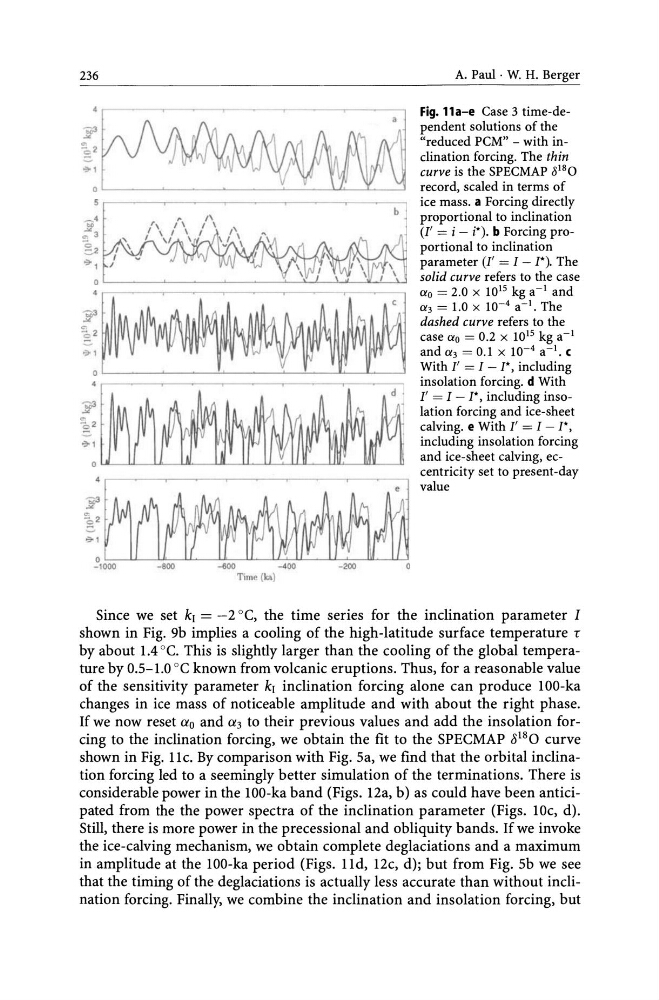
Fig. 11 a-e Case 3 time-dependent solutions of the
"reduced PCM" - with inclination forcing. The thin
curve is the SPECMAP 8 18 0
record, scaled in terms of
ice mass. a Forcing directly
proportional to inclination
(1' = i - i*). b Forcing proportional to inclination
parameter (1' = 1- 1*). The
solid curve refers to the case
ao = 2.0 x lOIS kg a-I and
a3 = 1.0 x 10- 4 a-I. The
dashed curve refers to the
case ao = 0.2 x lOiS kg a-I
and a3 = 0.1 x 10- 4 a-I. c
With l' = I - I*, including
insolation forcing. d With
l' = I - I*, including insolation forcing and ice-sheet
calving. e With l' = I - I*,
including insolation forcing
and ice-sheet calving, eccentricity set to present-day
value
Since we set kJ = -2°C, the time series for the inclination parameter I
shown in Fig. 9b implies a cooling of the high-latitude surface temperature r
by about 1.4 0c. This is slightly larger than the cooling of the global temperature by 0.5-1.0 °C known from volcanic eruptions. Thus, for a reasonable value
of the sensitivity parameter kJ inclination forcing alone can produce 100-ka
changes in ice mass of noticeable amplitude and with about the right phase.
If we now reset ao and a3 to their previous values and add the insolation forcing to the inclination forcing, we obtain the fit to the SPECMAP 8 18 0 curve
shown in Fig. 11c. By comparison with Fig. Sa, we find that the orbital inclination forcing led to a seemingly better simulation of the terminations. There is
considerable power in the 100-ka band (Figs. 12a, b) as could have been anticipated from the the power spectra of the inclination parameter (Figs. 10c, d).
Still, there is more power in the precessional and obliquity bands. If we invoke
the ice-calving mechanism, we obtain complete deglaciations and a maximum
in amplitude at the 100-ka period (Figs. lld, 12c, d); but from Fig. sb we see
that the timing of the deglaciations is actually less accurate than without inclination forcing. Finally, we combine the inclination and insolation forcing, but
OUL~L-~ __ UL __ ~~~~~~ __ ~~~~~
4 r-----~------~------~------~----_.
A. Paul· W. H. Berger
Fig. 11 a-e Case 3 time-dependent solutions of the
"reduced PCM" - with inclination forcing. The thin
curve is the SPECMAP 8 18 0
record, scaled in terms of
ice mass. a Forcing directly
proportional to inclination
(1' = i - i*). b Forcing proportional to inclination
parameter (1' = 1- 1*). The
solid curve refers to the case
ao = 2.0 x lOIS kg a-I and
a3 = 1.0 x 10- 4 a-I. The
dashed curve refers to the
case ao = 0.2 x lOiS kg a-I
and a3 = 0.1 x 10- 4 a-I. c
With l' = I - I*, including
insolation forcing. d With
l' = I - I*, including insolation forcing and ice-sheet
calving. e With l' = I - I*,
including insolation forcing
and ice-sheet calving, eccentricity set to present-day
value
Since we set kJ = -2°C, the time series for the inclination parameter I
shown in Fig. 9b implies a cooling of the high-latitude surface temperature r
by about 1.4 0c. This is slightly larger than the cooling of the global temperature by 0.5-1.0 °C known from volcanic eruptions. Thus, for a reasonable value
of the sensitivity parameter kJ inclination forcing alone can produce 100-ka
changes in ice mass of noticeable amplitude and with about the right phase.
If we now reset ao and a3 to their previous values and add the insolation forcing to the inclination forcing, we obtain the fit to the SPECMAP 8 18 0 curve
shown in Fig. 11c. By comparison with Fig. Sa, we find that the orbital inclination forcing led to a seemingly better simulation of the terminations. There is
considerable power in the 100-ka band (Figs. 12a, b) as could have been anticipated from the the power spectra of the inclination parameter (Figs. 10c, d).
Still, there is more power in the precessional and obliquity bands. If we invoke
the ice-calving mechanism, we obtain complete deglaciations and a maximum
in amplitude at the 100-ka period (Figs. lld, 12c, d); but from Fig. sb we see
that the timing of the deglaciations is actually less accurate than without inclination forcing. Finally, we combine the inclination and insolation forcing, but