

Climate Cycles and Climate Transitions . ..
°.lOO !:-,7 0 ----: SOO ~, O----, ~:-:: OO:-::, O----, _300 ~.O:----~ 200 7,O :-----:-: , OO ~,7 0 ----:' 0.0
Tim, (b.)
....... 1'04
• .... DuO
. . "
+
...
... b
..- . .... ... .... ...
"-~~"I
......,~
-1>01
... . . " . . "
... . . " " "
..
+
."
." d
... •
0.00_
~O>
... ~ .. -
0.00
F~(' • .-')
235
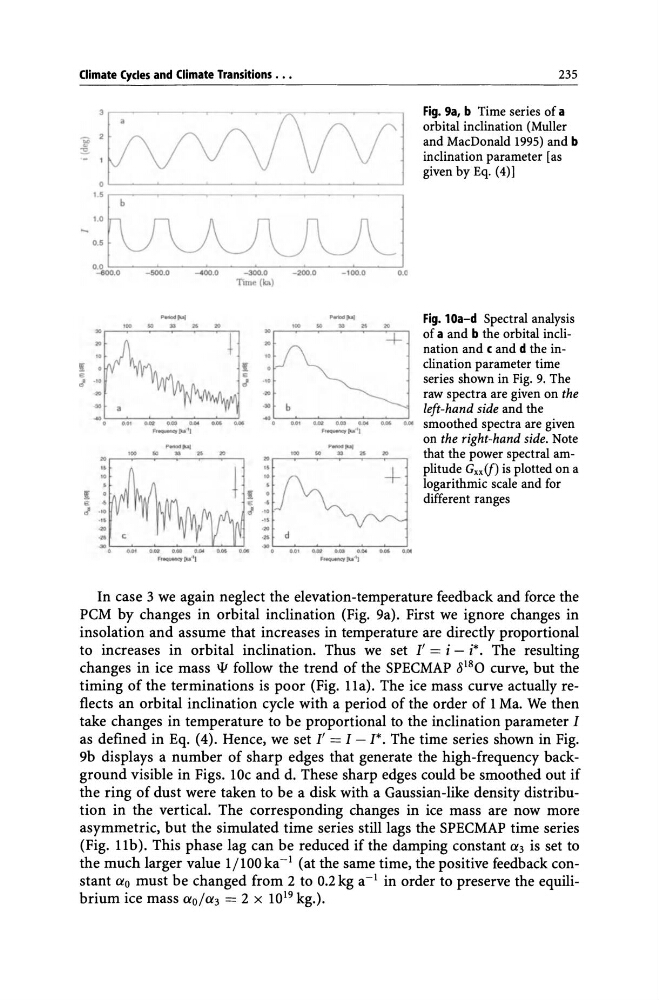
Fig. 9a, b Time series of a
orbital inclination (Muller
and MacDonald 1995) and b
inclination parameter [as
given by Eq. (4)]
Fig. 10a-d Spectral analysis
of a and b the orbital inclination and c and d the inclination parameter time
series shown in Fig. 9. The
raw spectra are given on the
left-hand side and the
smoothed spectra are given
on the right-hand side. Note
that the power spectral amplitude Gxxlf) is plotted on a
logarithmic scale and for
different ranges
In case 3 we again neglect the elevation-temperature feedback and force the
PCM by changes in orbital inclination (Fig. 9a). First we ignore changes in
insolation and assume that increases in temperature are directly proportional
to increases in orbital inclination. Thus we set I' = i - i*. The resulting
changes in ice mass \II follow the trend of the SPECMAP 8 18 0 curve, but the
timing of the terminations is poor (Fig. lla). The ice mass curve actually reflects an orbital inclination cycle with a period of the order of 1 Ma. We then
take changes in temperature to be proportional to the inclination parameter I
as defined in Eq. (4). Hence, we set l' = I - 1*. The time series shown in Fig.
9b displays a number of sharp edges that generate the high-frequency background visible in Figs. 10c and d. These sharp edges could be smoothed out if
the ring of dust were taken to be a disk with a Gaussian-like density distribution in the vertical. The corresponding changes in ice mass are now more
asymmetric, but the simulated time series still lags the SPECMAP time series
(Fig. llb). This phase lag can be reduced if the damping constant a3 is set to
the much larger value 1/100ka- 1 (at the same time, the positive feedback constant ao must be changed from 2 to 0.2 kg a-I in order to preserve the equilibrium ice mass aO/a3 = 2 x 10 19 kg.).
°.lOO !:-,7 0 ----: SOO ~, O----, ~:-:: OO:-::, O----, _300 ~.O:----~ 200 7,O :-----:-: , OO ~,7 0 ----:' 0.0
Tim, (b.)
....... 1'04
• .... DuO
. . "
+
...
... b
..- . .... ... .... ...
"-~~"I
......,~
-1>01
... . . " . . "
... . . " " "
..
+
."
." d
... •
0.00_
~O>
... ~ .. -
0.00
F~(' • .-')
235
Fig. 9a, b Time series of a
orbital inclination (Muller
and MacDonald 1995) and b
inclination parameter [as
given by Eq. (4)]
Fig. 10a-d Spectral analysis
of a and b the orbital inclination and c and d the inclination parameter time
series shown in Fig. 9. The
raw spectra are given on the
left-hand side and the
smoothed spectra are given
on the right-hand side. Note
that the power spectral amplitude Gxxlf) is plotted on a
logarithmic scale and for
different ranges
In case 3 we again neglect the elevation-temperature feedback and force the
PCM by changes in orbital inclination (Fig. 9a). First we ignore changes in
insolation and assume that increases in temperature are directly proportional
to increases in orbital inclination. Thus we set I' = i - i*. The resulting
changes in ice mass \II follow the trend of the SPECMAP 8 18 0 curve, but the
timing of the terminations is poor (Fig. lla). The ice mass curve actually reflects an orbital inclination cycle with a period of the order of 1 Ma. We then
take changes in temperature to be proportional to the inclination parameter I
as defined in Eq. (4). Hence, we set l' = I - 1*. The time series shown in Fig.
9b displays a number of sharp edges that generate the high-frequency background visible in Figs. 10c and d. These sharp edges could be smoothed out if
the ring of dust were taken to be a disk with a Gaussian-like density distribution in the vertical. The corresponding changes in ice mass are now more
asymmetric, but the simulated time series still lags the SPECMAP time series
(Fig. llb). This phase lag can be reduced if the damping constant a3 is set to
the much larger value 1/100ka- 1 (at the same time, the positive feedback constant ao must be changed from 2 to 0.2 kg a-I in order to preserve the equilibrium ice mass aO/a3 = 2 x 10 19 kg.).