

234
~lb~
I:~!lCivw\Nv\IWl
o 2°OL~ . , V . .. . ." i
o ~----~~----~~----~------~------~
-1000
-800
-600
---400
-200
0
Time (lea)
0 ,01
.. .. .. ., 0." .GO ' 01
F"1~fq.~1
-~
' """(>oJ
, . . . . " " ..
, . . . . " " . .
+
. .
."
d
."
."
• . . , ... ' J" .. .. 0. " . . .. • .. , .. .. O./XI. .... ... OlIO
FI~IQ-II
~lQ"l
A. Paul· W. H. Berger
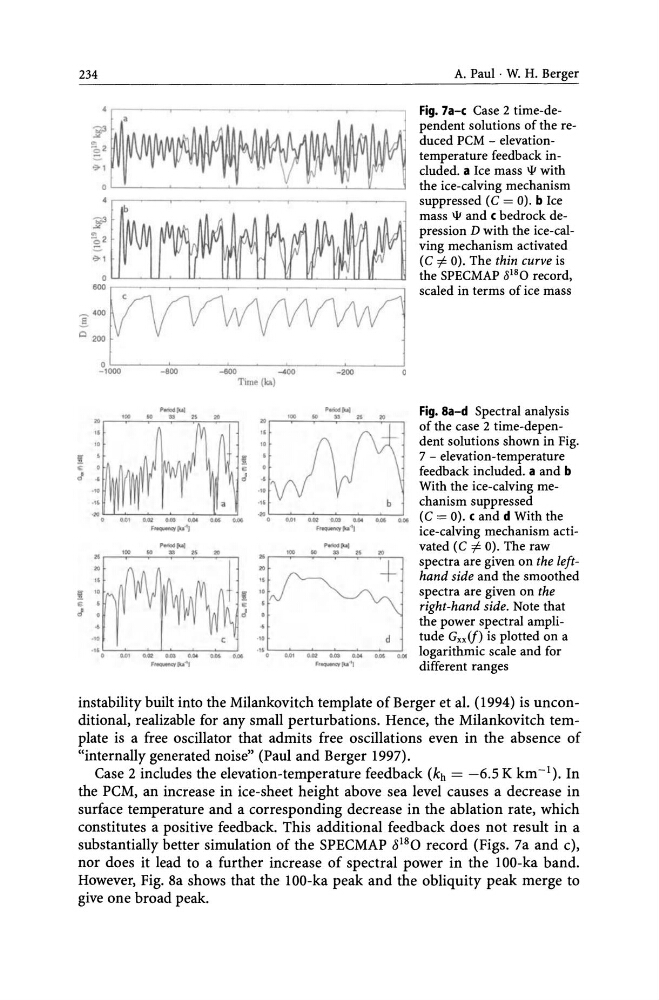
Fig. 7a-c Case 2 time-dependent solutions of the reduced PCM - elevationtemperature feedback included. a Ice mass \If with
the ice-calving mechanism
suppressed (C = 0). b Ice
mass \If and c bedrock depression D with the ice-calving mechanism activated
(C =I- 0). The thin curve is
the SPECMAP 8 18 0 record,
scaled in terms of ice mass
Fig. 8a-d Spectral analysis
of the case 2 time-dependent solutions shown in Fig.
7 - elevation-temperature
feedback included. a and b
With the ice-calving mechanism suppressed
(C = 0). c and d With the
ice-calving mechanism activated (C =I- 0). The raw
spectra are given on the lefthand side and the smoothed
spectra are given on the
right-hand side. Note that
the power spectral amplitude Gxx(f) is plotted on a
logarithmic scale and for
different ranges
instability built into the Milankovitch template of Berger et al. (1994) is unconditional, realizable for any small perturbations. Hence, the Milankovitch template is a free oscillator that admits free oscillations even in the absence of
"internally generated noise" (Paul and Berger 1997).
Case 2 includes the elevation-temperature feedback (kh = -6.S K km- 1 ). In
the PCM, an increase in ice-sheet height above sea level causes a decrease in
surface temperature and a corresponding decrease in the ablation rate, which
constitutes a positive feedback. This additional feedback does not result in a
substantially better simulation of the SPECMAP 8 18 0 record (Figs. 7a and c),
nor does it lead to a further increase of spectral power in the lOO-ka band.
However, Fig. Sa shows that the lOO-ka peak and the obliquity peak merge to
give one broad peak.
~lb~
I:~!lCivw\Nv\IWl
o 2°OL~ . , V . .. . ." i
o ~----~~----~~----~------~------~
-1000
-800
-600
---400
-200
0
Time (lea)
0 ,01
.. .. .. ., 0." .GO ' 01
F"1~fq.~1
-~
' """(>oJ
, . . . . " " ..
, . . . . " " . .
+
. .
."
d
."
."
• . . , ... ' J" .. .. 0. " . . .. • .. , .. .. O./XI. .... ... OlIO
FI~IQ-II
~lQ"l
A. Paul· W. H. Berger
Fig. 7a-c Case 2 time-dependent solutions of the reduced PCM - elevationtemperature feedback included. a Ice mass \If with
the ice-calving mechanism
suppressed (C = 0). b Ice
mass \If and c bedrock depression D with the ice-calving mechanism activated
(C =I- 0). The thin curve is
the SPECMAP 8 18 0 record,
scaled in terms of ice mass
Fig. 8a-d Spectral analysis
of the case 2 time-dependent solutions shown in Fig.
7 - elevation-temperature
feedback included. a and b
With the ice-calving mechanism suppressed
(C = 0). c and d With the
ice-calving mechanism activated (C =I- 0). The raw
spectra are given on the lefthand side and the smoothed
spectra are given on the
right-hand side. Note that
the power spectral amplitude Gxx(f) is plotted on a
logarithmic scale and for
different ranges
instability built into the Milankovitch template of Berger et al. (1994) is unconditional, realizable for any small perturbations. Hence, the Milankovitch template is a free oscillator that admits free oscillations even in the absence of
"internally generated noise" (Paul and Berger 1997).
Case 2 includes the elevation-temperature feedback (kh = -6.S K km- 1 ). In
the PCM, an increase in ice-sheet height above sea level causes a decrease in
surface temperature and a corresponding decrease in the ablation rate, which
constitutes a positive feedback. This additional feedback does not result in a
substantially better simulation of the SPECMAP 8 18 0 record (Figs. 7a and c),
nor does it lead to a further increase of spectral power in the lOO-ka band.
However, Fig. Sa shows that the lOO-ka peak and the obliquity peak merge to
give one broad peak.