

Climate Cycles and Climate Transitions . ..
O,(U
too
~
·to
." • ...,
.... . ... . ...
~~",,-II
..... IUI
. . :I:t "
.... .m . ...
~I~~~I
....
"
+
Q" ...
233
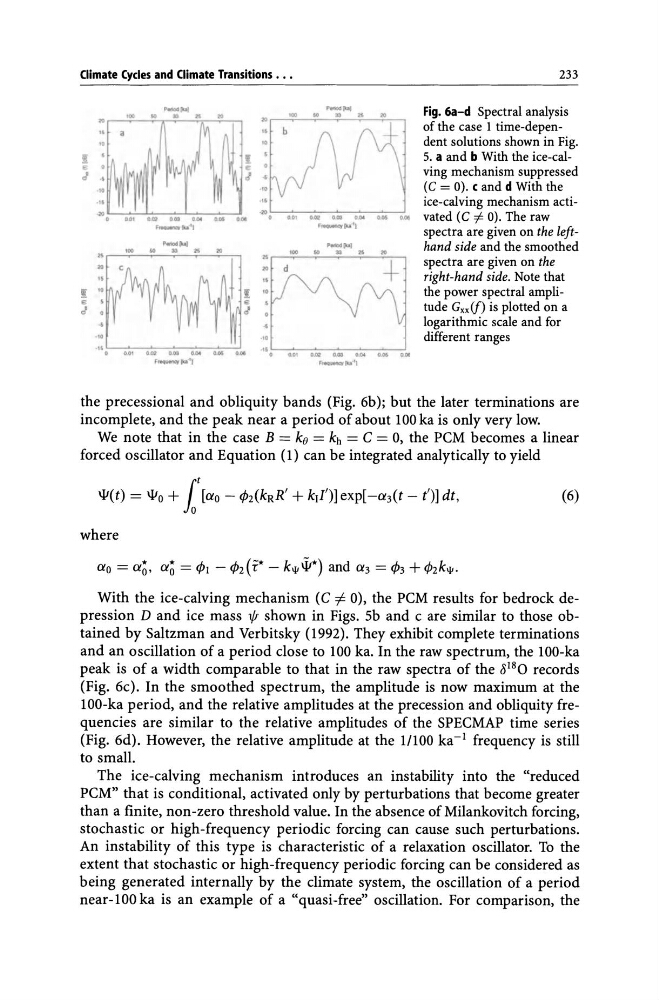
Fig. 6a-d Spectral analysis
of the case 1 time-dependent solutions shown in Fig.
5. a and b With the ice-calving mechanism suppressed
(C = 0). c and d With the
ice-calving mechanism activated (C =1= 0). The raw
spectra are given on the le/thand side and the smoothed
spectra are given on the
right-hand side. Note that
the power spectral amplitude Gxx(f) is plotted on a
logarithmic scale and for
different ranges
the precessional and obliquity bands (Fig. 6b); but the later terminations are
incomplete, and the peak near a period of about 100 ka is only very low.
We note that in the case B = ko = kb = C = 0, the PCM becomes a linear
forced oscillator and Equation (1) can be integrated analytically to yield
Wet) = % + It[CXO - ¢2(kRR' + k,I')]exp[-CX3(t - t')] dt,
(6)
where
CXo = cx~, cx~ = ¢I - ¢2(i* - kw"'*) and CX3 = ¢3 + ¢2kW'
With the ice-calving mechanism (C i- 0), the PCM results for bedrock depression D and ice mass 1/f shown in Figs. sb and c are similar to those obtained by Saltzman and Verbitsky (1992). They exhibit complete terminations
and an oscillation of a period close to 100 ka. In the raw spectrum, the 100-ka
peak is of a width comparable to that in the raw spectra of the 8 18 0 records
(Fig. 6c). In the smoothed spectrum, the amplitude is now maximum at the
100-ka period, and the relative amplitudes at the precession and obliquity frequencies are similar to the relative amplitudes of the SPECMAP time series
(Fig. 6d). However, the relative amplitude at the 1/100 ka- I frequency is still
to small.
The ice-calving mechanism introduces an instability into the «reduced
PCM" that is conditional, activated only by perturbations that become greater
than a finite, non-zero threshold value. In the absence of Milankovitch forcing,
stochastic or high-frequency periodic forcing can cause such perturbations.
An instability of this type is characteristic of a relaxation oscillator. To the
extent that stochastic or high-frequency periodic forcing can be considered as
being generated internally by the climate system, the oscillation of a period
near-IOO ka is an example of a «quasi-free" oscillation. For comparison, the
O,(U
too
~
·to
." • ...,
.... . ... . ...
~~",,-II
..... IUI
. . :I:t "
.... .m . ...
~I~~~I
....
"
+
Q" ...
233
Fig. 6a-d Spectral analysis
of the case 1 time-dependent solutions shown in Fig.
5. a and b With the ice-calving mechanism suppressed
(C = 0). c and d With the
ice-calving mechanism activated (C =1= 0). The raw
spectra are given on the le/thand side and the smoothed
spectra are given on the
right-hand side. Note that
the power spectral amplitude Gxx(f) is plotted on a
logarithmic scale and for
different ranges
the precessional and obliquity bands (Fig. 6b); but the later terminations are
incomplete, and the peak near a period of about 100 ka is only very low.
We note that in the case B = ko = kb = C = 0, the PCM becomes a linear
forced oscillator and Equation (1) can be integrated analytically to yield
Wet) = % + It[CXO - ¢2(kRR' + k,I')]exp[-CX3(t - t')] dt,
(6)
where
CXo = cx~, cx~ = ¢I - ¢2(i* - kw"'*) and CX3 = ¢3 + ¢2kW'
With the ice-calving mechanism (C i- 0), the PCM results for bedrock depression D and ice mass 1/f shown in Figs. sb and c are similar to those obtained by Saltzman and Verbitsky (1992). They exhibit complete terminations
and an oscillation of a period close to 100 ka. In the raw spectrum, the 100-ka
peak is of a width comparable to that in the raw spectra of the 8 18 0 records
(Fig. 6c). In the smoothed spectrum, the amplitude is now maximum at the
100-ka period, and the relative amplitudes at the precession and obliquity frequencies are similar to the relative amplitudes of the SPECMAP time series
(Fig. 6d). However, the relative amplitude at the 1/100 ka- I frequency is still
to small.
The ice-calving mechanism introduces an instability into the «reduced
PCM" that is conditional, activated only by perturbations that become greater
than a finite, non-zero threshold value. In the absence of Milankovitch forcing,
stochastic or high-frequency periodic forcing can cause such perturbations.
An instability of this type is characteristic of a relaxation oscillator. To the
extent that stochastic or high-frequency periodic forcing can be considered as
being generated internally by the climate system, the oscillation of a period
near-IOO ka is an example of a «quasi-free" oscillation. For comparison, the