

232
A. Paul· W. H. Berger
Table 2 Summary of the numerical experiments
Case
1 Standard
2 Elevation-temperature effect included
3 With inclination forcing
4 Global carbon cycle and heat storage
in the ocean included
7 1
Experiment
a No ice calving
b With ice calving
a No ice calving
b With ice calving
a Directly proportional to inclination
b Proportional to inclination parameter
c Proportional to inclination parameter,
with insolation forcing
d Proportional to inclination parameter,
with insolation forcing and ice calving
e Proportional to inclination parameter,
with insolation forcing and ice calving,
eccentricity set to present-day value
a With insolation forcing and ice calving
b Combined insolation and inclination
forcing, with ice calving
c Combined insolation and inclination
forcing, with ice calving and
eccentricity set to present-day value
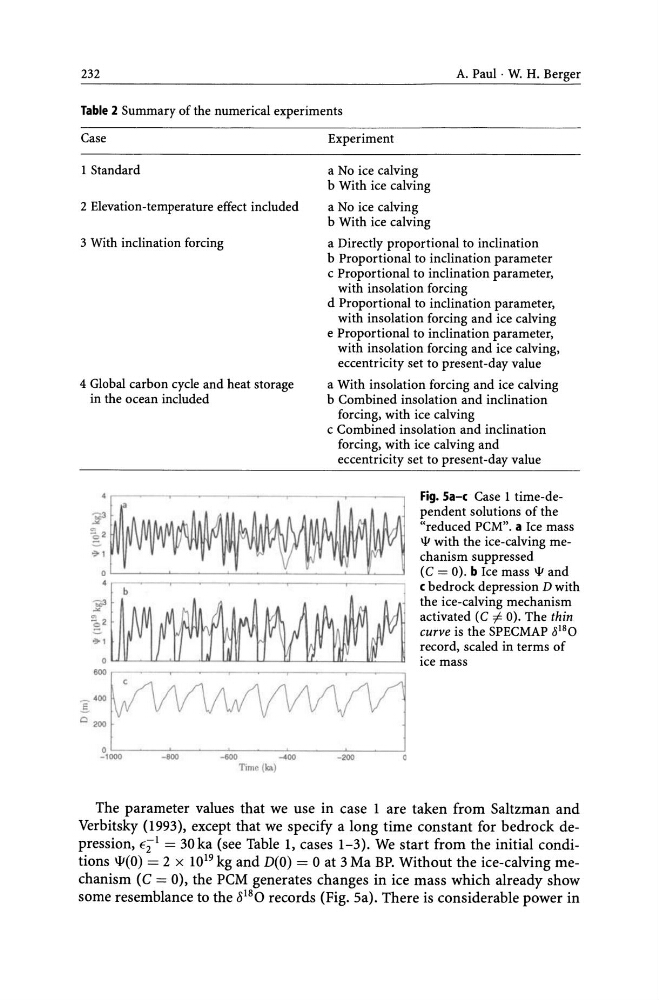
Fig. Sa-c Case 1 time-dependent solutions of the
"reduced PCM". a Ice mass
IlJ with the ice-calving mechanism suppressed
o ~~==~==~~==~
~l~~
I:~
(C = 0). b Ice mass IlJ and
c bedrock depression D with
the ice-calving mechanism
activated (C -=p 0). The thin
curve is the SPECMAP 8 18 0
record, scaled in terms of
ice mass
Cl 200
~ooo ~------ ~~~~--- ~ ~------~ ~ 00 ------- -2~ 00 ------~ o
Time (ka)
The parameter values that we use in case 1 are taken from Saltzman and
Verbitsky (1993), except that we specify a long time constant for bedrock depression, Ell = 30ka (see Table 1, cases 1-3). We start from the initial conditions W(O) = 2 X 10 19 kg and D(O) = 0 at 3 Ma BP. Without the ice-calving mechanism (C = 0), the PCM generates changes in ice mass which already show
some resemblance to the 8 18 0 records (Fig. Sa). There is considerable power in
A. Paul· W. H. Berger
Table 2 Summary of the numerical experiments
Case
1 Standard
2 Elevation-temperature effect included
3 With inclination forcing
4 Global carbon cycle and heat storage
in the ocean included
7 1
Experiment
a No ice calving
b With ice calving
a No ice calving
b With ice calving
a Directly proportional to inclination
b Proportional to inclination parameter
c Proportional to inclination parameter,
with insolation forcing
d Proportional to inclination parameter,
with insolation forcing and ice calving
e Proportional to inclination parameter,
with insolation forcing and ice calving,
eccentricity set to present-day value
a With insolation forcing and ice calving
b Combined insolation and inclination
forcing, with ice calving
c Combined insolation and inclination
forcing, with ice calving and
eccentricity set to present-day value
Fig. Sa-c Case 1 time-dependent solutions of the
"reduced PCM". a Ice mass
IlJ with the ice-calving mechanism suppressed
o ~~==~==~~==~
~l~~
I:~
(C = 0). b Ice mass IlJ and
c bedrock depression D with
the ice-calving mechanism
activated (C -=p 0). The thin
curve is the SPECMAP 8 18 0
record, scaled in terms of
ice mass
Cl 200
~ooo ~------ ~~~~--- ~ ~------~ ~ 00 ------- -2~ 00 ------~ o
Time (ka)
The parameter values that we use in case 1 are taken from Saltzman and
Verbitsky (1993), except that we specify a long time constant for bedrock depression, Ell = 30ka (see Table 1, cases 1-3). We start from the initial conditions W(O) = 2 X 10 19 kg and D(O) = 0 at 3 Ma BP. Without the ice-calving mechanism (C = 0), the PCM generates changes in ice mass which already show
some resemblance to the 8 18 0 records (Fig. Sa). There is considerable power in