

Possibilities of Cause-and-Effect Simulation in the Study of System Climate-Ocean-Sediments
211
Another important point in data formalization is the choice of object. This is
determined by a concrete problem and the entire manner of investigating. In the
case of the system climate-ocean-sediments, two main types of standard object
groups are possible, stations or observation times.
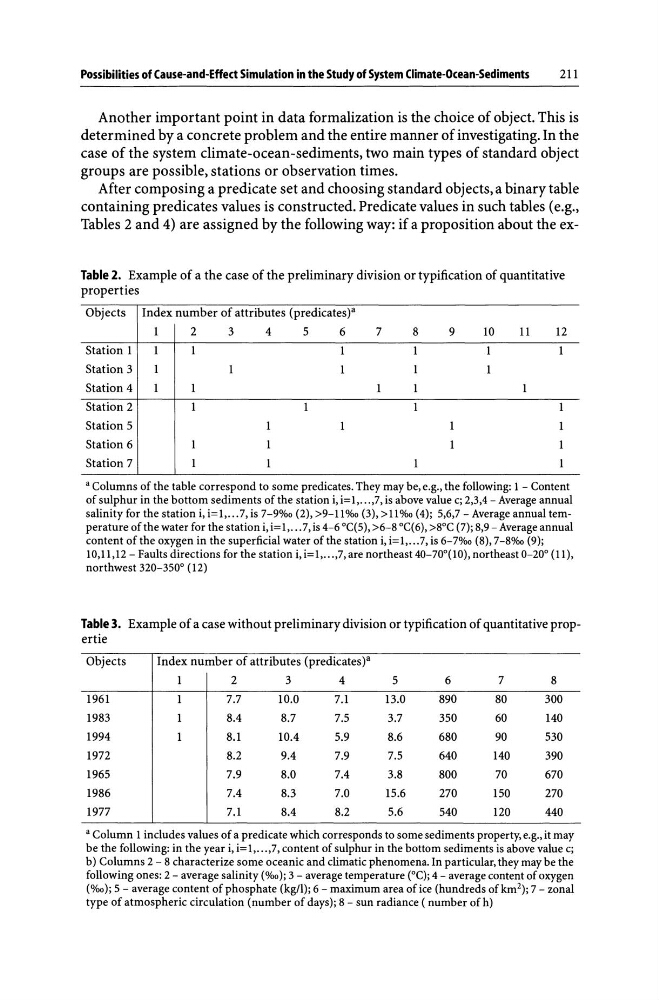
After composing a predicate set and choosing standard objects, a binary table
containing predicates values is constructed. Predicate values in such tables (e.g.,
Tables 2 and 4) are assigned by the following way: if a proposition about the exTable 2. Example of a the case of the preliminary division or typification of quantitative
properties
Objects Index number of attributes (predicates)a
1
2
3
4
5
6
7
8
9
10
11
12
Station 1
1
Station 3
Station 4
Station 2
Station 5
Station 6
Station 7
a Columns of the table correspond to some predicates. They may be, e.g., the following: 1 - Content
of sulphur in the bottom sediments of the station i, i=l, ... ,7, is above value c; 2,3,4 - Average annual
salinity for the station i, i=l, ... 7, is 7-9%0 (2), >9-11 %0 (3), > 11 %0 (4); 5,6,7 - Average annual temperature of the water for the station i, i=I, ... 7,is 4-6 °C(5), >6-8 °C(6), >8°C (7); 8,9 - Average annual
content ofthe oxygen in the superficial water of the station i, i=I, ... 7, is 6-7%0 (8),7-8%0 (9);
10,11,12 - Faults directions for the station i, i=l, ... ,7, are northeast 40-70°(10), northeast 0-20° (11),
northwest 320-350° (12)
Table 3. Example of a case without preliminary division or typification of quantitative propertie
Objects
Index number of attributes (predicates)a
1
2
3
4
5
6
7
8
1961
1
7.7
10.0
7.1
13.0
890
80
300
1983
8.4
8.7
7.5
3.7
350
60
140
1994
8.1
10.4
5.9
8.6
680
90
530
1972
8.2
9.4
7.9
7.5
640
140
390
1965
7.9
8.0
7.4
3.8
800
70
670
1986
7.4
8.3
7.0
15.6
270
150
270
1977
7.1
8.4
8.2
5.6
540
120
440
a Column 1 includes values of a predicate which corresponds to some sediments property, e.g., it may
be the following: in the year i, i=1, ... ,7, content of sulphur in the bottom sediments is above value c;
b) Columns 2 - 8 characterize some oceanic and climatic phenomena. In particular, they may be the
following ones: 2 - average salinity (%0); 3 - average temperature (OC); 4 - average content of oxygen
(%0); 5 - average content of phosphate (kgll); 6 - maximum area of ice (hundreds ofkm 2 ); 7 - zonal
type of atmospheric circulation (number of days); 8 - sun radiance (number of h)
211
Another important point in data formalization is the choice of object. This is
determined by a concrete problem and the entire manner of investigating. In the
case of the system climate-ocean-sediments, two main types of standard object
groups are possible, stations or observation times.
After composing a predicate set and choosing standard objects, a binary table
containing predicates values is constructed. Predicate values in such tables (e.g.,
Tables 2 and 4) are assigned by the following way: if a proposition about the exTable 2. Example of a the case of the preliminary division or typification of quantitative
properties
Objects Index number of attributes (predicates)a
1
2
3
4
5
6
7
8
9
10
11
12
Station 1
1
Station 3
Station 4
Station 2
Station 5
Station 6
Station 7
a Columns of the table correspond to some predicates. They may be, e.g., the following: 1 - Content
of sulphur in the bottom sediments of the station i, i=l, ... ,7, is above value c; 2,3,4 - Average annual
salinity for the station i, i=l, ... 7, is 7-9%0 (2), >9-11 %0 (3), > 11 %0 (4); 5,6,7 - Average annual temperature of the water for the station i, i=I, ... 7,is 4-6 °C(5), >6-8 °C(6), >8°C (7); 8,9 - Average annual
content ofthe oxygen in the superficial water of the station i, i=I, ... 7, is 6-7%0 (8),7-8%0 (9);
10,11,12 - Faults directions for the station i, i=l, ... ,7, are northeast 40-70°(10), northeast 0-20° (11),
northwest 320-350° (12)
Table 3. Example of a case without preliminary division or typification of quantitative propertie
Objects
Index number of attributes (predicates)a
1
2
3
4
5
6
7
8
1961
1
7.7
10.0
7.1
13.0
890
80
300
1983
8.4
8.7
7.5
3.7
350
60
140
1994
8.1
10.4
5.9
8.6
680
90
530
1972
8.2
9.4
7.9
7.5
640
140
390
1965
7.9
8.0
7.4
3.8
800
70
670
1986
7.4
8.3
7.0
15.6
270
150
270
1977
7.1
8.4
8.2
5.6
540
120
440
a Column 1 includes values of a predicate which corresponds to some sediments property, e.g., it may
be the following: in the year i, i=1, ... ,7, content of sulphur in the bottom sediments is above value c;
b) Columns 2 - 8 characterize some oceanic and climatic phenomena. In particular, they may be the
following ones: 2 - average salinity (%0); 3 - average temperature (OC); 4 - average content of oxygen
(%0); 5 - average content of phosphate (kgll); 6 - maximum area of ice (hundreds ofkm 2 ); 7 - zonal
type of atmospheric circulation (number of days); 8 - sun radiance (number of h)