

210
S. V. Sirotinskaya
the functions must be given. To this end CE simulation is performed. Data
processing consists of revealing the logical dependencies which coincide with
theoretical functions derived by the simulation of different types of CE relations.
As a result, an appropriate function is chosen and the formula expressing the CE
relation in the system under study, e.g., in the system climate-ocean-sediments,
is constructed. Before data processing, data formalization is fulfilled.
2
Data Formalization
CE simulation is based on mathematical logic including as main elements the
notions proposition and predicate (proposition related to objects). Thus, to use
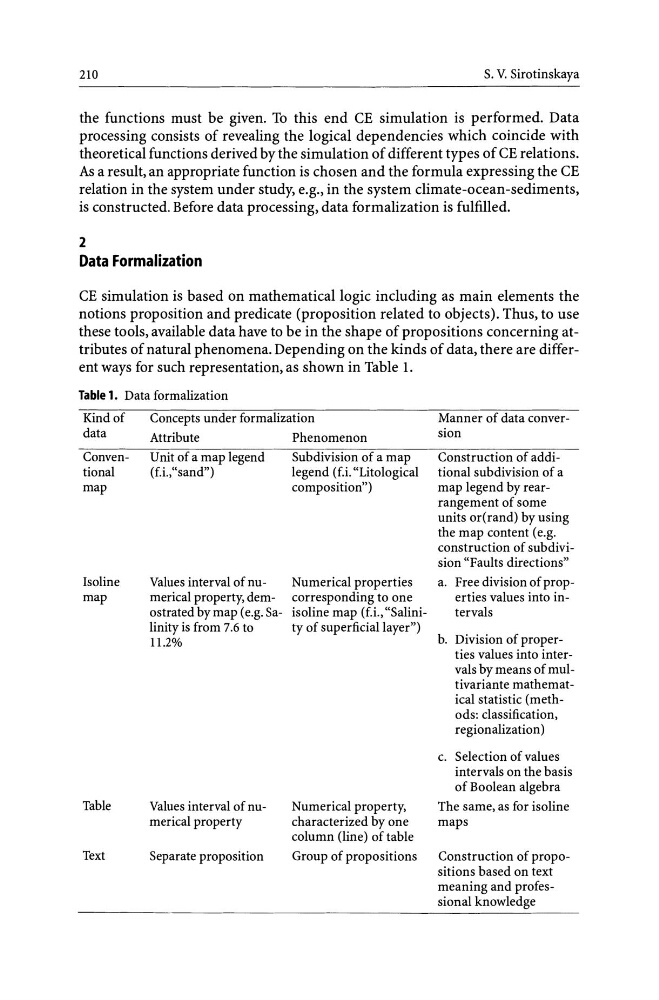
these tools, available data have to be in the shape of propositions concerning attributes of natural phenomena. Depending on the kinds of data, there are different ways for such representation, as shown in Table 1.
Table 1. Data formalization
Kind of
Concepts under formalization
Manner of data converdata
Attribute
Phenomenon
sion
ConvenUnit of a map legend
Subdivision of a map
Construction of additional
(U., "sand")
legend (f.i. "Litological
tional subdivision of a
map
composition")
map legend by rearrangement of some
units or(rand) by using
the map content (e.g.
construction of subdivision "Faults directions"
Isoline
Values interval of nuNumerical properties
a. Free division of propmap
merical property, dem- corresponding to one
erties values into inostrated by map (e.g. Sa- isoline map (f.L, "Salinitervals
linity is from 7.6 to
ty of superficial layer")
b. Division of proper11.2%
ties values into intervals by means of multivariante mathematical statistic (methods: classification,
regionalization)
c. Selection of values
intervals on the basis
of Boolean algebra
Table
Values interval of nuNumerical property,
The same, as for isoline
merical property
characterized by one
maps
column (line) of table
Text
Separate proposition
Group of propositions
Construction of propositions based on text
meaning and professional knowledge
S. V. Sirotinskaya
the functions must be given. To this end CE simulation is performed. Data
processing consists of revealing the logical dependencies which coincide with
theoretical functions derived by the simulation of different types of CE relations.
As a result, an appropriate function is chosen and the formula expressing the CE
relation in the system under study, e.g., in the system climate-ocean-sediments,
is constructed. Before data processing, data formalization is fulfilled.
2
Data Formalization
CE simulation is based on mathematical logic including as main elements the
notions proposition and predicate (proposition related to objects). Thus, to use
these tools, available data have to be in the shape of propositions concerning attributes of natural phenomena. Depending on the kinds of data, there are different ways for such representation, as shown in Table 1.
Table 1. Data formalization
Kind of
Concepts under formalization
Manner of data converdata
Attribute
Phenomenon
sion
ConvenUnit of a map legend
Subdivision of a map
Construction of additional
(U., "sand")
legend (f.i. "Litological
tional subdivision of a
map
composition")
map legend by rearrangement of some
units or(rand) by using
the map content (e.g.
construction of subdivision "Faults directions"
Isoline
Values interval of nuNumerical properties
a. Free division of propmap
merical property, dem- corresponding to one
erties values into inostrated by map (e.g. Sa- isoline map (f.L, "Salinitervals
linity is from 7.6 to
ty of superficial layer")
b. Division of proper11.2%
ties values into intervals by means of multivariante mathematical statistic (methods: classification,
regionalization)
c. Selection of values
intervals on the basis
of Boolean algebra
Table
Values interval of nuNumerical property,
The same, as for isoline
merical property
characterized by one
maps
column (line) of table
Text
Separate proposition
Group of propositions
Construction of propositions based on text
meaning and professional knowledge