

212
S. V. Sirotinskaya
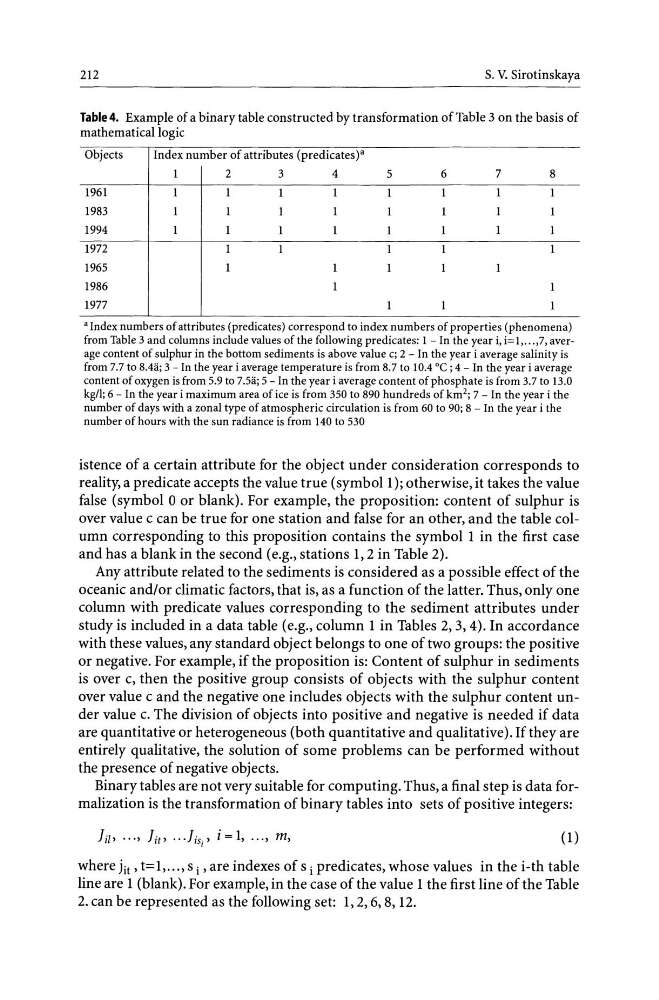
Table 4. Example of a binary table constructed by transformation of Table 3 on the basis of
mathematical logic
Objects
1961
1983
1994
1972
1965
1986
1977
Index number of attributes (predicates)'
1
2
3
4
5
6
7
8
'Index numbers of attributes (predicates) correspond to index numbers of properties (phenomena)
from Table 3 and columns include values of the following predicates: 1 - In the year i, i= 1 , ... ,7, average content of sulphur in the bottom sediments is above value c; 2 - In the year i average salinity is
from 7.7 to 8.4a; 3 - In the year i average temperature is from 8.7 to 10.4 °C; 4 - In the year i average
content of oxygen is from 5.9 to 7.Sa; 5 - In the year i average content of phosphate is from 3.7 to 13.0
kg/I; 6 - In the year i maximum area of ice is from 350 to 890 hundreds of km 2 ; 7 - In the year i the
number of days with a zonal type of atmospheric circulation is from 60 to 90; 8 - In the year i the
number of hours with the sun radiance is from 140 to 530
istence of a certain attribute for the object under consideration corresponds to
reality, a predicate accepts the value true (symbol!); otherwise, it takes the value
false (symbol 0 or blank). For example, the proposition: content of sulphur is
over value c can be true for one station and false for an other, and the table column corresponding to this proposition contains the symbol 1 in the first case
and has a blank in the second (e.g., stations 1,2 in Table 2).
Any attribute related to the sediments is considered as a possible effect of the
oceanic and/or climatic factors, that is, as a function of the latter. Thus, only one
column with predicate values corresponding to the sediment attributes under
study is included in a data table (e.g., column 1 in Tables 2,3,4). In accordance
with these values, any standard object belongs to one of two groups: the positive
or negative. For example, if the proposition is: Content of sulphur in sediments
is over c, then the positive group consists of objects with the sulphur content
over value c and the negative one includes objects with the sulphur content under value c. The division of objects into positive and negative is needed if data
are quantitative or heterogeneous (both quantitative and qualitative). If they are
entirely qualitative, the solution of some problems can be performed without
the presence of negative objects.
Binary tables are not very suitable for computing. Thus, a final step is data formalization is the transformation of binary tables into sets of positive integers:
Iii' ... , lit> .. . lis-' i = 1, ... , m,
I
(1)
where jit ' t=I, ... , s i ,are indexes of s i predicates, whose values in the i-th table
line are 1 (blank). For example, in the case of the value 1 the first line of the Table
2. can be represented as the following set: 1,2,6,8,12.
S. V. Sirotinskaya
Table 4. Example of a binary table constructed by transformation of Table 3 on the basis of
mathematical logic
Objects
1961
1983
1994
1972
1965
1986
1977
Index number of attributes (predicates)'
1
2
3
4
5
6
7
8
'Index numbers of attributes (predicates) correspond to index numbers of properties (phenomena)
from Table 3 and columns include values of the following predicates: 1 - In the year i, i= 1 , ... ,7, average content of sulphur in the bottom sediments is above value c; 2 - In the year i average salinity is
from 7.7 to 8.4a; 3 - In the year i average temperature is from 8.7 to 10.4 °C; 4 - In the year i average
content of oxygen is from 5.9 to 7.Sa; 5 - In the year i average content of phosphate is from 3.7 to 13.0
kg/I; 6 - In the year i maximum area of ice is from 350 to 890 hundreds of km 2 ; 7 - In the year i the
number of days with a zonal type of atmospheric circulation is from 60 to 90; 8 - In the year i the
number of hours with the sun radiance is from 140 to 530
istence of a certain attribute for the object under consideration corresponds to
reality, a predicate accepts the value true (symbol!); otherwise, it takes the value
false (symbol 0 or blank). For example, the proposition: content of sulphur is
over value c can be true for one station and false for an other, and the table column corresponding to this proposition contains the symbol 1 in the first case
and has a blank in the second (e.g., stations 1,2 in Table 2).
Any attribute related to the sediments is considered as a possible effect of the
oceanic and/or climatic factors, that is, as a function of the latter. Thus, only one
column with predicate values corresponding to the sediment attributes under
study is included in a data table (e.g., column 1 in Tables 2,3,4). In accordance
with these values, any standard object belongs to one of two groups: the positive
or negative. For example, if the proposition is: Content of sulphur in sediments
is over c, then the positive group consists of objects with the sulphur content
over value c and the negative one includes objects with the sulphur content under value c. The division of objects into positive and negative is needed if data
are quantitative or heterogeneous (both quantitative and qualitative). If they are
entirely qualitative, the solution of some problems can be performed without
the presence of negative objects.
Binary tables are not very suitable for computing. Thus, a final step is data formalization is the transformation of binary tables into sets of positive integers:
Iii' ... , lit> .. . lis-' i = 1, ... , m,
I
(1)
where jit ' t=I, ... , s i ,are indexes of s i predicates, whose values in the i-th table
line are 1 (blank). For example, in the case of the value 1 the first line of the Table
2. can be represented as the following set: 1,2,6,8,12.