

14.3 Hydrocarbon Habitats
/
f
i
7
o
o
o 00
o
o
717
a
o
o
o
o
o
o
PARIS BASIN
/ 4~ ~ 1.00
~, . % ~
/ / / /
/ / / / / /I%@*tl MATURE
/ /
• OlL FIELD
100 km
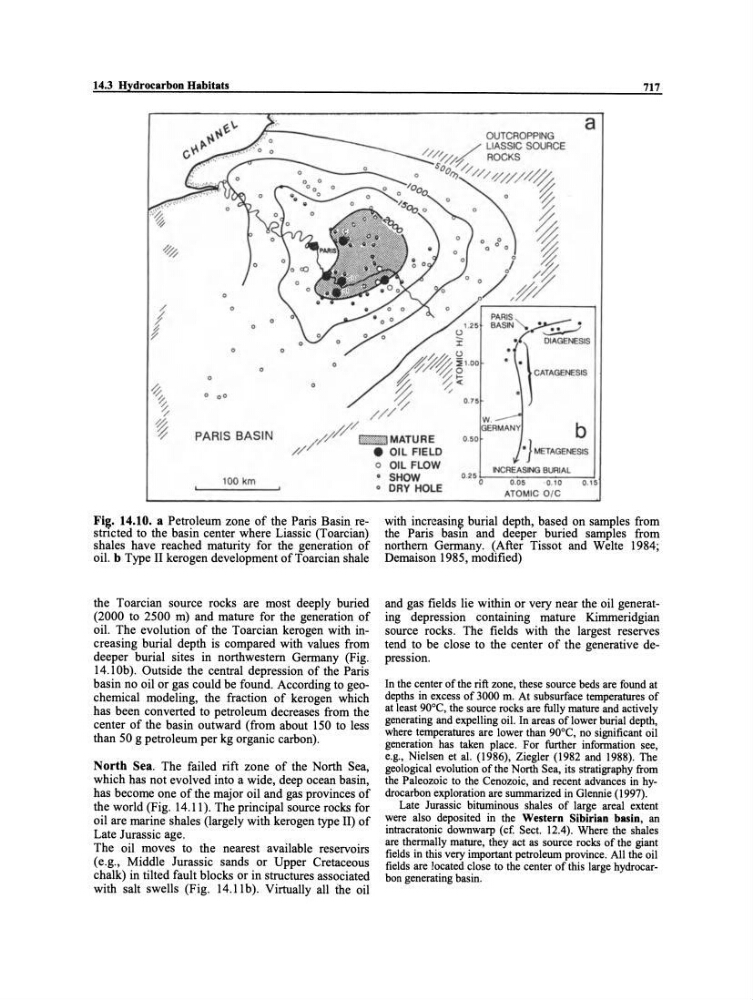
Fi~. 14.10. a Petroleum zone of the Paris Basin restrlcted to the basin center where Liassic (Toarcian)
shales have reached maturity for the generation of
oil. b Type 11 kerogen development of Toarcian shale
the Toarcian source rocks are most deeply buried
(2000 to 2500 m) and mature for the generation of
oil. The evolution of the Toarcian kerogen with increasing burial depth is compared with values from
deeper burial sites in northwestem Germany (Fig.
14.1 Ob). Outside the central depression of the Paris
basin no oil or gas could be found. According to geochernical mode1ing, the fraction of kerogen which
has been converted to petroleum decreases from the
center of the basin outward (from about 150 to less
than 50 g petroleum per kg organic carbon).
North Sea. The failed rift zone of the North Sea,
which has not evolved into a wide, deep ocean basin,
has become one of the major oil and gas provinces of
the world (Fig. 14.11). The principal source rocks for
oil are marine shales (largely with kerogen type 11) of
Late Jurassic age.
The oil moves to the nearest available reservoirs
(e.g., Middle Jurassic sands or Upper Cretaceous
chalk) in tilted fault blocks or in structures associated
with salt swells (Fig. 14.l1 b). Virtually all the oil
o OlL FLOW
o SHOW
0.25 ':--....,-,0-- - - - - ' - 1
o DRY HOLE
with incr~asin~ burial depth, based on sampies from
the Paris basm and deeper buried sampies from
northem Germany. (After Tissot and Weite 1984;
Demaison 1985, modified)
and gas fields lie within or very near the oil generating depression containing mature Kimmeridgian
source rocks. The fields with the largest reserves
tend to be elose to the center of the generative depression.
In the center of the rift zone, these source beds are found at
depths in excess of 3000 m. At subsurface temperatures of
at least 90°C, the source rocks are fully mature and actively
generating and expelling oil. In areas of lower burial depth,
where temperatures are lower than 90°C, no significant oil
generation has taken place. For further information see,
e.g., Nielsen et al. (1986), Ziegler (1982 and 1988). The
geological evolution of the North Sea, its stratigraphy from
the Paleozoic to the Cenozoic, and recent advances in hydrocarbon exploration are summarized in Glennie (1997).
Late Jurassic bituminous shales of large areal extent
were also deposited in the Western Sibirian basin, an
intracratonic downwarp (cf. Sect. 12.4). Where the sha1es
are thermally mature, they act as source rocks of the giant
fields in this very important petroleum province. All the oil
fields are located elose to the center of this large hydrocarbon generating basin.