

710
Chapter 14 Hydrocarbons and Coal
EVOLUTION OF ORGANIC MATTER AND COAL
MAIN
EVOLUTION OF COAL
HYDRORANK STAGES
COMPOSITION OF
INHERITED DISSEMINATED
BITUMEN
ORGANIC MATTER
CARBON
BIOPOLYMERS ~~f~~gf. GENER. ~~Ä~ttEH~~~A.
USA
BIO·
GENIC
GAS
~~f --- --- T ---- - - ~- -BIOCHEMICAL
I
DEGRADATION
I
T
I
PEAT
PEAT
POLYCONDENSATION I
I
I
FULVIC 1
ACIDS
DIA·
GENESIS
SOFT
B. C.
IZ
W
IZ
0
U
a:
w
< ~
Cl
INSOLUBILIZATION
I
I
I
I
GEOPOiMERS 1
METHANE
BROWN
COAL
DULL
B. C.
BRIGHT
B. C.
LIGNITE
SUB·
BITUMINOUS
------- - -- - (SO-80°C. R .~ 0.5) I - - - + - - - - - + - - - - - - l
z
if.i
I C~A'
<
~ 1
U
w
HIGH
THERMAL
GENESIS
DEGRADATION
I
0
OlL
BITU·
MINOUS
H. C.
VOLATILE
BITU·
MINOUS
I
I I
HARD
COAL
MEDIUM
1
(CRACKING)
-V
WEl GAS
-------1' --(JOO-150oC, RI"' 2)+----i
LOW
CARBONIZATION ~~tSIS METHANE
-----1 -----(R~:;~. --SEMI·ANTHA.
ANTHRACITE
ANTHRACITE
10
0
GRAPHITE
META·ANTHA.
(%) GARBON RESIDUE
MORPHISM
100 % C
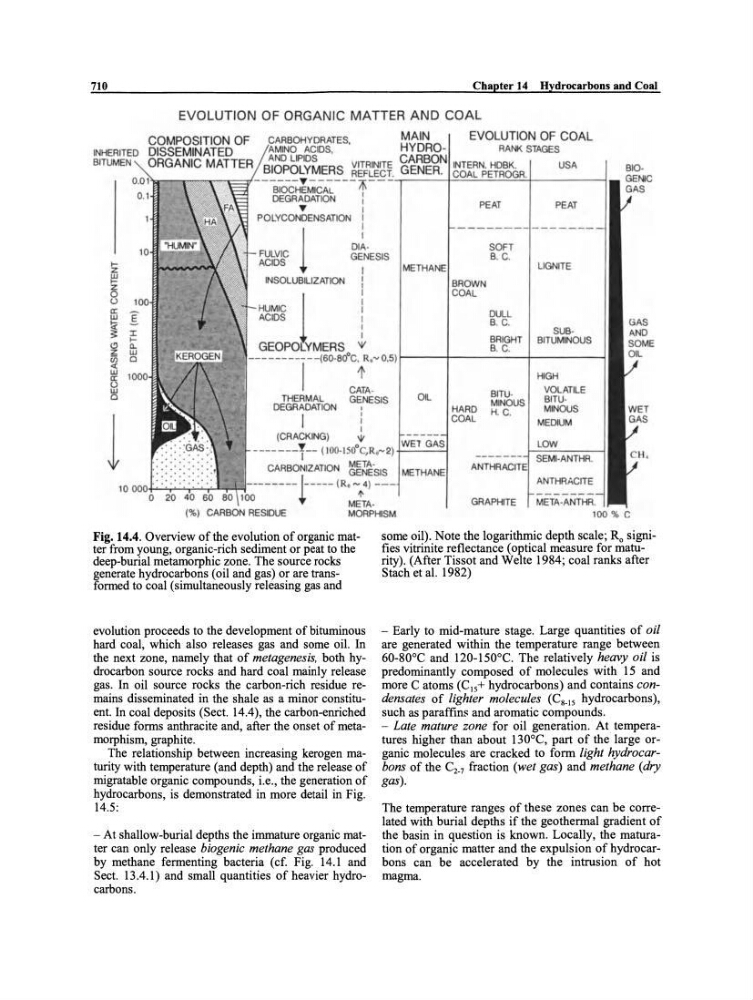
Fig. 14.4. Overview ofthe evolution of organic matter from young, organic-rich sediment or peat to the
deep-burial metamorphic zone. The source rocks
generate hydrocarbons (oil and gas) or are transformed to coal (simultaneously releasing gas and
evolution proceeds to the development of bituminous
hard coal, which also releases gas and some oil. In
the next zone, namely that of metagenesis, both hydrocarbon source rocks and hard coal mainly release
gas. In oil source rocks the carbon-rich residue remains disseminated in the shale as a minor constituent. In coal deposits (Sect. 14.4), the carbon-enriched
residue forms anthracite and, after the onset of metamorphism, graphite.
The relationship between increasing kerogen maturity with temperature (and depth) and the release of
rnigratable organic compounds, i.e., the generation of
hydrocarbons, is demonstrated in more detail in Fig.
14.5:
- At shallow-burial depths the immature organic matter can only release biogenic methane gas produced
by methane fermenting bacteria (cf. Fig. 14.1 and
Sect. 13.4.1) and small quantities of heavier hydrocarbons.
some oil). Note the logarithmic depth scale; Ra signifies vitrinite reflectance (optical measure for maturity). (After Tissot and Welte 1984; coal ranks after
Stach et al. 1982)
- Early to mid-mature stage. Large quantities of oil
are generated within the temperature range between
60-80°C and 120-150°C. The relatively heavy oil is
predorninantly composed of moleeules with 15 and
more C atoms (C 15 + hydrocarbons) and contains condensates of lighter molecules (C S • 15 hydrocarbons),
such as paraffins and aromatic compounds.
- Late mature zone for oil generation. At temperatures higher than about 130°C, part of the large organic molecules are cracked to form light hydrocarbons of the C 2 • 7 fraction (wet gas) and methane (dry
gas).
The temperature ranges of these zones can be correlated with burial depths if the geothermal gradient of
the basin in question is known. Locally, the maturation of organic matter and the expulsion of hydrocarbons can be accelerated by the intrusion of hot
magma.