

14.2 Generation and Migration of Hydrocarbons
709
KEROGEN TYPES AND THEIR MATURATI ON
2.0
o
~ CI: 1.5
Ü
~
o
~
~ 1.0
:z:
INCREASING
TEMPERATURE
LlPTINITE
rTYPE I")
<
MATURATION
PATHWAY
EXINITE
("TYPE 11")
0.5
INERTINITE ("TYPE IIIb" )
(ALTERED WOODY
cr "TYPE IV"
MATERIAL )
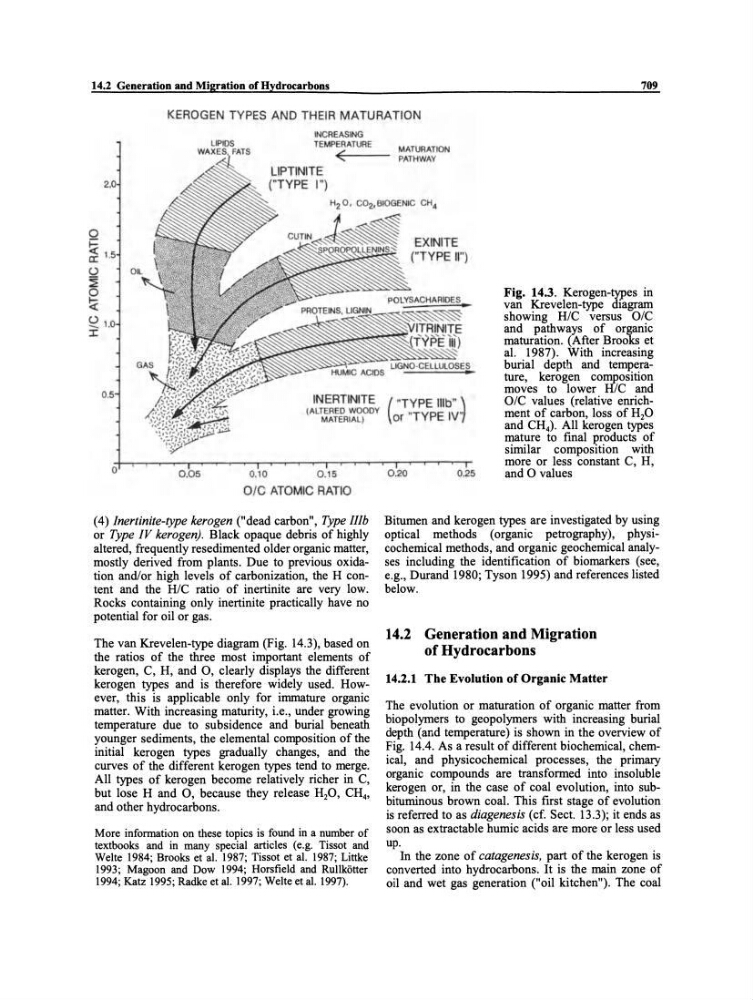
Fig. 14.3. Kerogen-types in
van Krevelen-type diagram
showing H/C versus OIC
and pathways of organic
maturation. (After Brooks et
al. 1987). With increasing
burial depth and temperature, kerogen eomposition
moves to lower H/C and
OIC values (relative enriehment of carbon, loss of H 2 0
and CH 4 ) . All kerogen types
mature to final produets of
similar eomposition with
more or less constant C, H,
and Ovalues
o
0.05
0.10
0.15
O/C ATOMIC RATIO
(4) Inertinite-type kerogen ("dead earbon", Type ///b
or Type IV kerogen). Blaek opaque debris of highly
altered, frequently resedimented older organic matter,
mostly derived from plants. Due to previous oxidation and/or high levels of carbonization, the H eontent and the H /C ratio of inertinite are very low.
Rocks eontaining only inertinite practically have no
potential for oil or gas.
The van Krevelen-type diagram (Fig. 14.3), based on
the ratios of the three most important elements of
kerogen, C, H, and 0, elearly displays the different
kerogen types and is therefore widely used. However, this is applicable only for immature organie
matter. With inereasing maturity, i.e., under growing
temperature due to subsidence and burial beneath
younger sediments, the elemental eomposition of the
initial kerogen types gradually ehanges, and the
curves of the different kerogen types tend to merge.
All types of kerogen beeome relatively richer in C,
but lose Hand 0, beeause they release H 2 0, CH 4 ,
and other hydroearbons.
More infonnation on these topics is found in a number of
textbooks and in many special articles (e.g. Tissot and
WeIte 1984; Brooks et al. 1987; Tissot et al. 1987; Littke
1993; Magoon and Dow 1994; Horsfield and Rullkötter
1994; Katz 1995; Radke et al. 1997; WeIte et al. 1997).
0.20
0.25
Bitumen and kerogen types are investigated by using
optieal methods (organie petrography), physicoehemieal methods, and organie geoehemieal analyses including the identification of biomarkers (see,
e.g., Durand 1980; Tyson 1995) and referenees listed
below.
14.2 Generation and Migration
of Hydrocarbons
14.2.1 The Evolution of Organic Matter
The evolution or maturation of organie matter from
biopolymers to geopolymers with inereasing burial
depth (and temperature ) is shown in the overview of
Fig. 14.4. As a result of different biochemieal, ehemical, and physieoehemieal processes, the primary
organie eompounds are transformed into insoluble
kerogen or, in the ease of eoal evolution, into subbituminous brown eoal. This first stage of evolution
is referred to as diagenesis (cf. Seet. 13.3); it ends as
soon as extraetable humie acids are more or less used
up.
In the zone of catagenesis, part of the kerogen is
eonverted into hydroearbons. It is the main zone of
oil and wet gas generation ("oil kitehen"). The eoal