

13.3 Chemical Diagenesis
Quartzose Sands tones. Significant pressure solution
at the grain contacts of quartz commonly occurs at
burial depths of 2.5-3.5 km at temperatures greater
than approximately 90°C (the "silica mobilitywindow"
at 80 to 120°C). Up to this depth range the sandstones
can maintain porosities of about 25% if other cementing materials (e.g. carbonate) are absent. Higher or
lower temperature gradients than the average
(~35°CIkm) cause a shift ofthe onset ofpressure solution to shallower or deeper burial depths. Below this
temperature threshold, young sandstones can have
higher residual porosities than old ones.
Fine-grained quartzose sandstones appear to develop more intergranularpressure solution than coarser
counterparts. Pressure solution of quartz appears to be
enhanced by the presence of clay as grain coatings.
Chemical reactions involving clays probably yield high
pH in the pore water and thus favor the dissolution of
quartz. Therefore, clean quartz sands have a higher
potential for preserving their porosity with depth than
"dirty" sands.
Ongoing pressure solution will lead to an increase in the area
of grain contacts (cf. Fig. B.lld) and thus to a reduction in
stress at these contacts. As a result, the solution process
slows down. Finally, the grain contacts often merge and display dissolution seams, sutures, or microstylolites. The dissolved matter is usually precipitated immediately next to the
grain contacts on free grain surfaces and in the open pore
space, where minimum stress conditions prevail. The
pressure-solved material forms mineral overgrowths and
pore cement. If all pores are filled, pressure solution tends to
end. It may continue during early stages of rock deformation,
when fractures can be filled by pressure-solved material.
Bioclastic carbonates (calcarenites). Pressure solution of carbonates largely occurs at depths of a few
hundred meters. It contributes to the early cementation
ofbiogenic carbonates which, in addition, is promoted
by dissolution and reprecipitation of unstable mineral
phases (such as aragonite and high-Mg calcite, see below).
The question whether or not the cement of orthoquartzites or
carbonate-cemented strata has been derived entirely from the
same layer by pressure solution is controversial. Several authors assume that both carbonate and silica can also be delivered from neighboring mudstones and shales (e.g.,
Füchtbauer 1974a and b; Ricken 1986; McBride 1989).
However, it was also inferred from petrographie evidence
that, in the case of quartz sandstones, pressure solution during deep burial diagenesis may provide more silica than
needed for complete cementation and then export silica.
13.3.4 Solute Transport by Diffusion
Molecular or ionic diffusion in aqueous solutions has
been already mentioned in the previous sections. It is
one of the most important processes of mass transport
in diagenesis and therefore described here in some de673
tail (avoiding the normally used differential equations).
It tends to overcome differences in concentration or
chemical potential of a specific ion or pair of ions, for
example Na+ and Cl- at the surface ofburied rock salt,
between two locations within the solution. These locations are usually the source and sink (or reaction zone)
of the specific ions in question.
A thorough treatment of diffusion in sediments is a rather
difficult topic (see, e.g., Garrels and Mackenzie 1971; Berner
1980; Pingitore 1982; Hesse 1986; Ranganathan and Hanor
1987). Here, a relatively simple approach is favored.
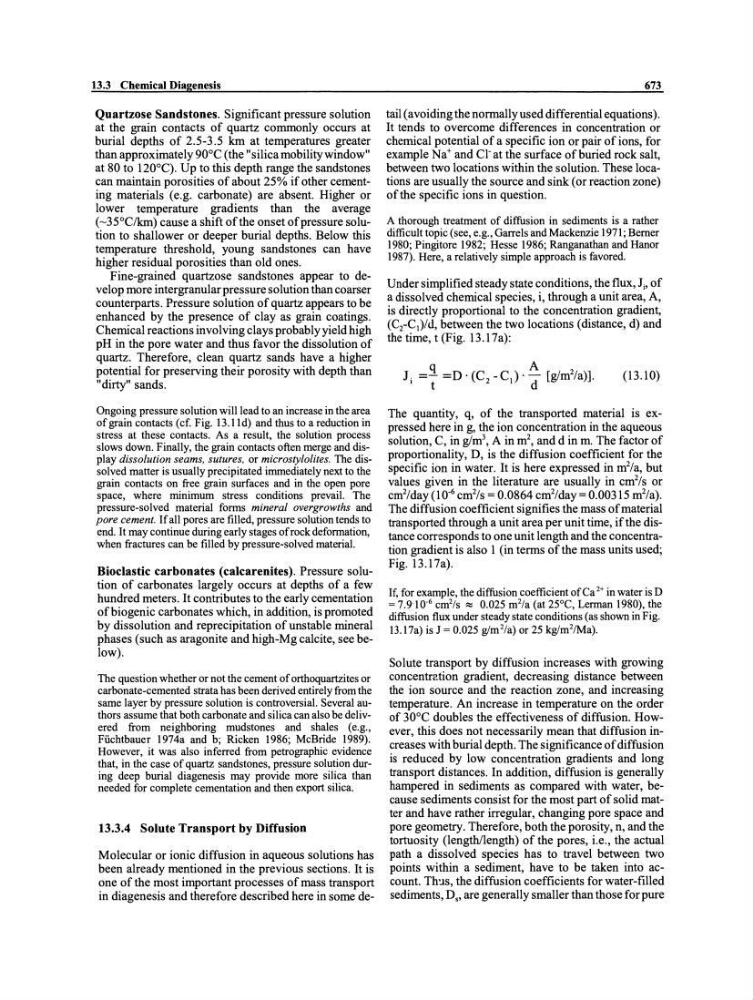
Under simplified steady state conditions, the flux, Ji, of
a dissolved chemical species, i, through a unit area, A,
is directly proportional to the concentration gradient,
(C 2 -Cj )/d, between the two locations (distance, d) and
the time, t (Fig. 13.17a):
(13.10)
The quantity, q, of the transported material is expressed here in g, the ion concentration in the aqueous
solution, C, in g/m 3 , A in m 2 , and d in m. The factor of
proportionality, D, is the diffusion coefficient for the
specific ion in water. It is here expressed in m 2 /a, but
values given in the literature are usually in cm 2 /s or
cm 2 /day (10- 6 cm 2 /s = 0.0864 cm 2 /day = 0.00315 m 2 /a).
The diffusion coefficient signifies the mass of material
transported through a unit area per unit time, if the distance corresponds to one unit length and the concentration gradient is also 1 (in terms ofthe mass units used;
Fig. 13.17a).
If, for example, the diffusion coefficient ofCa 2+ in water is D
= 7.9-10- 6 cm 2 /s : : : : : : 0.025 m 2 /a (at 25°C, Lerman 1980), the
diffusion flux under steady state conditions (as shown in Fig.
13. 17a) is J = 0.025 glm 2/a) or 25 kglm 2 /Ma).
Solute transport by diffusion increases with growing
concentration gradient, decreasing distance between
the ion source and the re action zone, and increasing
temperature. An increase in temperature on the order
of 30°C doubles the effectiveness of diffusion. However, this does not necessarily mean that diffusion increases with burial depth. The significance of diffusion
is reduced by low concentration gradients and long
transport distances. In addition, diffusion is generally
hampered in sediments as compared with water, because sediments consist for the most part of solid matter and have rather irregular, changing pore space and
pore geometry. Therefore, both the porosity, n, and the
tortuosity (length/length) of the pores, i.e., the actual
path a dissolved species has to travel between two
points within asediment, have to be taken into account. Th:ls, the diffusion coefficients for water-filled
sediments, D" are generally smaller than those for pure