

672
sync1inal troughs where the pore fluids are most rapidly cooled or heated. In this way, a continuous transfer of solutes is accomplished in the permeable rock
layer.
For example, the slowly moving pore fluid (rate of convection in the order of I mlyear) may circulate in a thick sand
layer in a folded sequence in a so-called toroidal cell (Fig.
13.16t). It is heated during its downward flow to the
synclinal trough and cools as it approaches the anticlinal
crest. During its circulation, the pore fluid has the tendency
to maintain chemical equilibrium with the adjacent rock matrix. Because the solubility of minerals is, among other factors, a function oftemperature, the cooling pore fluid precipitates minerals which have "prograde solubilities" (for exampie quartz) and dissolves minerals whose solubility decreases
with increasing temperature ("retrograde solubility", for example carbonates).
Solute transport by convective flow is discussed, e.g., by
Wood and Hewett (1984), Bjorlykke 1984), Morse et al.
(1997). It is interesting to note that from 60 to 150°C the solubilities of common hydrocarbons in water are similar to that
of quartz. Hence, both components can be transferred and
accumulated in comparable quantities under these conditions.
Combination of Various Processes of
Solute Transport
In rnany sedimentary basins several solute transport
systems operate simultaneously (Fig. 13 .16c) in conjunction with pressure solution and molecular diffusion (see below). While the open meteoric system is
realized in emerged, coastal and shallowly buried parts
ofthe basin fill, water-covered and deeply buried portions of the basin fill are characterized by compaction
flow, diffusion, and convective flow in a more or less
c10sed system.
As a result of the different mechanism of solute
transport, the mineral reactions occurring in individual
pores and micropores in the sediments vary fundamentally. In a c10sed system, an unstable mineral rnay dissolve and be replaced by one or several stable minerals, which in total have the same chemical composition
as the parent mineral. For example, high-Mg calcite
may be transformed into low-Mg calcite and some dolomite. The new mineral phase(s) are formed directly
adjacent to the dissolving mineral; solute transport
takes place by diffusion via a very thin film of pore
water (Fig. 13.16d). In an open system, the micropores
between a dissolving and newly crystallizing mineral
are in contact with the macropores. These serve as conduits for pore fluid flow and thus for the exchange of
chemical species between the reaction zone of the
micropore and zones far away from this location. In
this case, the new mineral phase(s) and their trace element contents frequently differ in their bulk composition from the primary minerale s ) (allochemical
diagenesis ).
Chapter 13 Diagenesis
13.3.3 Pressure Solution
Mechanical compaction inc1udes ductile deformation,
re arrangement, and fracturing ofminerals all ofwhich
contribute to a denser grain packing. In addition, pressure solution at the contacts of individual grains is a
very important process in diagenesis. This can be regarded as a process transitional between mechanical
and chemical diagenesis. The principle mechanism has
long been known, but its efficiency as a provider of
pore cement for various types of sandstones, orthoquartzites, and carbonates is somewhat controversial.
This problem has been discussed by several authors (e.g.
Trumit and Amstutz 1979; Bjorlykke 1983, 1984, 1991;
Bathurst 1987, 1991; Pettijohn et al. 1987; Füchtbauer 1988;
Houseknecht 1987, 1988; Mitra 1988; Bayer 1989b;
McBride 1989; Tada and Siever 1989; Ramm 1992; Bjorkum
et al. 1998).
According to Riecke's principle, the solubility of minerals is enhanced under compressional stress, i.e., at
the contact between two grains or bedding planes. If
the composition of adjacent partic1es is different, one
of them usuaUy maintains its shape at the expense of
the other, which is partially dissolved. However, pressure solution does not occur between deformable clay
partic1es. Pressure solution has been described rnainly
from carbonate rocks and quartzitic sandstones, but it
also occurs in other rock types.
The effective vertical stress at the grain contacts is
a function ofthe effective overburden pressure and the
area, a, which the grain contacts occupy per unit area,
A, of a horizontal plane within the rock (cf. Fig.
13.11c). The smaller the grain contacts, the higher is
the effective stress at these contacts.
For example, at aburial depth of2000 m, the effective vertical stress exerted on a plane with area A is
Pe = PI - Ph = 25 Mpa (= 250 bar)
In this calculation the hydrostatic pressure and lithostatic
pressure gradients listed in Fig. 13.11a are used, and it is assumed that there is no excess pore pressure. Then, the mean
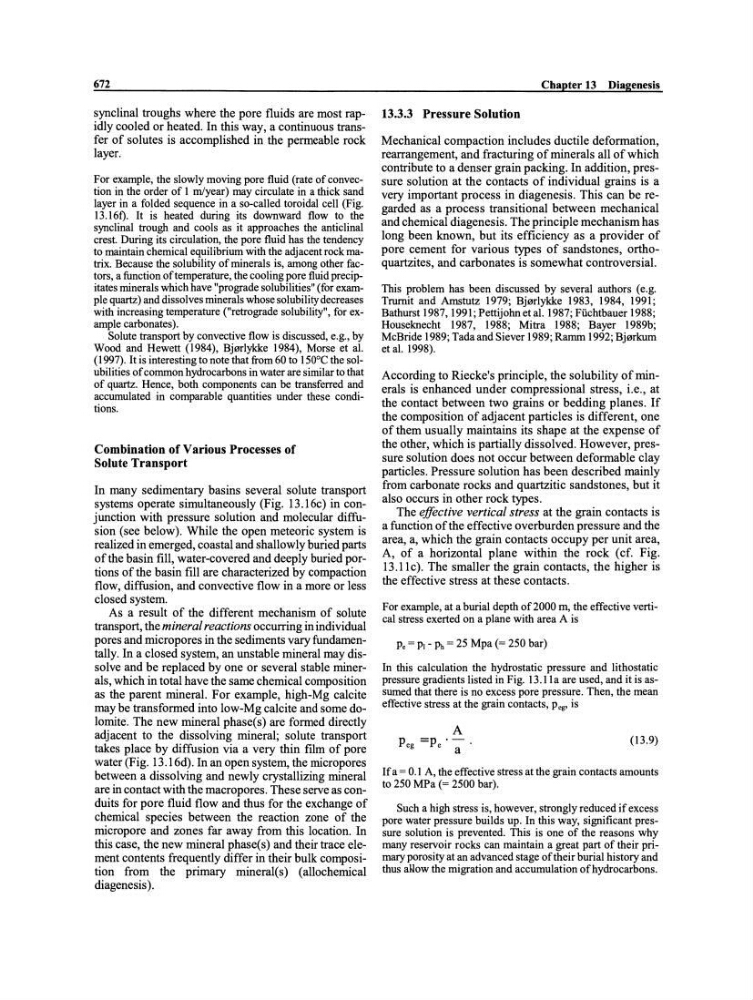
effective stress at the grain contacts, p eg' is
A
P eg =P e • - .
a
(13.9)
If a = 0.1 A, the effective stress at the grain contacts amounts
to 250 MPa (= 2500 bar).
Such a high stress is, however, strongly reduced if excess
pore water pressure builds up. In this way, significant pressure solution is prevented. This is one of the reasons why
many reservoir rocks can maintain a great part of their primary porosity at an advanced stage oftheir burial history and
thus aYow the migration and accumulation ofhydrocarbons.