

674
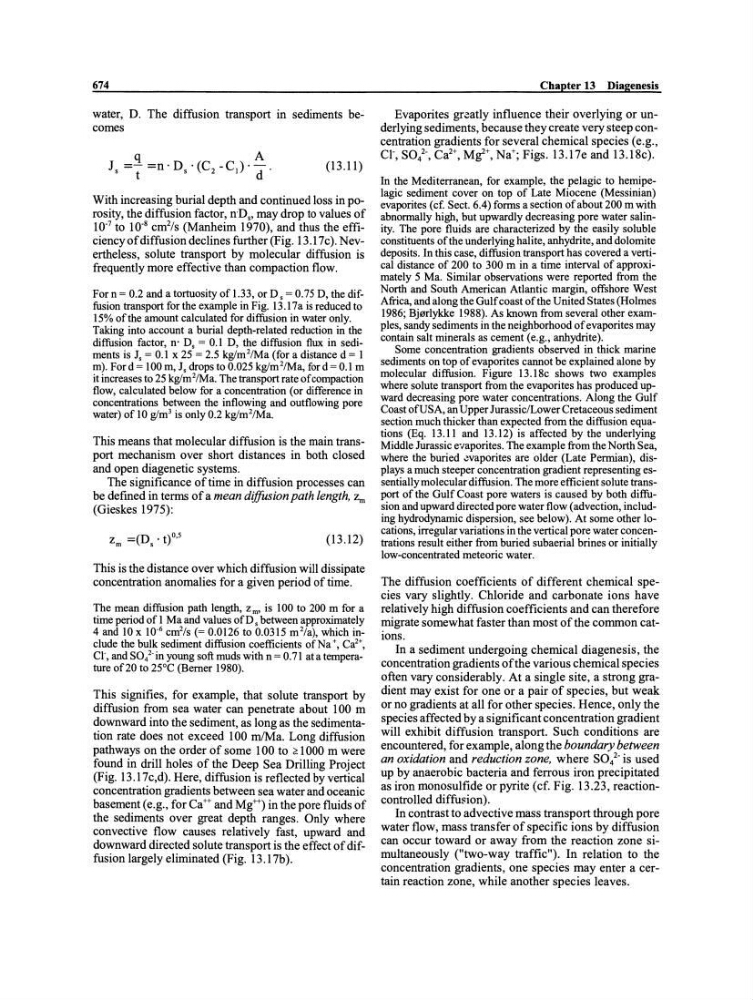
water, D. The diffusion transport in sediments becomes
q
A
J =- =n· D . (C - C ) . -
' t
, 2
1
d·
(13.11)
With increasing burial depth and continued loss in porosity, the diffusion factor, nD" may drop to values of
10- 7 to lO- g cm 2 /s (Manheim 1970), and thus the efficiency of diffusion declines further (Fig. 13.17 c). N evertheless, solute transport by molecular diffusion is
frequently more effective than compaction flow.
For n = 0.2 and a tortuosity of 1.33, or D, = 0.75 D, the diffusion transport for the example in Fig. 13.17a is reduced to
15% ofthe amount calculated for diffusion in water only.
Taking into account aburial depth-related reduction in the
diffusion factor, n· D, = 0.1 D, the diffusion flux in sediments is J, = 0.1 x 25 = 2.5 kg/m 2 /Ma (for a distance d = I
m). Ford = 100 m, J, drops to 0.025 kg/m 2 /Ma, ford= 0.1 m
it increases to 25 kg/m 2/Ma. The transport rate of compaction
flow, calculated below for a concentration (or difference in
concentrations between the inflowing and outflowing pore
water) of 10 g/m 3 is only 0.2 kg/m 2 /Ma.
This means that molecular diffusion is the main transport mechanism over short distances in both closed
and open diagenetic systems.
The significance of time in diffusion processes can
be defined in terms of a mean diffusion path length, ~
(Gieskes 1975):
(13.12)
This is the distance over which diffusion will dissipate
concentration anomalies for a given period of time.
The mean diffusion path length, Z m' is 100 to 200 m for a
time period of I Ma and values ofD, between approximately
4 and 10 x 10- 6 cm 2 /s (= 0.0126 to 0.0315 m 2/a), which include the bulk sediment diffusion coefficients ofNa + Ca 2 +
Cl-, and SO/in young soft muds with n = 0.71 ata te~pera-'
ture of 20 to 25°C (Bemer 1980).
This signifies, for example, that solute transport by
diffusion from sea water can penetrate about 100 m
downward into the sediment, as long as the sedimentation rate does not exceed 100 mlMa. Long diffusion
pathways on the order of some 100 to c; 1000 m were
fo~nd in drill holes of the Deep Sea Drilling Project
(Flg. 13.17 c,d). Here, diffusion is reflected by vertical
concentration gradients between sea water and oceanic
basement (e.g., for Ca++ and Mg++) in the pore fluids of
the sediments over great depth ranges. Only where
convective flow causes relatively fast, upward and
downward directed solute transport is the effect of diffusion largely eliminated (Fig. 13.1 7b).
Chapter 13 Diagenesis
Evaporites gr<:atly influence their overlying or underlying sediments, because they create very steep concentration gradients for several chemical species (e.g.,
Cl-, SO/", Ca 2 +, Mi+, Na+; Figs. 13.17e and 13.18c).
In the Mediterranean, for example, the pelagic to hemipelagic sediment cover on top of Late Miocene (Messinian)
evaporites (cf. Sect. 6.4) forms a section ofabout 200 m with
abnormally high, but upwardly decreasing pore water salinity. The pore fluids are characterized by the easily soluble
constituents ofthe underlying halite, anhydrite, and dolomite
deposits. In this case, diffusion transport has covered a vertical distance of 200 to 300 m in a time interval of approximately 5 Ma. Similar observations were reported from the
North and South American Atlantic margin, offshore West
Africa, and along the Gulf coast ofthe United States (Holmes
1986; Bj0rlykke 1988). As known from several other exampIes, sandy sediments in the neighborhood of evaporites may
contain salt minerals as cement (e.g., anhydrite).
Some concentration gradients observed in thick marine
sediments on top of evaporites cannot be explained alone by
molecular diffusion. Figure 13.18c shows two examples
where solute transport from the evaporites has produced upward decreasing pore water concentrations. Along the Gulf
Coast ofUSA, an Upper Jurassic/Lower Cretaceous sediment
section much thicker than expected from the diffusion equations (Eq. 13.11 and 13.12) is affected by the underlying
Middle Jurassic enporites. The example from the North Sea,
where the buried ~vaporites are older (Late Permian), displays a much steeper concentration gradient representing essentially molecular diffusion. The more efficient solute transport of the Gulf Coast pore waters is caused by both diffusion and upward directed pore water flow (advection, including hydrodynamic dispersion, see below). At some other 10cations, irregular variations in the vertical pore water concentrations result either from buried subaerial brines or initially
low-concentrated meteoric water.
The diffusion coefficients of different chemical species vary slightly. Chloride and carbonate ions have
relatively high diffusion coefficients and can therefore
migrate somewhat faster than most ofthe common cations.
In a sediment undergoing chemical diagenesis, the
concentration gradients ofthe various chemical species
often vary considerably. At a single site, a strong gradient may exist for one or a pair of species, but weak
or no gradients at all for other species. Hence, only the
species affected by a significant concentration gradient
will exhibit diffusion transport. Such conditions are
encountered, for example, along the boundary between
an oxidation and reduction zone, where SO/" is used
up by anaerobic bacteria and ferrous iron precipitated
as iron monosulfide or pyrite (cf. Fig. 13 .23, reactioncontrolled diffusion).
In contrast to advective mass transport through pore
water flow, mass transfer of specific ions by diffusion
can occur toward or away from the reaction zone simultaneously ("two-way traffic"). In relation to the
concentration gradients, one species may enter a certain reaction zone, while another species leaves.