

13.2 Compaction, Flow Mechanisms
DEPOSITION
>SUBSIDENCE
659
c
DIFFERENTIAL
COMPACTION AND
GROWTH FAULTS
b
SHALE
DEPOSITION
~SUBSIDENCE
d
SEA LEVEL
SEA LEVEL
QUATERNARY SAND AND SHALE
COASTAL PLAIN ----1--- CONT, SHELF -
PRE· TERTIARY L O ~ W ~ . ~D~E:~y~IIIIIIII ' R ~ I ~ D ~ G ~ E ~ S ~
' ~ O F
SHALE WITH HIGH FLUID PRESSURE
UNCOMPACTED SHALE
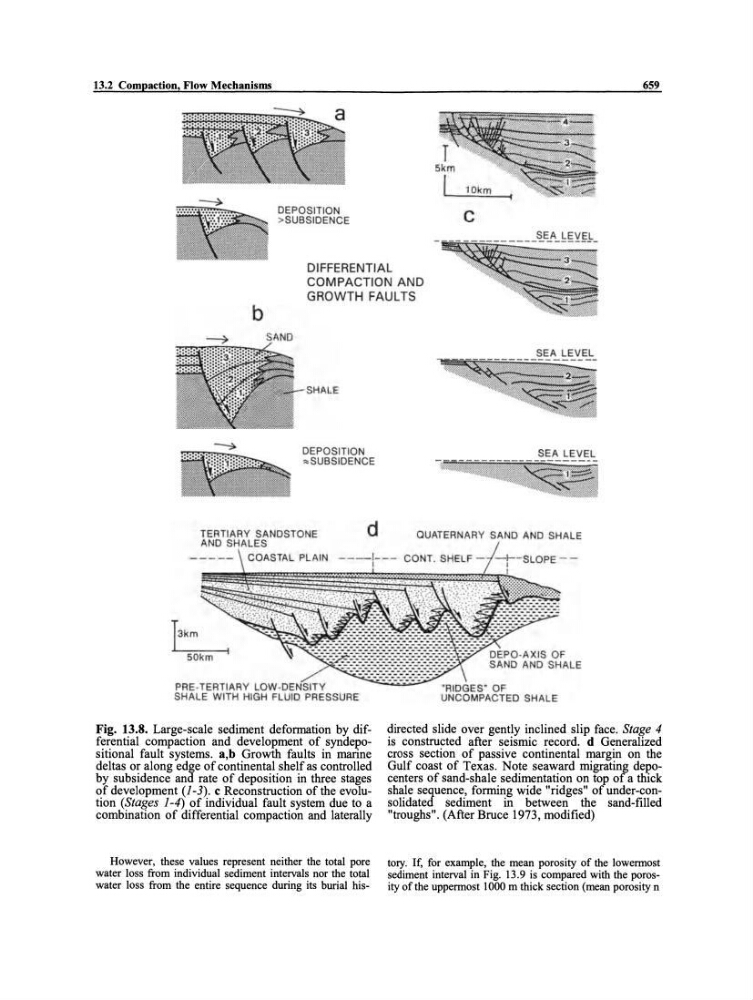
Fig. 13.8. Large-scale sediment deformation by differential compaction and development of syndepositional fault systems. a,b Growth faults in marine
deltas or along edge of continental shelf as controlled
by subsidence and rate of deposition in three stages
of development (1-3). c Reconstruction of the evolution (Stages 1-4) of individual fault system due to a
combination of differential compaction and laterally
However, these values represent neither the total pore
water loss from individual sediment intervals nor the total
water loss from the entire sequence during its burial hisdirected slide over gently inclined slip face. Stage 4
is constructed after seismic record. d Generalized
cross section of passive continental margin on the
Gulf coast of Texas. Note seaward migrating depocenters of sand-shale sedimentation on top of a thick
shale sequence, forming wide "ridges" of under-consolidated sediment in between the sand-filled
"troughs". (After Bruce 1973, modified)
tory. If, for example, the mean porosity of the lowermost
sediment interval in Fig. 13.9 is compared with the porosity ofthe uppermost 1000 m thick section (mean porosity n
DEPOSITION
>SUBSIDENCE
659
c
DIFFERENTIAL
COMPACTION AND
GROWTH FAULTS
b
SHALE
DEPOSITION
~SUBSIDENCE
d
SEA LEVEL
SEA LEVEL
QUATERNARY SAND AND SHALE
COASTAL PLAIN ----1--- CONT, SHELF -
PRE· TERTIARY L O ~ W ~ . ~D~E:~y~IIIIIIII ' R ~ I ~ D ~ G ~ E ~ S ~
' ~ O F
SHALE WITH HIGH FLUID PRESSURE
UNCOMPACTED SHALE
Fig. 13.8. Large-scale sediment deformation by differential compaction and development of syndepositional fault systems. a,b Growth faults in marine
deltas or along edge of continental shelf as controlled
by subsidence and rate of deposition in three stages
of development (1-3). c Reconstruction of the evolution (Stages 1-4) of individual fault system due to a
combination of differential compaction and laterally
However, these values represent neither the total pore
water loss from individual sediment intervals nor the total
water loss from the entire sequence during its burial hisdirected slide over gently inclined slip face. Stage 4
is constructed after seismic record. d Generalized
cross section of passive continental margin on the
Gulf coast of Texas. Note seaward migrating depocenters of sand-shale sedimentation on top of a thick
shale sequence, forming wide "ridges" of under-consolidated sediment in between the sand-filled
"troughs". (After Bruce 1973, modified)
tory. If, for example, the mean porosity of the lowermost
sediment interval in Fig. 13.9 is compared with the porosity ofthe uppermost 1000 m thick section (mean porosity n