

658
Chapter 13 Diagenesis
a
DIFFERENTIAL COMPACTION
b
i
@
' "
3 .
I .
.
1000 '
z .. lbOOm
SAND.FILLED
.'.
z .. I . m
CHANNEL
~ 't. . , . : .. ,
CARBONATE MIGRATION
g~L~~ _________ _
CD
REEF CORE
PALEORELIEF
REEF
BASIN
DETRITUS
SEDIMENT
SAND AND GRAVEL
SOLID BEDROCK
d
SAND AND GRAVEL
can be calculated from the reduction in porosity and
the thickness of the sedimentary column considered
(Fig. 13.6a, Eq. 2). An example of such a calculation
for vertically ascending water, using the BaldwinButler (1985) porosity-depth curve for normally consolidated argillaceous sediments, is shown in Fig.
13.9.
First, the volume of expelled pore water is determined for
specific depth intervals (1000 m in thickness, in the uppermost 250 to 500 m of the seetion), which was released by
the deposition of the last 1000 m increment of sediment.
-
-~. -:--;-~-~~,
.
. JF10 i·
. I
' z..,1000in
FAULT DUE TO' ~ "'-~"
DIFFER~NTIAL ..
,,"=, .. ... ...... .
COMP"';CTION
p' .. ' .', .
:t:~m
+ I
z .. 1000m
I
I
~
/" / : 'SOLID BEDRO~t / ///////////,
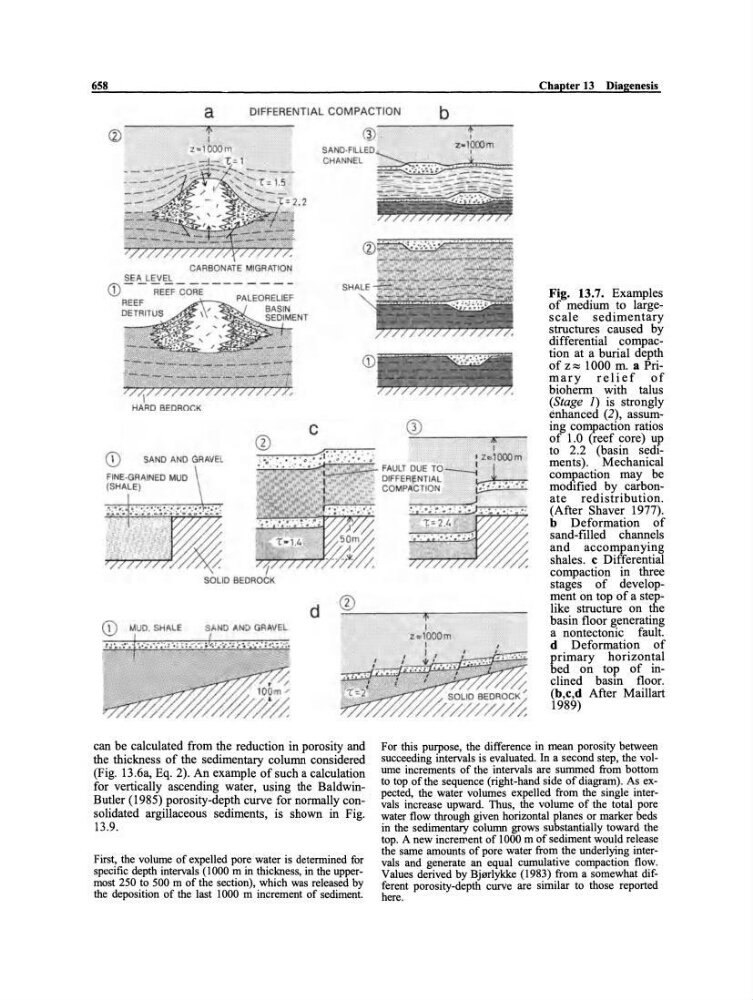
Fig. 13.7. Examples
of medium to largescale sedimentary
structures caused by
differential compaction at a burial depth
of z::::; 1000 m. a Primary relief of
bioherm with talus
(Stage I) is strongly
enhanced (2), assuming compaction ratios
of 1.0 (reef core) up
to 2.2 (basin sedIments). Mechanical
compaction may be
modified by carbonate redistribution.
(After Shaver 1977).
b Deformation of
sand-filled channe1s
and accompanying
shales. c Differential
compaction in three
stages of development on top of a steplike structure on the
basin floor generating
a nontectonic fault.
d Deformation of
primary horizontal
bed on top of inc1ined baslll floor.
(b,c,d After Maillart
1989)
For this purpose, the difference in mean porosity between
succeeding intervals is evaluated. In a second step, the volurne increments of the intervals are summed from bottom
to top of the sequence (right-hand side of diagrarn). As expected, the water volumes expelled from the single intervals increase upward. Thus, the volume of the total pore
water flow through given horizontal planes or marker beds
in the sedimentary column grows substantially toward the
top. A new increII'ent of 1000 m of sediment would release
the same amounts of pore water from the underlying intervals and generate an equal cumulative compaction flow.
Values derived by Bjerlykke (1983) from a somewhat different porosity-depth curve are similar to those reported
here.