

12.5 Subduction Complexes
SEDIMENT TRANSFER FROM
TRENCH TO ACCRETIONARY WEDGE
585
a
NEWL Y DEPOSITED
TRENCH SEDIMENT
V
DEFORMATION FRONT OF
2 I
ACCRETIONAAY WEDGE
~~E=z=riEz=~~
........... ....
~'"
DECOUEMENT '
SEDIMENT ADDED TO
ACCR. WEDGE
BELOW TRENCH FIL1.
-- CR, CONVERGENCE RATE
b
SR, SEDIMENTATION RATE
i
-_ .... __ .. -........... _._-_._ .... _._-_._._ ............................. -;
T
-:~~~~- ~- ~-~~ .... J! ~~~
SUBDUCTING OCEANIC :'.LA TE
- - - - -
*
WlTH PELAGIC AND HEMIPELAGIC SEDIMENTS
- CR
c
ACCRETED SEDIMENT
/
DEFORMATIONFRONT
!
USED FOR ADVANCE OF
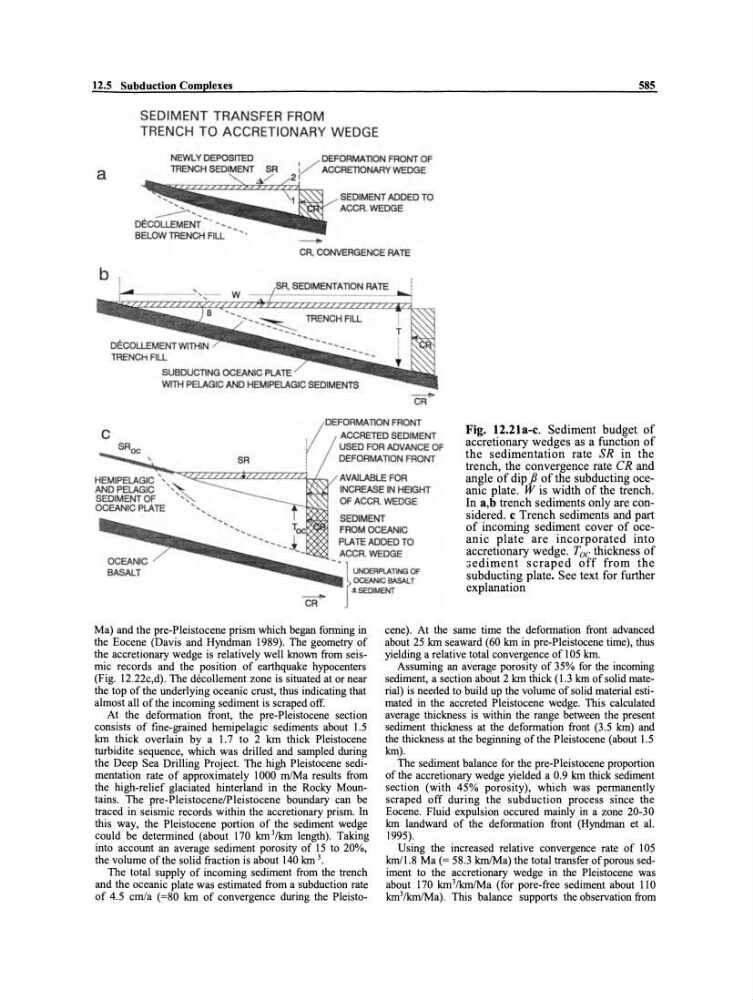
Fig. 12.21a-c. Sediment budget of
accretionary wedges as a function of
the sedimentation rate SR in the
trench, the convergence rate eR and
angle of dip ß of the subducting oceanic plate. W is width of the trench.
In a,b trench sediments only are considered. c Trench sediments and part
of incorning sediment cover of oceanic plate are incorporated into
accretionary wedge. T ()(' thickness of
:;ediment scraped off from the
subducting plate. See text for further
explanation
! DEFORMATION FRONT
HEMIPELAGIC~'7' , ,-'
AND PELAGIC
"
INCREASE IN HEIGHT
SEDIMENT OF
- -
OF ACCR. WEDGE
OCEANIC PLATE
\ __ _
-
SEDIMENT
""--__
I
FROM OCEANIC
- ____ ~
PLATE ADDED TO
ACCR.WEDGE
OCEANIC
BASALT
- CR
-. } UNDERPlATING OF
OCEANtC 8ASAl. T
:tSEDlMENT
Ma) and the pre-Pleistocene prism which began forming in
the Eocene (Davis and Hyndman 1989). The geometry of
the accretionary wedge is relatively weil known from seismic records and the position of earthquake hypocenters
(Fig. 12.22c,d). The decollement zone is situated at or near
the top of the underlying oceanic crnst, thus indicating that
almost all ofthe incoming sediment is scraped off.
At the deformation front, the pre-Pleistocene section
consists of fine-grained hemipelagic sediments about 1.5
km thick overlain by a 1.7 to 2 km thick Pleistocene
turbidite sequence, which was drilled and sampled during
the Deep Sea Drilling Project. The high Pleistocene sedimentation rate of approximately 1000 mJMa results from
the high-relief glaciated hinterland in the Rocky Mountains. The pre-Pleistocene/Pleistocene boundary can be
traced in seismic records within the accretionary prism. In
this way, the Pleistocene portion of the sediment wedge
could be determined (about 170 km 3/km length). Taking
into account an average sediment porosity of 15 to 20%,
the volume ofthe solid fraction is about 140 km 3.
The total supply of incoming sediment from the trench
and the oceanic plate was estimated from a subduction rate
of 4.5 cmla (=80 km of convergence during the Pleistocene). At the same time the deformation front advanced
about 25 km seaward (60 km in pre-Pleistocene time), thus
yielding a relative total convergence of 105 km.
Assuming an average porosity of 35% for the incoming
sediment, a section abotit 2 km thick (1.3 km of solid material) is neerled to build up the volume of solid material estimated in the accreted Pleistocene wedge. This calculated
average thickness is within the range between the present
sediment thickness at the deformation front (3.5 km) and
the thickness at the beginning ofthe Pleistocene (about 1.5
km).
The sediment balance for the pre-Pleistocene proportion
of the accretionary wedge yielded a 0.9 km thick sediment
section (with 45% porosity), which was permanently
scraped off during the subduction process since the
Eocene. Fluid expulsion occured mainly in a zone 20-30
km landward of the deformation front (Hyndman et al.
1995).
Using the increased relative convergence rate of 105
km/1.8 Ma (= 58.3 kmlMa) the total transfer ofporous sediment to the accretionary wedge in the Pleistocene was
about 170 km 3 /kmlMa (for pore-free sediment about 110
km 3 /kmlMa). This balance supports the observation from