

584
a N. JAPAN
TRENCH
~
50 km
b PERU TRENCH , T ECT ONIC EROSION
Chapter 12 Basin Evolution and Sediments
HEMIPELAGIC
SEDIMENTS .
DEFORMED
FOREARC BASIN
COASTAL
BATHOLITH
VOLCANIC ARC
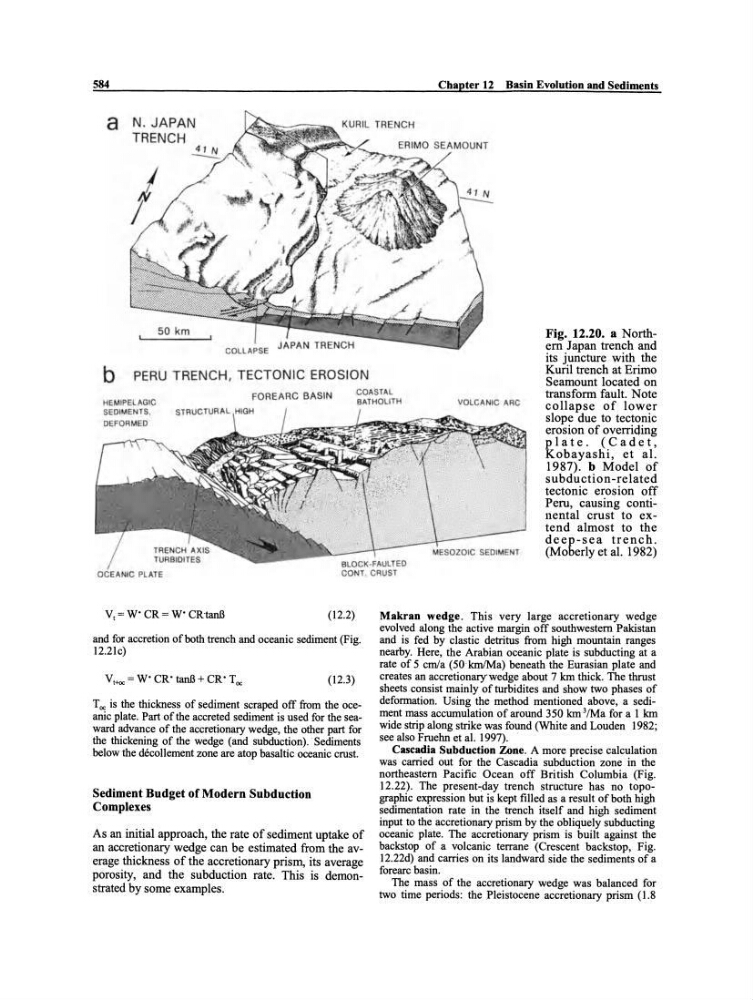
Fig. 12.20. a Northem Japan trench and
its juncture with the
Kuril trench at Erimo
Seamount located on
transform fault. Note
collapse of lower
slope due to tectonic
erosion of overriding
plate. (Cadet,
Kobayashi, et al.
1987). b Model of
subduction-related
tectonic erosion off
Peru, causing continental crust to extend almost to the
deep-sea trench.
(Moberly et al. 1982)
VI = W' CR = W' CRtanß
(12.2)
and for aeeretion ofboth treneh and oeeanie sediment (Fig.
12.21e)
VI+oc = W' CR' tanß+ CR' Toe
(12.3)
T oe is the thiekness of sediment seraped off from the oeeanie plate. Part of the aeereted sediment is used for the seaward advanee of the aeeretionary wedge, the other part for
the thiekening of the wedge (and subduetion). Sediments
below the deeollement zone are atop basaltie oeeanie erust.
Sediment Budget of Modern Subduction
Complexes
As an initial approach, the rate of sediment uptake of
an accretionary wedge can be estimated from the average thickness of the accretionary prism, its average
porosity, and the subduction rate. This is demonstrated by some examples.
ME~;OZ'OIC SEDIMENT
Makran wedge. This very large aceretionary wedge
evolved along the aetive margin off southwestem Pakistan
and is fed by c1astie detritus from high mountain ranges
nearby. Here, the Arabian oeeanic plate is subdueting at a
rate of 5 emla (50'kmlMa) beneath the Eurasian plate and
ereates an aecretionarywedge about 7 km thiek. The thrust
sheets eonsist mainly of turbidites and show two phases of
deformation. Using the method mentioned above, a sediment mass aeeumulation of around 350 km 3/Ma for a 1 km
wide strip along strike was found (White and Louden 1982;
see also Fruehn et al. 1997).
Cascadia Subduction Zone. A more preeise ealeulation
was earried out for the Caseadia subduetion zone in the
northeastem Paeifie Oeean off British Columbia (Fig.
12.22). The present~day treneh strueture has no topographie expression but is kept filled as a result of both high
sedimentation rate in the treneh itself and high sediment
input to the aeeretionary prism by the obliquely subdueting
oeeanie plate. The aeeretionary prism is built against the
baekstop of a volcanie terrane (Creseent backstop, Fig.
12.22d) and earries on its landward side the sediments of a
foreare basin.
The mass of the accretionary wedge was balaneed for
two time periods: the Pleistoeene aecretionary prism (1.8