

538
log S
a
s, ~ :21:' I t
I
4
t 1 0
Time units B.P.
b
volcanic free
K T
6
5
4
3 _2
1
Time B.P. (x 100 Ma)
c - Caledon.-+- Hercyn.+-- Alpine ---r-'"
r--..,
I
I
Average
I
I
I
E d d-.L
I
I
I rate of
rChapter 11 Sediment Supply, Subsidence, and Basin Fill
10
m
BE I/J c 0
6;-'
0
.4- Cf)
Q)
.....
2 ~
m >
0';;
o :;
Cf)
10
m
::E
Ben
ro e I
I
I I deposition 1 K
--1-.---+.. __ I . --I-J. -_. - .1_-"I/,4~
I
""'-"1.. I
I
-
c
o
.....
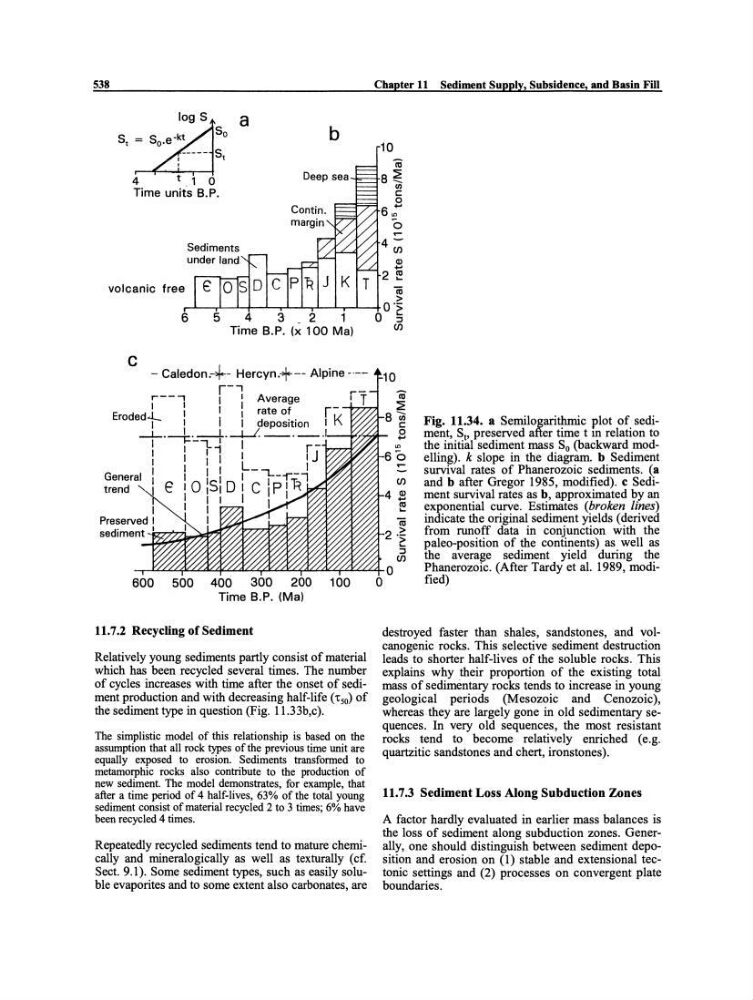
Fig. 11.34. a Semilogarithmic plot of sediment, St, preserved after time t In relation to
the initial sediment rnass So (backward modelling). k slope in the diagram. b Sediment
survival rates of Phanerozoic sediments. (a
and b after Gregor 1985, modified). c Sediment survival rates as b, approximated by an
exponential curve. Estirnates (broken fines)
indicate the original sediment yields (derived
from runoff data in conjunction with the
paleo-position of the continents) as weH as
the average sediment yield during the
Phanerozoic. (After Tardy et al. 1989, modified)
I
I
1"1
1
r J
I
:
I I
L
:
General I
I
I I
I - L..-;:-l
I ~ I 0 15 1 0 l e i p IR
trend "I c: I
1 I
I
I I
I
I
I 1
I
Preserved I
I
sedimenlt~ _]I~~~~~
600
500 400
300
200
100
Time B.P. (Ma)
11.7.2 Recycling of Sediment
Relatively young sediments partly consist of material
which has been recycled several times. The number
of cycles increases with time after the onset of sediment production and with decreasing half-life ('t"50) of
the sediment type in question (Fig. 11.33b,c).
The simplistic model of this relationship is based on the
assumption that all rock types of the previous time unit are
equally exposed to erosion. Sediments transformed to
metamorphic rocks also contribute to the production of
new sediment. The model demonstrates, for example, that
after a time period of 4 half-lives, 63% of the total young
sediment consist of material recyc1ed 2 to 3 times; 6% have
been recycled 4 times.
Repeatedly recycled sediments tend to mature chemically and mineralogically as well as texturally (cf.
Sect. 9.1). Some sediment types, such as easi1y soluble evaporites and to some extent also carbonates, are
"'
6'0
Cf)
4 ~
CI)
....
destroyed faster than shales, sandstones, and volcanogenic rocks. This selective sediment destruction
leads to shorter half-lives of the soluble rocks. This
explains why their proportion of the existing total
mass of sedimentary rocks tends to increase in young
geological periods (Mesozoic and Cenozoic),
whereas· they are largely gone in old sedimentary sequences. In very old sequences, the most resistant
rocks tend to become relatively enriched (e.g.
quartzitic sandstones and chert, ironstones ).
11.7.3 Sediment Loss Along Subduction Zones
A factor hardly evaluated in earlier mass balances is
the loss of sediment along subduction zones. Generally, one should distinguish between sediment deposition and erosion on (1) stable and extensional tectonic settings and (2) processes on convergent plate
boundaries.
log S
a
s, ~ :21:' I t
I
4
t 1 0
Time units B.P.
b
volcanic free
K T
6
5
4
3 _2
1
Time B.P. (x 100 Ma)
c - Caledon.-+- Hercyn.+-- Alpine ---r-'"
r--..,
I
I
Average
I
I
I
E d d-.L
I
I
I rate of
rChapter 11 Sediment Supply, Subsidence, and Basin Fill
10
m
BE I/J c 0
6;-'
0
.4- Cf)
Q)
.....
2 ~
m >
0';;
o :;
Cf)
10
m
::E
Ben
ro e I
I
I I deposition 1 K
--1-.---+.. __ I . --I-J. -_. - .1_-"I/,4~
I
""'-"1.. I
I
-
c
o
.....
Fig. 11.34. a Semilogarithmic plot of sediment, St, preserved after time t In relation to
the initial sediment rnass So (backward modelling). k slope in the diagram. b Sediment
survival rates of Phanerozoic sediments. (a
and b after Gregor 1985, modified). c Sediment survival rates as b, approximated by an
exponential curve. Estirnates (broken fines)
indicate the original sediment yields (derived
from runoff data in conjunction with the
paleo-position of the continents) as weH as
the average sediment yield during the
Phanerozoic. (After Tardy et al. 1989, modified)
I
I
1"1
1
r J
I
:
I I
L
:
General I
I
I I
I - L..-;:-l
I ~ I 0 15 1 0 l e i p IR
trend "I c: I
1 I
I
I I
I
I
I 1
I
Preserved I
I
sedimenlt~ _]I~~~~~
600
500 400
300
200
100
Time B.P. (Ma)
11.7.2 Recycling of Sediment
Relatively young sediments partly consist of material
which has been recycled several times. The number
of cycles increases with time after the onset of sediment production and with decreasing half-life ('t"50) of
the sediment type in question (Fig. 11.33b,c).
The simplistic model of this relationship is based on the
assumption that all rock types of the previous time unit are
equally exposed to erosion. Sediments transformed to
metamorphic rocks also contribute to the production of
new sediment. The model demonstrates, for example, that
after a time period of 4 half-lives, 63% of the total young
sediment consist of material recyc1ed 2 to 3 times; 6% have
been recycled 4 times.
Repeatedly recycled sediments tend to mature chemically and mineralogically as well as texturally (cf.
Sect. 9.1). Some sediment types, such as easi1y soluble evaporites and to some extent also carbonates, are
"'
6'0
Cf)
4 ~
CI)
....
destroyed faster than shales, sandstones, and volcanogenic rocks. This selective sediment destruction
leads to shorter half-lives of the soluble rocks. This
explains why their proportion of the existing total
mass of sedimentary rocks tends to increase in young
geological periods (Mesozoic and Cenozoic),
whereas· they are largely gone in old sedimentary sequences. In very old sequences, the most resistant
rocks tend to become relatively enriched (e.g.
quartzitic sandstones and chert, ironstones ).
11.7.3 Sediment Loss Along Subduction Zones
A factor hardly evaluated in earlier mass balances is
the loss of sediment along subduction zones. Generally, one should distinguish between sediment deposition and erosion on (1) stable and extensional tectonic settings and (2) processes on convergent plate
boundaries.