

11.7 Preservation and Recycling ofOlder Sediments
I
!/J
!/J
ttI
E
.....
c
Q)
...
E :: :
"0
..
Q)
..
Cf)
:: :
. .
:.:
..
Mass of initial sediment
Recycled into sediment
of next time unit
Sediment of t o
preserved
Sediment
cycling
a
Time
units
3x
2x
b
1x Recycled
537
New
sediment
, 2, 3, .. Sediment eroded during t o -t 1 , t 1 -t 2 , t 2 -t 3
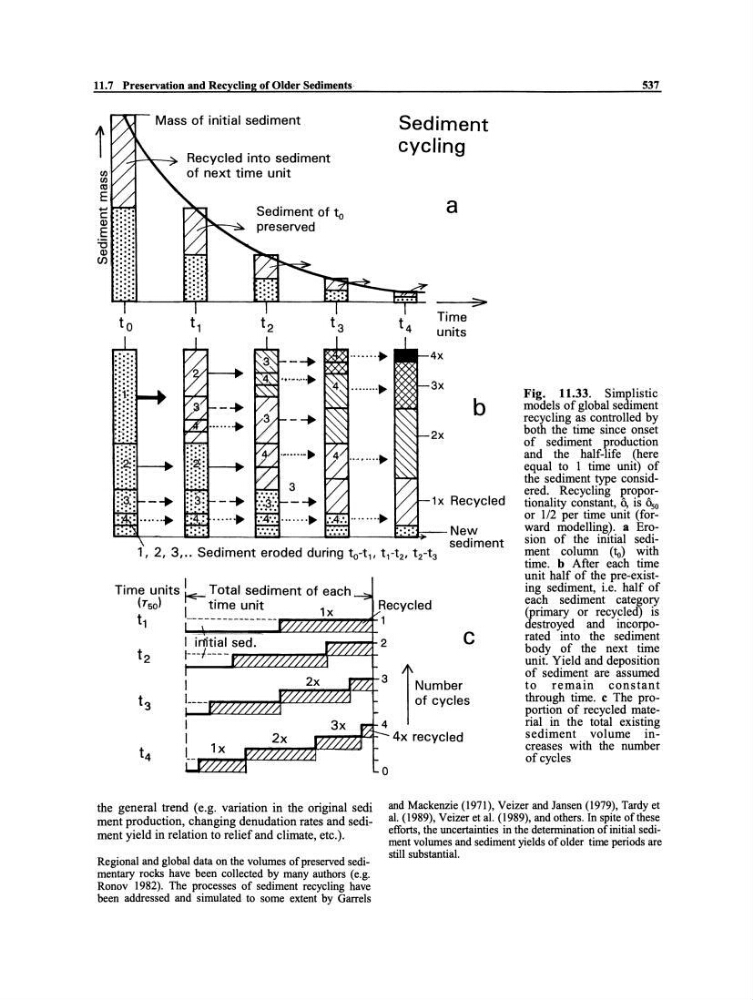
Fig. 11.33. Simplistic
models of global sediment
recycling as controlled by
both the time since onset
of sediment production
and the half-life (here
equal to 1 time unit) of
the sediment type considered. Recycling proportionality constant, Ö, is 050
or 1/2 per time unit (forward modelling). a Erosion of the initial sediment column (10) with
time. b After each time
unit half of the pre-existing sediment, i.e. half of
each sediment category
(primary or recycled) is
destroyed and incorporated into the sediment
body of the next time
unit. Yield and deposition
of sediment are assumed
to remain constant
through time. c The proportion of recycled material in the total existing
sediment volume increases with the number
of cycles
Time units ~ Total sediment of each
(Tso)
I time unit
t 1
-------------the general trend (e.g. variation in the original sedi
ment production, changing denudation rates and sediment yield in relation to relief and climate, etc.).
Regional and global data on the volumes ofpreserved sedimentary rocks have been collected by many authors (e.g.
Ronov 1982). The processes of sediment recycling have
been addressed and simulated to some extent by Garrels
o
c
and Mackenzie (1971), Veizer and Jansen (1979), Tardyet
al. (1989), Veizer et al. (1989), and others. In spite ofthese
efforts, the uncertainties in the detennination of initial sediment volumes and sediment yields of older time periods are
still substantial.
I
!/J
!/J
ttI
E
.....
c
Q)
...
E :: :
"0
..
Q)
..
Cf)
:: :
. .
:.:
..
Mass of initial sediment
Recycled into sediment
of next time unit
Sediment of t o
preserved
Sediment
cycling
a
Time
units
3x
2x
b
1x Recycled
537
New
sediment
, 2, 3, .. Sediment eroded during t o -t 1 , t 1 -t 2 , t 2 -t 3
Fig. 11.33. Simplistic
models of global sediment
recycling as controlled by
both the time since onset
of sediment production
and the half-life (here
equal to 1 time unit) of
the sediment type considered. Recycling proportionality constant, Ö, is 050
or 1/2 per time unit (forward modelling). a Erosion of the initial sediment column (10) with
time. b After each time
unit half of the pre-existing sediment, i.e. half of
each sediment category
(primary or recycled) is
destroyed and incorporated into the sediment
body of the next time
unit. Yield and deposition
of sediment are assumed
to remain constant
through time. c The proportion of recycled material in the total existing
sediment volume increases with the number
of cycles
Time units ~ Total sediment of each
(Tso)
I time unit
t 1
-------------the general trend (e.g. variation in the original sedi
ment production, changing denudation rates and sediment yield in relation to relief and climate, etc.).
Regional and global data on the volumes ofpreserved sedimentary rocks have been collected by many authors (e.g.
Ronov 1982). The processes of sediment recycling have
been addressed and simulated to some extent by Garrels
o
c
and Mackenzie (1971), Veizer and Jansen (1979), Tardyet
al. (1989), Veizer et al. (1989), and others. In spite ofthese
efforts, the uncertainties in the detennination of initial sediment volumes and sediment yields of older time periods are
still substantial.