

526
Chapter 11 Sediment Supply, Subsidence, and Basin Fill
MASS BALANCE FOR HOLOCENE COASTAL SEDIMENTS
NORTH
SEA
25
NORTH SEA ISLANO
B.P., the sea level stood at -25 m below the present level,
and the landward migrating barrier coast line had approximately reached the present-day coast or barrier islands. As
a result of the slowing relative sea-Ievel rise (from 6 to l.5
mIka), the barrier system became stabilized and the accommodation space in the back-barrier zone could be more or
less filled with sediment in the time period up to about 2 ka
B.P. In this way further coastal retreat was largely prevented and finally replaced by some prograding. Behind
the barrier extensive peat swamps evolved.
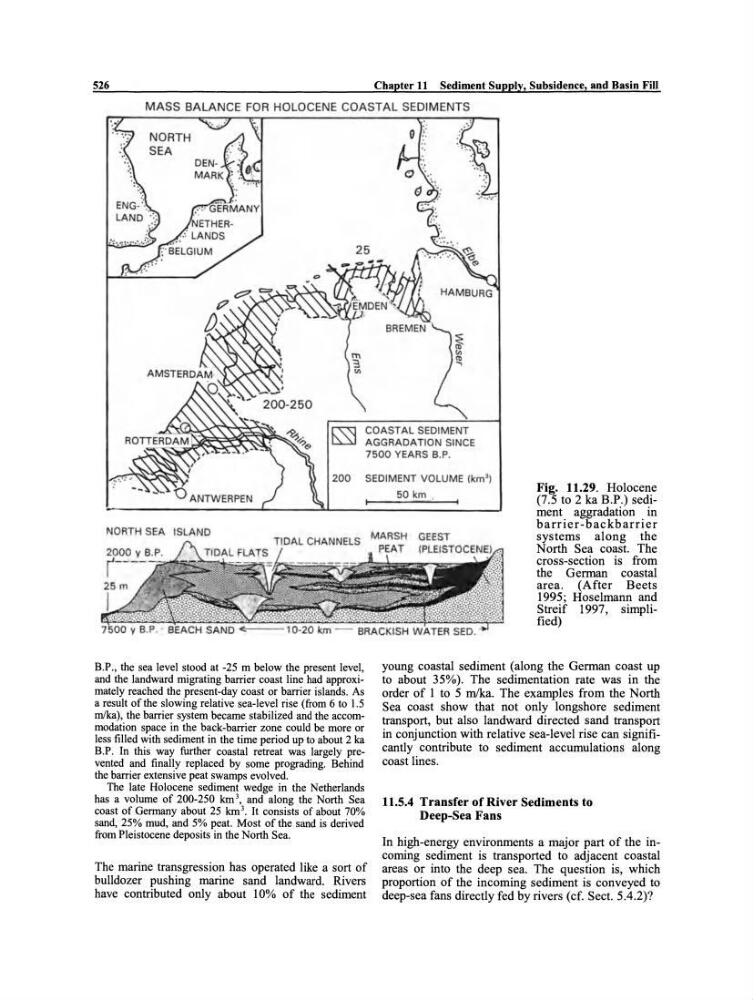
The late Holocene sediment wedge in the Netherlands
has a volume of 200-250 km 3, and along the N orth Sea
coast of Gerrnany about 25 km 3 • It consists of about 70%
sand, 25% mud, and 5% peat. Most of the sand is derived
from Pleistocene deposits in the North Sea.
COASTAL SEDIMENT
AGGRADATION SINCE
7500 YEARS B.P.
SEDIMENT VOLUME (km l )
50 km ,
Fig. 11.29. Holocene
(7.5 to 2 ka B.P.) sediment aggradation in
barrier-backbarrier
systems along the
N orth Sea coast. The
cross-section is from
the German coastal
area. (After Beets
1995; Hoselmann and
Streif 1997, simplified)
young coastal sediment (along the German coast up
to about 35%). The sedimentation rate was in the
order of 1 to 5 mlka. The examples from the North
Sea coast show that not only longshore sediment
transport, but also landward directed sand transport
in conjunction with relative sea-level rise can significantly contribute to sediment accumulations along
coast lines.
11.5.4 Transfer of River Sediments to
Deep-Sea Fans
The marine transgression has operated like a sort of
bulldozer pushing marine sand landward. Rivers
have contributed only about 10% of the sediment
In high-energy environments a major part of the incorning sediment is transported to adjacent coastal
areas or into the deep sea. The question is, which
proportion of the incoming sediment is conveyed to
deep-sea fans directly fed by rivers (cf. Sect. 5.4.2)?
Chapter 11 Sediment Supply, Subsidence, and Basin Fill
MASS BALANCE FOR HOLOCENE COASTAL SEDIMENTS
NORTH
SEA
25
NORTH SEA ISLANO
B.P., the sea level stood at -25 m below the present level,
and the landward migrating barrier coast line had approximately reached the present-day coast or barrier islands. As
a result of the slowing relative sea-Ievel rise (from 6 to l.5
mIka), the barrier system became stabilized and the accommodation space in the back-barrier zone could be more or
less filled with sediment in the time period up to about 2 ka
B.P. In this way further coastal retreat was largely prevented and finally replaced by some prograding. Behind
the barrier extensive peat swamps evolved.
The late Holocene sediment wedge in the Netherlands
has a volume of 200-250 km 3, and along the N orth Sea
coast of Gerrnany about 25 km 3 • It consists of about 70%
sand, 25% mud, and 5% peat. Most of the sand is derived
from Pleistocene deposits in the North Sea.
COASTAL SEDIMENT
AGGRADATION SINCE
7500 YEARS B.P.
SEDIMENT VOLUME (km l )
50 km ,
Fig. 11.29. Holocene
(7.5 to 2 ka B.P.) sediment aggradation in
barrier-backbarrier
systems along the
N orth Sea coast. The
cross-section is from
the German coastal
area. (After Beets
1995; Hoselmann and
Streif 1997, simplified)
young coastal sediment (along the German coast up
to about 35%). The sedimentation rate was in the
order of 1 to 5 mlka. The examples from the North
Sea coast show that not only longshore sediment
transport, but also landward directed sand transport
in conjunction with relative sea-level rise can significantly contribute to sediment accumulations along
coast lines.
11.5.4 Transfer of River Sediments to
Deep-Sea Fans
The marine transgression has operated like a sort of
bulldozer pushing marine sand landward. Rivers
have contributed only about 10% of the sediment
In high-energy environments a major part of the incorning sediment is transported to adjacent coastal
areas or into the deep sea. The question is, which
proportion of the incoming sediment is conveyed to
deep-sea fans directly fed by rivers (cf. Sect. 5.4.2)?