

11.5 Clastie Sediment, Distribution
v V
I
I
I
I
I
I
I
I
I
I
I
I
\
/
100 km
b
I
I
I
525
~
.... ......... -- ------·-·100m :·: .
C
... :-.: . . <:: .. . ... .
COASTAL PLAIN
(MARSH) \
LAGOONAL DEP .
d
OLDER
BEACH RIDGE
RAVINEMENT
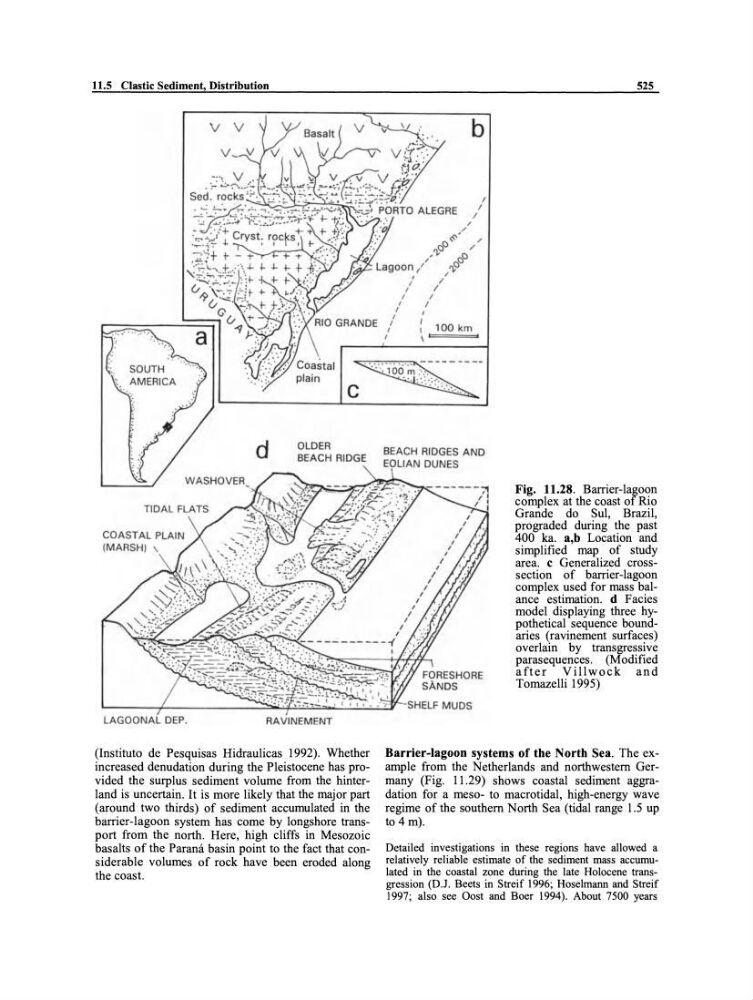
(Instituto de Pesquisas Hidraulicas 1992). Whether
increased denudation during the Pleistocene has provided the surplus sediment volume from the hinterland is uncertain. It is more likely that the major part
(around two thirds) of sediment accumulated in the
barrier-lagoon system has come by longshore transport from the north. Here, high cliffs in Mesozoic
basalts of the Parana basin point to the fact that considerable volumes of rock have been eroded along
the coast.
BEACH RIDGES AND
EOLIAN DUNES
Fig. 11.28. Barrier-lagoon
complex at the coast of Rio
Grande do Sul, Brazil,
prograded during the past
400 ka. a,b Location and
simplified map of study
area. c Generalized crosssection of barrier-lagoon
complex used for mass balance estimation. d Facies
model displaying three hypothetical sequence boundaries (ravinement surfaces)
overlain by transgressive
parasequences. (Modified
after Villwock and
Tomazelli 1995)
Barrier-Iagoon systems of the North Sea. The example from the Netherlands and northwestem Germany (Fig. 11.29) shows coastal sediment aggradation for a meso- to macrotidal, high-energy wave
regime of the southem North Sea (tidal range 1.5 up
to 4 m).
Detailed investigations in these regions have allowed a
relatively reliable estimate of the sediment mass accumulated in the coastal zone during the late Holocene transgression (DJ. Beets in Streif 1996; Hoselmann and Streif
1997; also see Oost and Boer 1994). About 7500 years
v V
I
I
I
I
I
I
I
I
I
I
I
I
\
/
100 km
b
I
I
I
525
~
.... ......... -- ------·-·100m :·: .
C
... :-.: . . <:: .. . ... .
COASTAL PLAIN
(MARSH) \
LAGOONAL DEP .
d
OLDER
BEACH RIDGE
RAVINEMENT
(Instituto de Pesquisas Hidraulicas 1992). Whether
increased denudation during the Pleistocene has provided the surplus sediment volume from the hinterland is uncertain. It is more likely that the major part
(around two thirds) of sediment accumulated in the
barrier-lagoon system has come by longshore transport from the north. Here, high cliffs in Mesozoic
basalts of the Parana basin point to the fact that considerable volumes of rock have been eroded along
the coast.
BEACH RIDGES AND
EOLIAN DUNES
Fig. 11.28. Barrier-lagoon
complex at the coast of Rio
Grande do Sul, Brazil,
prograded during the past
400 ka. a,b Location and
simplified map of study
area. c Generalized crosssection of barrier-lagoon
complex used for mass balance estimation. d Facies
model displaying three hypothetical sequence boundaries (ravinement surfaces)
overlain by transgressive
parasequences. (Modified
after Villwock and
Tomazelli 1995)
Barrier-Iagoon systems of the North Sea. The example from the Netherlands and northwestem Germany (Fig. 11.29) shows coastal sediment aggradation for a meso- to macrotidal, high-energy wave
regime of the southem North Sea (tidal range 1.5 up
to 4 m).
Detailed investigations in these regions have allowed a
relatively reliable estimate of the sediment mass accumulated in the coastal zone during the late Holocene transgression (DJ. Beets in Streif 1996; Hoselmann and Streif
1997; also see Oost and Boer 1994). About 7500 years