

10.1 General Aspects
SEDIMENT BUILDUP
(THICKNESS)
SHORT-TERM
SED. RATE
h
"'--SR= AB
/"
tA~,/'
457
a
A~~--~---++---~+---------~-r----~
OFSEDIMENT
CHRONOSTRA TlGRAPHIC SEQUENCE
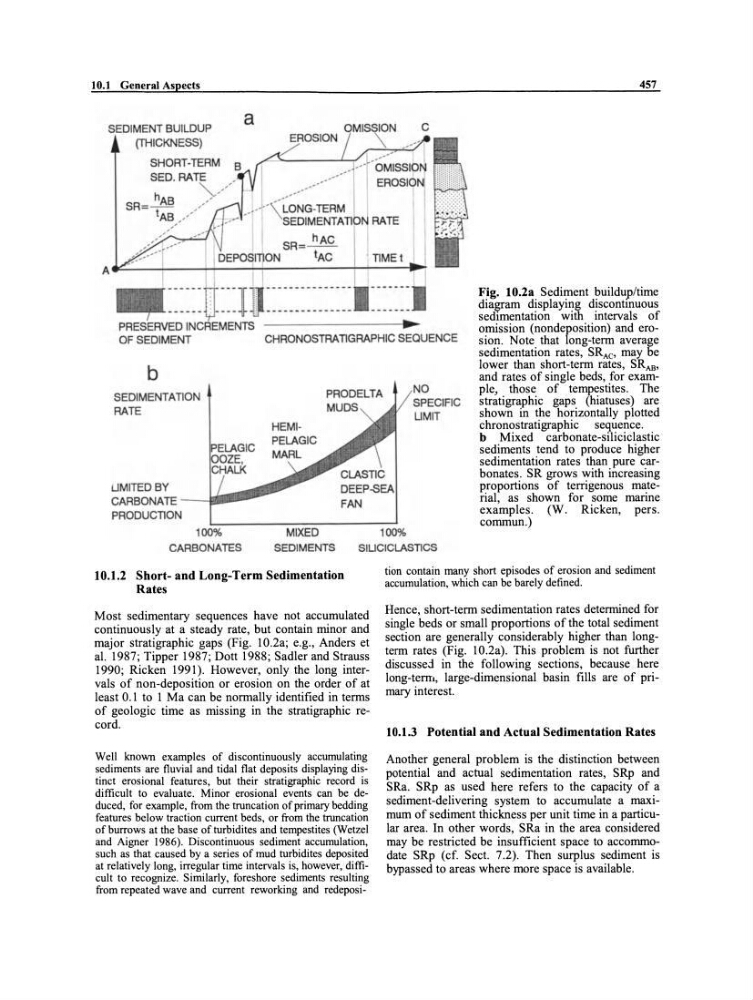
Fig. 10.2a Sediment buildup/time
diawarn displaying diseontmuous
sedimentation with intervals of
omission (nondeposition) and erosion. Note that long-term average
sedimentation rates, SR AO may be
lower than short-term rates, SR AB ,
and rates of single beds, for exampie, those of tempestites. The
stratigraphie gaps (hiatuses) are
shown in the horizontally plotted
ehronostratigraphie sequenee.
b
SEDIMENTATION
RATE
UMITED BY __ ~_ ... _"' 1111""""' "
CARBONATE
PRODUCTlON
PRODELTA
MUDS
FAN
o
SPECIFIC
UMIT
100%
CARBONATES
MIXED
SEDIMENTS
100%
SIUCICLASTlCS
b Mixed earbonate-silieiclastie
sediments tend to produee higher
sedimentation rates than pure carbonates. SR grows with inereasing
proportions of terrigenous material, as shown for some marine
examples. (W. Ricken, pers.
eommun.)
10.1.2 Short- and Long-Term Sedimentation
Rates
Most sedimentary sequenees have not aeeumulated
eontinuously at a steady rate, but eontain minor and
major stratigraphie gaps (Fig. 10.2a; e.g., Anders et
al. 1987; Tipper 1987; Dott 1988; Sadler and Strauss
1990; Ricken 1991). However, only the long intervals of non-deposition or erosion on the order of at
least 0.1 to 1 Ma ean be normally identified in terms
of geologie time as missing in the stratigraphie record.
Weil known examples of discontinuously accumulating
sediments are fluvial and tidal flat deposits displaying distinct erosional features, but their stratigraphie record is
difficult to evaluate. Minor erosional events can be deduced, for example, trom the truncation of primary bedding
features below traction current beds, or trom the truncation
of burrows at the base of turbidites and tempestites (Wetze!
and Aigner 1986). Discontinuous sediment accumulation,
such as that caused by aseries of mud turbidites deposited
at relatively long, irregular time intervals is, however, difficult to recognize. Similarly, foreshore sediments resulting
trom repeated wave and current reworking and redeposition contain many short episodes of erosion and sediment
accumulation, wh ich can be barely defined.
Henee, short-term sedimentation rates deterrnined for
single beds or small proportions of the total sediment
seetion are generally eonsiderably higher than longterm rates (Fig. 10.2a). This problem is not further
diseussd in the following seetions, beeause here
long-tern., large-dimensional basin fills are of primary interest.
10.1.3 Potential and Actual Sedimentation Rates
Another general problem is the distinetion between
potential and aetual sedimentation rates, SRp and
SRa. SRp as used here refers to the capacity of a
sediment-delivering system to aeeumulate a maximum of sediment thiekness per unit time in a partieular area. In other words, SRa in the area eonsidered
may be restrieted be insuffieient spaee to aeeommodate SRp (cf. Seet. 7.2). Then surplus sediment is
bypassed to areas where more spaee is available.
SEDIMENT BUILDUP
(THICKNESS)
SHORT-TERM
SED. RATE
h
"'--SR= AB
/"
tA~,/'
457
a
A~~--~---++---~+---------~-r----~
OFSEDIMENT
CHRONOSTRA TlGRAPHIC SEQUENCE
Fig. 10.2a Sediment buildup/time
diawarn displaying diseontmuous
sedimentation with intervals of
omission (nondeposition) and erosion. Note that long-term average
sedimentation rates, SR AO may be
lower than short-term rates, SR AB ,
and rates of single beds, for exampie, those of tempestites. The
stratigraphie gaps (hiatuses) are
shown in the horizontally plotted
ehronostratigraphie sequenee.
b
SEDIMENTATION
RATE
UMITED BY __ ~_ ... _"' 1111""""' "
CARBONATE
PRODUCTlON
PRODELTA
MUDS
FAN
o
SPECIFIC
UMIT
100%
CARBONATES
MIXED
SEDIMENTS
100%
SIUCICLASTlCS
b Mixed earbonate-silieiclastie
sediments tend to produee higher
sedimentation rates than pure carbonates. SR grows with inereasing
proportions of terrigenous material, as shown for some marine
examples. (W. Ricken, pers.
eommun.)
10.1.2 Short- and Long-Term Sedimentation
Rates
Most sedimentary sequenees have not aeeumulated
eontinuously at a steady rate, but eontain minor and
major stratigraphie gaps (Fig. 10.2a; e.g., Anders et
al. 1987; Tipper 1987; Dott 1988; Sadler and Strauss
1990; Ricken 1991). However, only the long intervals of non-deposition or erosion on the order of at
least 0.1 to 1 Ma ean be normally identified in terms
of geologie time as missing in the stratigraphie record.
Weil known examples of discontinuously accumulating
sediments are fluvial and tidal flat deposits displaying distinct erosional features, but their stratigraphie record is
difficult to evaluate. Minor erosional events can be deduced, for example, trom the truncation of primary bedding
features below traction current beds, or trom the truncation
of burrows at the base of turbidites and tempestites (Wetze!
and Aigner 1986). Discontinuous sediment accumulation,
such as that caused by aseries of mud turbidites deposited
at relatively long, irregular time intervals is, however, difficult to recognize. Similarly, foreshore sediments resulting
trom repeated wave and current reworking and redeposition contain many short episodes of erosion and sediment
accumulation, wh ich can be barely defined.
Henee, short-term sedimentation rates deterrnined for
single beds or small proportions of the total sediment
seetion are generally eonsiderably higher than longterm rates (Fig. 10.2a). This problem is not further
diseussd in the following seetions, beeause here
long-tern., large-dimensional basin fills are of primary interest.
10.1.3 Potential and Actual Sedimentation Rates
Another general problem is the distinetion between
potential and aetual sedimentation rates, SRp and
SRa. SRp as used here refers to the capacity of a
sediment-delivering system to aeeumulate a maximum of sediment thiekness per unit time in a partieular area. In other words, SRa in the area eonsidered
may be restrieted be insuffieient spaee to aeeommodate SRp (cf. Seet. 7.2). Then surplus sediment is
bypassed to areas where more spaee is available.