

456
within the measured section may often be substantial. Average linear sedimentation rates for sediments of some
thickness are therefore only an approximation. Nonetheless, SR is used for many applications in sedimentology
and geology because more accurate values are not available
or time-consuming to get.
The accumu1ation rate, AR, is defined as the quantity
(weight or mass), W, of solid particles deposited during a certain time span, t, on unit area, A:
AR=W/AJt
(10.2)
It may be expressed in g/m 2 /a, kg/m 2 /ka, g/cm 2 IMa,
or tlm 2 lMa; 1 g/m 2 /a = 1 kg/m 2 /ka = 100 glcm 2 IMa =
1 tlm 2 lMa.
One can distinguish between bulk accumu1ation
rates, AR b , comprising all constituents of asediment,
and specific accumu1ation rates for certain sediment
components such as calcium carbonate, opa1ine si1ica, organic matter, etc.
In order to ca1cu1ate bulk accumu1ation rates, besides the requirements mentioned above, the porosity, n (as a portion of 1), as weIl as the wet and dry
bulk densities, D w and D d (in g/cm 3 or tlm 3 ), of the
sediment must be known.
(10.3)
D d is re1atedto the same vo1ume as D w ; it must not be
confused with average grain density, y s'
If the total pore space is filled with sea water (density
Ysw = 1.025 g/cm\, wet and dry bulk densities are
linked by the term
(10.4)
For pore fluids differing from sea water, other correction factors have to be used. Porosity, n, derived
from (5.3) is
(10.5)
Dw and D d are usually determined as follows:
(10.6)
where W wand W d are wet weight and dry weight,
respectively, and VI is total vo1ume of the (water-saturated) sampie being measured.
The porosity, n, is also found by
(10.7)
where V w = volume of water in the water-saturated
sampie.
Chapter 10 Sedimentation Rates and Organic Matter
Fresh fine-grained sampIes from drillholes or from the sea
bottom usually are fully water-saturated. If part of the pore
space is filled by gas, other formulae must be applied (see,
e.g., special literature on soil mechanics or from the oil
industry).
Having determined D d , the bulk accumulation rate, ARb, is
(10.8)
In order to calculate the accumulation rate of specific sediment components, AR., the concentration, C., of component x in the total sediment must be determined. If Cx is
given in percent by weight, the accumulation rate, AR., of
component x is
(10.9)
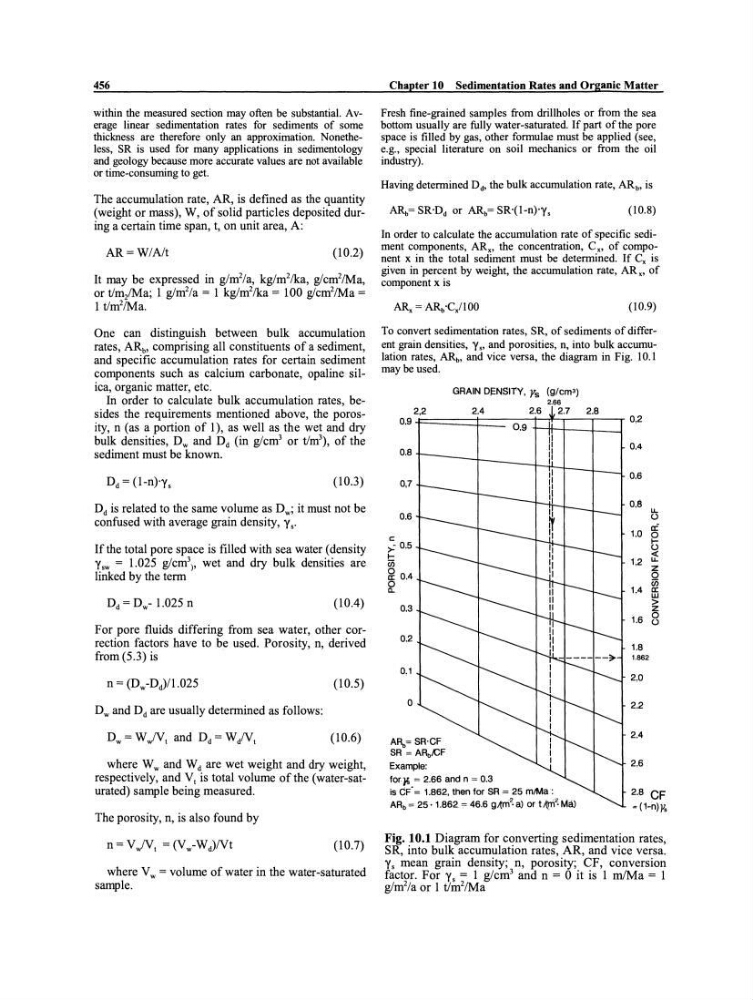
To convert sedimentation rates, SR, of sediments of different grain densities, y" and porosities, n, into bulk accumulation rates, ~, and vice versa, the diagram in Fig. 10.1
maybe used.
GRAIN D~NSITY, Ys (g/cm3 )
2.66
2,2
2.4
2.6
2.7
2.8
0.9 -F=====t=~o~t:::1h-T--r .9 r-it--I--+--..J
0.8 r---r--+fH---l-1
0,7
0.6
c:
:>:' 0.5
ICi)
~ 0.4
~
0.3
0.2
0.1
o
AR b = SR·CF
SR = ARo,cF
Example:
for~ = 2.66 and n = 0.3
is CF' = 1.862, then for SR = 25 mtMa:
ARb = 25· 1.862 = 46.6 g;trn~ a) cr t /(i1l'. Ma)
0,2
0.4
0.6
0.8 u.
ü
1.0
ci
0
IÜ
z
0
Ci)
1.4 CI:
w
> z
1.6
0
Ü
1.8
1.862
2.0
2.2
2.4
2.6
2.8 CF
= (1-n)y.
Fig. 10.1 Diagram for converting sedimentation rates,
SR, into bulk accumulation rates, AR, and vi ce versa.
Ys mean grain density; n, porosity; CF, conversion
factor. For Ys = 1 g/cm 3 and n = 0 it is 1 m/Ma = 1
glm 2 /a or 1 tlm 2 IMa
within the measured section may often be substantial. Average linear sedimentation rates for sediments of some
thickness are therefore only an approximation. Nonetheless, SR is used for many applications in sedimentology
and geology because more accurate values are not available
or time-consuming to get.
The accumu1ation rate, AR, is defined as the quantity
(weight or mass), W, of solid particles deposited during a certain time span, t, on unit area, A:
AR=W/AJt
(10.2)
It may be expressed in g/m 2 /a, kg/m 2 /ka, g/cm 2 IMa,
or tlm 2 lMa; 1 g/m 2 /a = 1 kg/m 2 /ka = 100 glcm 2 IMa =
1 tlm 2 lMa.
One can distinguish between bulk accumu1ation
rates, AR b , comprising all constituents of asediment,
and specific accumu1ation rates for certain sediment
components such as calcium carbonate, opa1ine si1ica, organic matter, etc.
In order to ca1cu1ate bulk accumu1ation rates, besides the requirements mentioned above, the porosity, n (as a portion of 1), as weIl as the wet and dry
bulk densities, D w and D d (in g/cm 3 or tlm 3 ), of the
sediment must be known.
(10.3)
D d is re1atedto the same vo1ume as D w ; it must not be
confused with average grain density, y s'
If the total pore space is filled with sea water (density
Ysw = 1.025 g/cm\, wet and dry bulk densities are
linked by the term
(10.4)
For pore fluids differing from sea water, other correction factors have to be used. Porosity, n, derived
from (5.3) is
(10.5)
Dw and D d are usually determined as follows:
(10.6)
where W wand W d are wet weight and dry weight,
respectively, and VI is total vo1ume of the (water-saturated) sampie being measured.
The porosity, n, is also found by
(10.7)
where V w = volume of water in the water-saturated
sampie.
Chapter 10 Sedimentation Rates and Organic Matter
Fresh fine-grained sampIes from drillholes or from the sea
bottom usually are fully water-saturated. If part of the pore
space is filled by gas, other formulae must be applied (see,
e.g., special literature on soil mechanics or from the oil
industry).
Having determined D d , the bulk accumulation rate, ARb, is
(10.8)
In order to calculate the accumulation rate of specific sediment components, AR., the concentration, C., of component x in the total sediment must be determined. If Cx is
given in percent by weight, the accumulation rate, AR., of
component x is
(10.9)
To convert sedimentation rates, SR, of sediments of different grain densities, y" and porosities, n, into bulk accumulation rates, ~, and vice versa, the diagram in Fig. 10.1
maybe used.
GRAIN D~NSITY, Ys (g/cm3 )
2.66
2,2
2.4
2.6
2.7
2.8
0.9 -F=====t=~o~t:::1h-T--r .9 r-it--I--+--..J
0.8 r---r--+fH---l-1
0,7
0.6
c:
:>:' 0.5
ICi)
~ 0.4
~
0.3
0.2
0.1
o
AR b = SR·CF
SR = ARo,cF
Example:
for~ = 2.66 and n = 0.3
is CF' = 1.862, then for SR = 25 mtMa:
ARb = 25· 1.862 = 46.6 g;trn~ a) cr t /(i1l'. Ma)
0,2
0.4
0.6
0.8 u.
ü
1.0
ci
0
IÜ
z
0
Ci)
1.4 CI:
w
> z
1.6
0
Ü
1.8
1.862
2.0
2.2
2.4
2.6
2.8 CF
= (1-n)y.
Fig. 10.1 Diagram for converting sedimentation rates,
SR, into bulk accumulation rates, AR, and vi ce versa.
Ys mean grain density; n, porosity; CF, conversion
factor. For Ys = 1 g/cm 3 and n = 0 it is 1 m/Ma = 1
glm 2 /a or 1 tlm 2 IMa