

8.3 Rift Basin Models and Observed Subsidence
o
5
5
SLiGHT
UPLIFT
km
km
100 km
BASIN MARGIN
POST -RIFT SEDIMENTS
(REGIONAL FlEXURAl
COMPENSATION)
SYN-RIFT SEDIMENTS
(lOCAl ISOSTATIC
COMPENSATlON)
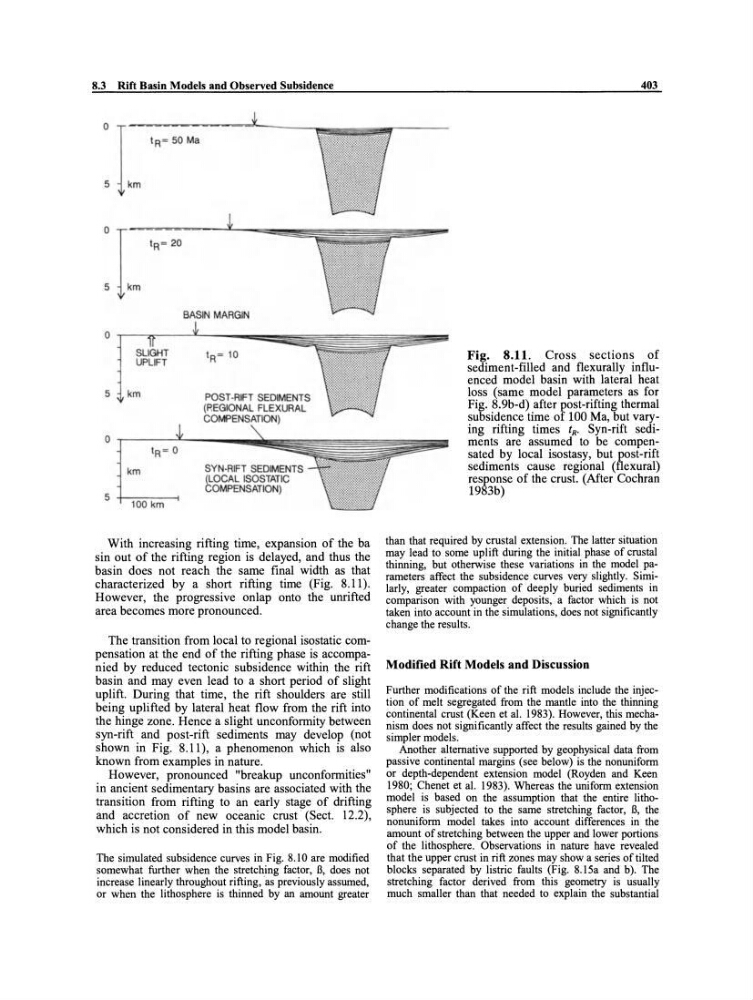
With increasing rifting time, expansion of the ba
sin out of the rifting region is de1ayed, and thus the
basin does not reach the same final width as that
characterized by a short rifting time (Fig. 8.11).
However, the progressive onlap onto the unrifted
area becomes more pronounced.
The transition from local to regional isostatic compensation at the end of the rifting phase is. accompanied by reduced tee tonic subsidence within the rift
basin and may even lead to a short period of slight
uplift. During that time, the rift shoulders are still
being uplifted by lateral heat flow from the rift into
the hinge zone. Hence a slight unconformity between
syn-rift and post-rift sediments may develop (not
shown in Fig. 8.11), a phenomenon which is also
known from examples in nature_
However, pronounced "breakup unconformities"
in ancient sedimentary basins are associated with the
transition from rifting to an early stage of drifting
and aceretion of new oeeanie erust· (Sect. 12.2),
whieh is not considered in this model basin.
The simulated subsidence curves in Fig. 8.10 are modified
somewhat further when the stretching factor, ß, does not
increase linearly throughout rifting, ·as previously assumed,
or when the lithosphere is thinned by an amount greater
403
Fig. 8.11. Cross seetions of
sediment-filled and flexurally influeneed model basin with lateral heat
loss (same model parameters as for
Fig. 8.9b-d) after post-rifting thermal
subsidence time of 100 Ma, but varying rifting times tR• Syn-rift sediments are assumed to be eompensated by loeal isostasy, but post-rift
sediments eause regional (flexural)
response of the erust. (Mter Coehran
1983b)
than that required by crustal extension. The latter situation
may lead to some uplift during the initial phase of crustal
thinning, but otherwise these variations in the model parameters affect the subsidence curves very slightly. Similarly, greater compaction of deeply buried sediments in
comparison with younger deposits, a factor which is not
taken into account in the simulations, does not significantly
change the results.
Modified Rift Models and Discussion
Further modifications of the rift models include the injection of melt segregated from the rnantle into the thinning
continental crust (Keen et al. 1983). However, this mechanism does not significantly affect the results gained by the
simpler models.
Another alternative supported by geophysical data from
passive continental margins (see below) is the nonuniform
or depth-dependent extension model (Royden and Keen
1980; Chenet et al. 1983). Whereas the uniform extension
model is based on the assumption that the entire lithosphere is subjected to the same stretching factor, ß, the
nonuniform model takes into account differences in the
amount of stretching between the upper and lower portions
of the lithosphere. Observations in nature have revealed
that the upper crust in rift zones may showaseries oftilted
blocks separated by listric faults (Fig. 8.15a and b). The
stretching factor derived from this geometry is usually
much smaller than that needed to explain the substantial
o
5
5
SLiGHT
UPLIFT
km
km
100 km
BASIN MARGIN
POST -RIFT SEDIMENTS
(REGIONAL FlEXURAl
COMPENSATION)
SYN-RIFT SEDIMENTS
(lOCAl ISOSTATIC
COMPENSATlON)
With increasing rifting time, expansion of the ba
sin out of the rifting region is de1ayed, and thus the
basin does not reach the same final width as that
characterized by a short rifting time (Fig. 8.11).
However, the progressive onlap onto the unrifted
area becomes more pronounced.
The transition from local to regional isostatic compensation at the end of the rifting phase is. accompanied by reduced tee tonic subsidence within the rift
basin and may even lead to a short period of slight
uplift. During that time, the rift shoulders are still
being uplifted by lateral heat flow from the rift into
the hinge zone. Hence a slight unconformity between
syn-rift and post-rift sediments may develop (not
shown in Fig. 8.11), a phenomenon which is also
known from examples in nature_
However, pronounced "breakup unconformities"
in ancient sedimentary basins are associated with the
transition from rifting to an early stage of drifting
and aceretion of new oeeanie erust· (Sect. 12.2),
whieh is not considered in this model basin.
The simulated subsidence curves in Fig. 8.10 are modified
somewhat further when the stretching factor, ß, does not
increase linearly throughout rifting, ·as previously assumed,
or when the lithosphere is thinned by an amount greater
403
Fig. 8.11. Cross seetions of
sediment-filled and flexurally influeneed model basin with lateral heat
loss (same model parameters as for
Fig. 8.9b-d) after post-rifting thermal
subsidence time of 100 Ma, but varying rifting times tR• Syn-rift sediments are assumed to be eompensated by loeal isostasy, but post-rift
sediments eause regional (flexural)
response of the erust. (Mter Coehran
1983b)
than that required by crustal extension. The latter situation
may lead to some uplift during the initial phase of crustal
thinning, but otherwise these variations in the model parameters affect the subsidence curves very slightly. Similarly, greater compaction of deeply buried sediments in
comparison with younger deposits, a factor which is not
taken into account in the simulations, does not significantly
change the results.
Modified Rift Models and Discussion
Further modifications of the rift models include the injection of melt segregated from the rnantle into the thinning
continental crust (Keen et al. 1983). However, this mechanism does not significantly affect the results gained by the
simpler models.
Another alternative supported by geophysical data from
passive continental margins (see below) is the nonuniform
or depth-dependent extension model (Royden and Keen
1980; Chenet et al. 1983). Whereas the uniform extension
model is based on the assumption that the entire lithosphere is subjected to the same stretching factor, ß, the
nonuniform model takes into account differences in the
amount of stretching between the upper and lower portions
of the lithosphere. Observations in nature have revealed
that the upper crust in rift zones may showaseries oftilted
blocks separated by listric faults (Fig. 8.15a and b). The
stretching factor derived from this geometry is usually
much smaller than that needed to explain the substantial