

404
Chapter 8 Subsidence
a
b
10
o Ma B.P.
40
30
20
10
o Ma
o
RHINE GRABEN
2
3
AFTER
ONSETOF
SEA-FLOOR
SPREADING
i GULF OF
I CALIFORNIA.
: DSDPSITES
~ 475 AND 476
PRESENT DEPTHS
10
\
' I
\
f············ RH 142
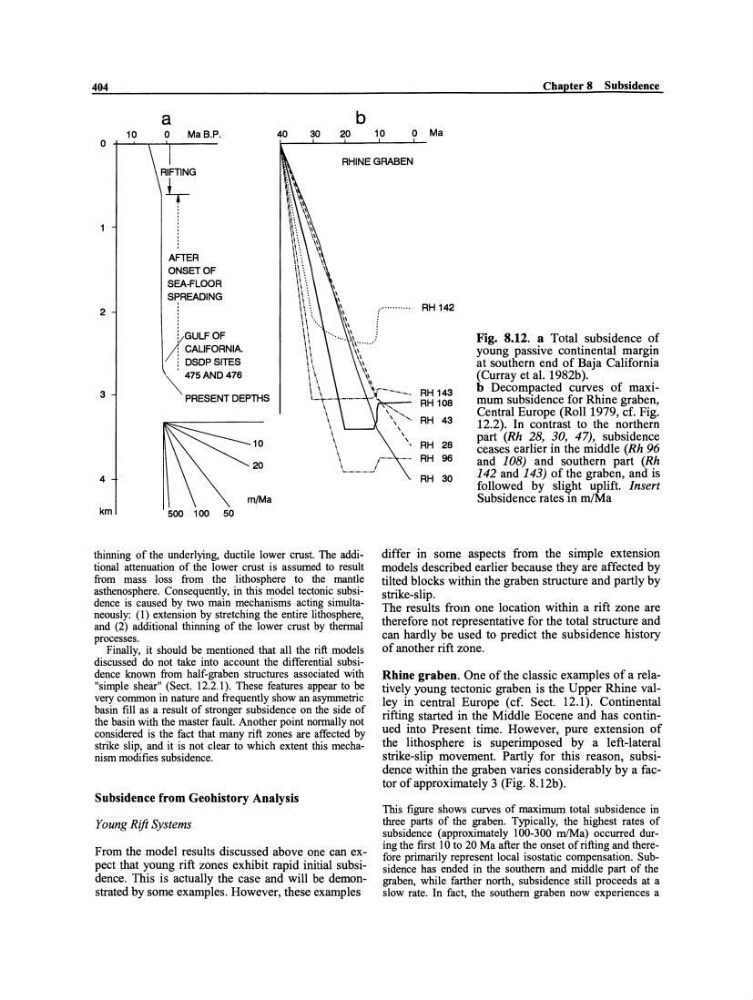
Fig. 8.12. a Total subsidence of
young passive continental margin
at southern end of Baja California
(Curray et al. 1982b).
RH 143
b Decompacted curves of maxiRH 108
mum subsidence for Rhine graben,
RH 43
Central Europe (Roll 1979, cf. Fig.
12.2). In contrast to the northern
part (Rh 28, 30, 47), subsidence
RH 28
\
RH 96
ceases earlier in the middle (Rh 96
/_._ ..
and 108) and southern part (Rh
'-.. _ .. _ .. _ .. ....l/
142 and 143) of the graben, and is
20
4
km
500 100 50
thinning of the underlying, duetile lower erust. The additional attenuation of the lower erust is assumed to result
from mass loss from the lithosphere to the mantle
asthenosphere. Consequently, in this model tectonic subsidence is eaused by two main meehanisms aeting simultaneously: (I) extension by stretching the entire lithosphere,
and (2) additional thinning of the lower erust by thermal
processes.
Finally, it should be mentioned that all the rift models
diseussed do not take into aeeount the differential subsidence known from half-graben struetures associated with
"simple shear" (Seet. 12.2.1). These features appear to be
very common in nature and frequently show an asynnnetrie
basin fill as a result of stronger subsidence on the side of
the basin with the master fault. Another point normally not
considered is the fact that many rift zones are affeeted by
strike slip, and it is not clear to whieh extent this meehani sm modifies subsidence.
Subsidence from Geohistory Analysis
Young Riß Systems
From the model results discussed above one can expect that young rift zones exhibit rapid initial subsidence. This is actually the case and will be demonstrated by some examples. However, these examples
RH 30
followed by slight uplift. Insert
Subsidence rates in m/Ma
differ in some aspects from the simple extension
models described earlier because they are affected by
tilted blocks within the graben structure and partly by
strike-slip.
The results from one location within a rift zone are
therefore not representative for the total structure and
can hardly be used to predict the subsidence history
of another rift zone.
Rhine graben. One of the classic examples of a relatively young tectonic graben is the Upper Rhine valley in central Europe (cf. Sect. 12.1). Continental
rifting started in the Middle Eocene and has continued into Present time. However, pure extension of
the lithosphere is superimposed by a left-Iateral
strike-slip movement. Partly for this reason, sub sidence within the graben varies considerably by a factor of approximately 3 (Fig. 8.12b).
This figure shows eurves of maximum total subsidenee in
three parts of the graben. Typieally, the highest rates of
subsidence (approximately 100-300 mlMa) occurred during the first 10 to 20 Ma after the onset of rifting and therefore primarily represent Ioeal isostatie compensation. Subsidence has ended in the southern and rniddle part of the
graben, while farther north, subsidenee still proeeeds at a
siow rate. In fact, the southern graben now experienees a
Chapter 8 Subsidence
a
b
10
o Ma B.P.
40
30
20
10
o Ma
o
RHINE GRABEN
2
3
AFTER
ONSETOF
SEA-FLOOR
SPREADING
i GULF OF
I CALIFORNIA.
: DSDPSITES
~ 475 AND 476
PRESENT DEPTHS
10
\
' I
\
f············ RH 142
Fig. 8.12. a Total subsidence of
young passive continental margin
at southern end of Baja California
(Curray et al. 1982b).
RH 143
b Decompacted curves of maxiRH 108
mum subsidence for Rhine graben,
RH 43
Central Europe (Roll 1979, cf. Fig.
12.2). In contrast to the northern
part (Rh 28, 30, 47), subsidence
RH 28
\
RH 96
ceases earlier in the middle (Rh 96
/_._ ..
and 108) and southern part (Rh
'-.. _ .. _ .. _ .. ....l/
142 and 143) of the graben, and is
20
4
km
500 100 50
thinning of the underlying, duetile lower erust. The additional attenuation of the lower erust is assumed to result
from mass loss from the lithosphere to the mantle
asthenosphere. Consequently, in this model tectonic subsidence is eaused by two main meehanisms aeting simultaneously: (I) extension by stretching the entire lithosphere,
and (2) additional thinning of the lower erust by thermal
processes.
Finally, it should be mentioned that all the rift models
diseussed do not take into aeeount the differential subsidence known from half-graben struetures associated with
"simple shear" (Seet. 12.2.1). These features appear to be
very common in nature and frequently show an asynnnetrie
basin fill as a result of stronger subsidence on the side of
the basin with the master fault. Another point normally not
considered is the fact that many rift zones are affeeted by
strike slip, and it is not clear to whieh extent this meehani sm modifies subsidence.
Subsidence from Geohistory Analysis
Young Riß Systems
From the model results discussed above one can expect that young rift zones exhibit rapid initial subsidence. This is actually the case and will be demonstrated by some examples. However, these examples
RH 30
followed by slight uplift. Insert
Subsidence rates in m/Ma
differ in some aspects from the simple extension
models described earlier because they are affected by
tilted blocks within the graben structure and partly by
strike-slip.
The results from one location within a rift zone are
therefore not representative for the total structure and
can hardly be used to predict the subsidence history
of another rift zone.
Rhine graben. One of the classic examples of a relatively young tectonic graben is the Upper Rhine valley in central Europe (cf. Sect. 12.1). Continental
rifting started in the Middle Eocene and has continued into Present time. However, pure extension of
the lithosphere is superimposed by a left-Iateral
strike-slip movement. Partly for this reason, sub sidence within the graben varies considerably by a factor of approximately 3 (Fig. 8.12b).
This figure shows eurves of maximum total subsidenee in
three parts of the graben. Typieally, the highest rates of
subsidence (approximately 100-300 mlMa) occurred during the first 10 to 20 Ma after the onset of rifting and therefore primarily represent Ioeal isostatie compensation. Subsidence has ended in the southern and rniddle part of the
graben, while farther north, subsidenee still proeeeds at a
siow rate. In fact, the southern graben now experienees a