

8.3 Rift Basin Models and Observed Subsidence
o
c
d
I
I
401
\
I
\,
I See (a) /~
''---0 -_- ~....J~-O---./ / Il
,-- - - - - -
- -9----' /
·9
I
_l_.......,r - 36- __ ..I
2
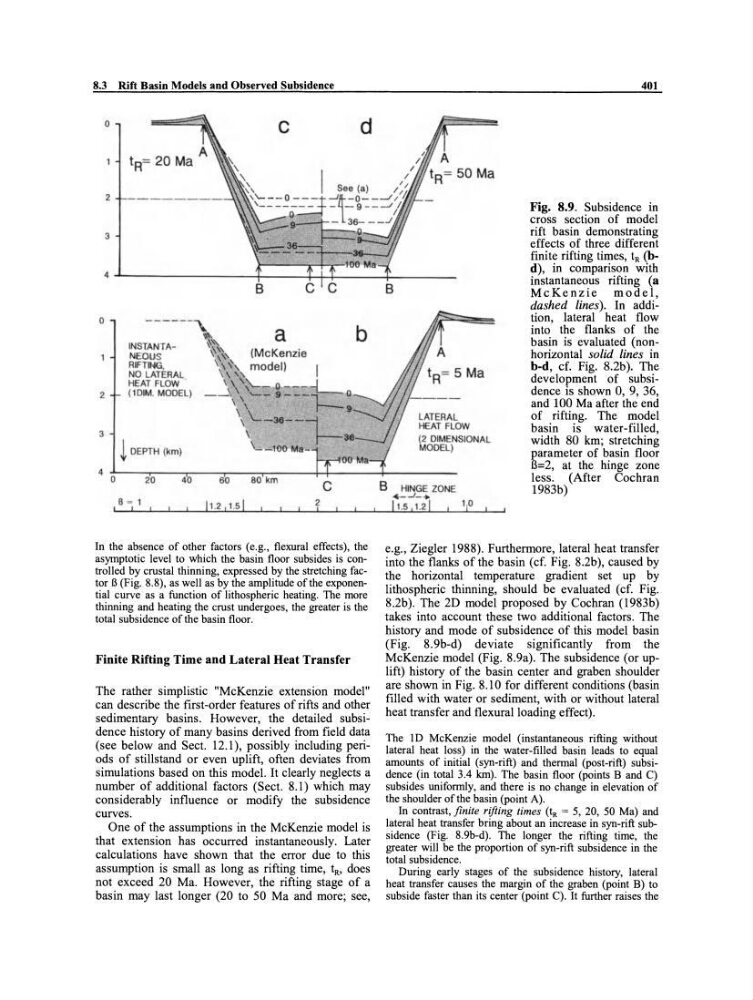
Fig. 8.9. Subsidence in
cross section of model
rift basin demonstrating
effects of three different
finite rifting times, tR (bd), in comparison with
instantaneous rifting (a
McKenzie model,
dashed lines). In addition, lateral heat flow
into the flanks of the
basin is evaluated (nonhorizontal solid lines in
b-d, cf. Fig. 8.2b). The
development of subsidence is shown 0, 9, 36,
and 100 Ma after the end
of rifting. The model
basin is water-filled,
width 80 km; stretching
parameter of basin floor
ß=2, at the hinge zone
less. (After Cochran
1983b)
3
4~----------------t-----4-t4------+-------0
------"
a
b
INSTANT ANEOUS
RIFTING.
NO l ATERAL
HEAT FlOW
2
(101M. MODEL)
3
! DEPTH (km)
4 0
20
40
60
80 km
C
ß = 1
2
11 .2 ,1 .51
I
I
I
In the absence of other factors (e.g., flexural effects), the
asymptotic level to which the basin floor subsides is controlled by crustal thinning, expressed by the stretching factor ß (Fig. 8.8), as weil as by the amplitude ofthe exponential curve as a function of lithospheric heating. The more
thinning and heating the crust undergoes, the greater is the
total subsidence ofthe basin floor.
Finite Rifting Time and Lateral Heat Transfer
The rather simplistic "McKenzie extension model"
can describe the first-order features of rifts and other
sedimentary basins. However, the detailed subsidence history of many basins derived from field data
(see below and Sect. 12.1), possibly including periods of stillstand or even uplift, often deviates from
simulations based on this model. It clearly neglects a
number of additional factors (Sect. 8.1) which may
considerably influence or modify the subsidence
curves.
One of the assumptions in the McKenzie model is
that extension has occurred instantaneously. Later
calculations have shown that the error due to this
assumption is small as long as rifting time, t R , does
not exceed 20 Ma. However, the rifting stage of a
basin may last longer (20 to 50 Ma and more; see,
t R = 5 Ma
l ATERAL
HEAT FlOW
~ DIMENSIONAL
ODEl)
B HINGE ZONE
~_...J_ ..
11 .5 ,1 .21
1.0
I
e.g., Ziegler 1988). Furthermore, lateral heat transfer
into the flanks of the basin (cf. Fig. 8 .2b), caused by
the horizontal temperature gradient set up by
lithospheric thinning, should be evaluated (cf. Fig.
8.2b). The 2D model proposed by Cochran (l983b)
takes into account these two additional factors. The
his tory and mode of subsidence of this model basin
(Fig. 8.9b-d) deviate significantly from the
McKenzie model (Fig. 8.9a). The subsidence (or uplift) history of the basin center and graben shoulder
are shown in Fig. 8.10 for different conditions (basin
filled with water or sediment, with or without lateral
heat transfer and flexuralloading effect).
The ID McKenzie model (instantaneous rifting without
lateral heat loss) in the water-filled basin leads to equal
amounts of initial (syn-rift) and thennal (post-rift) subsidence (in total 3.4 km). The basin floor (points Band C)
subsides unifonnly, and there is no change in elevation of
the shoulder ofthe basin (point A).
In contrast, finite rifting times (tR = 5, 20, 50 Ma) and
lateral heat transfer bring about an increase in syn-rift subsidence (Fig. 8.9b-d). The longer the rifting time, the
greater will be the proportion of syn-rift subsidence in the
total subsidence.
During early stages of the subsidence history, lateral
heat transfer causes the margin of the graben (point B) to
subside faster than its center (point C). It further raises the
o
c
d
I
I
401
\
I
\,
I See (a) /~
''---0 -_- ~....J~-O---./ / Il
,-- - - - - -
- -9----' /
·9
I
_l_.......,r - 36- __ ..I
2
Fig. 8.9. Subsidence in
cross section of model
rift basin demonstrating
effects of three different
finite rifting times, tR (bd), in comparison with
instantaneous rifting (a
McKenzie model,
dashed lines). In addition, lateral heat flow
into the flanks of the
basin is evaluated (nonhorizontal solid lines in
b-d, cf. Fig. 8.2b). The
development of subsidence is shown 0, 9, 36,
and 100 Ma after the end
of rifting. The model
basin is water-filled,
width 80 km; stretching
parameter of basin floor
ß=2, at the hinge zone
less. (After Cochran
1983b)
3
4~----------------t-----4-t4------+-------0
------"
a
b
INSTANT ANEOUS
RIFTING.
NO l ATERAL
HEAT FlOW
2
(101M. MODEL)
3
! DEPTH (km)
4 0
20
40
60
80 km
C
ß = 1
2
11 .2 ,1 .51
I
I
I
In the absence of other factors (e.g., flexural effects), the
asymptotic level to which the basin floor subsides is controlled by crustal thinning, expressed by the stretching factor ß (Fig. 8.8), as weil as by the amplitude ofthe exponential curve as a function of lithospheric heating. The more
thinning and heating the crust undergoes, the greater is the
total subsidence ofthe basin floor.
Finite Rifting Time and Lateral Heat Transfer
The rather simplistic "McKenzie extension model"
can describe the first-order features of rifts and other
sedimentary basins. However, the detailed subsidence history of many basins derived from field data
(see below and Sect. 12.1), possibly including periods of stillstand or even uplift, often deviates from
simulations based on this model. It clearly neglects a
number of additional factors (Sect. 8.1) which may
considerably influence or modify the subsidence
curves.
One of the assumptions in the McKenzie model is
that extension has occurred instantaneously. Later
calculations have shown that the error due to this
assumption is small as long as rifting time, t R , does
not exceed 20 Ma. However, the rifting stage of a
basin may last longer (20 to 50 Ma and more; see,
t R = 5 Ma
l ATERAL
HEAT FlOW
~ DIMENSIONAL
ODEl)
B HINGE ZONE
~_...J_ ..
11 .5 ,1 .21
1.0
I
e.g., Ziegler 1988). Furthermore, lateral heat transfer
into the flanks of the basin (cf. Fig. 8 .2b), caused by
the horizontal temperature gradient set up by
lithospheric thinning, should be evaluated (cf. Fig.
8.2b). The 2D model proposed by Cochran (l983b)
takes into account these two additional factors. The
his tory and mode of subsidence of this model basin
(Fig. 8.9b-d) deviate significantly from the
McKenzie model (Fig. 8.9a). The subsidence (or uplift) history of the basin center and graben shoulder
are shown in Fig. 8.10 for different conditions (basin
filled with water or sediment, with or without lateral
heat transfer and flexuralloading effect).
The ID McKenzie model (instantaneous rifting without
lateral heat loss) in the water-filled basin leads to equal
amounts of initial (syn-rift) and thennal (post-rift) subsidence (in total 3.4 km). The basin floor (points Band C)
subsides unifonnly, and there is no change in elevation of
the shoulder ofthe basin (point A).
In contrast, finite rifting times (tR = 5, 20, 50 Ma) and
lateral heat transfer bring about an increase in syn-rift subsidence (Fig. 8.9b-d). The longer the rifting time, the
greater will be the proportion of syn-rift subsidence in the
total subsidence.
During early stages of the subsidence history, lateral
heat transfer causes the margin of the graben (point B) to
subside faster than its center (point C). It further raises the