

5.6 Paleoceanography
241
ATMOSPHERIC CO 2 CONTROLLED BY WEATHERING
AND THE OCEANIC CARBONATE SYSTEM
SILICATE WEATHERING
b
OCEANIC CARBONATE PUMP:
RELEASE AND UPT AKE OF CO 2
CARBONATE WEATHERING
LOW SEA LEVEL:
DECREASE IN DEPOSITION
AND DISSOLUTION (?)
EMERGED SHELF
RIVERINE Ca 2 +, HC0 3 ', etc.
(± CARBONATE
,
DISSOL.)
~ CO 2 RIVER INPUT
-~
I
::.: . . :.: . . :.: . . :.: . . :.: . . : : :
. . : : : . : : :
. . : : :
. . : : : . : : : . , : : : ' ~ : : " : '
. . .
: . . :- .. ~- - - - - -C-0 2
- - - - - -
- - r - - -- - -- - . - -- - - - - - - - - ~::;1::::::::::
c~~ä·ö~lTE">}:::::.. CO 2
.J CÖ2 - ~"Äur~~~w~~~U~~{~~:~:}:::::
DEPOSITION "'\}\."---- --'<-ceD
~
.i~~~~ONATE DEPOSITION
··:t~I:: . . . . . . . . . . . . . . : . : . : . : . : . : . : . : . ~:;:~:;::::::·:~:·:::H(
.
CARBONATE DISSOLUTION:::::::::::::::::
::::::::::::::::::~CARBONATE DISSOLUTION
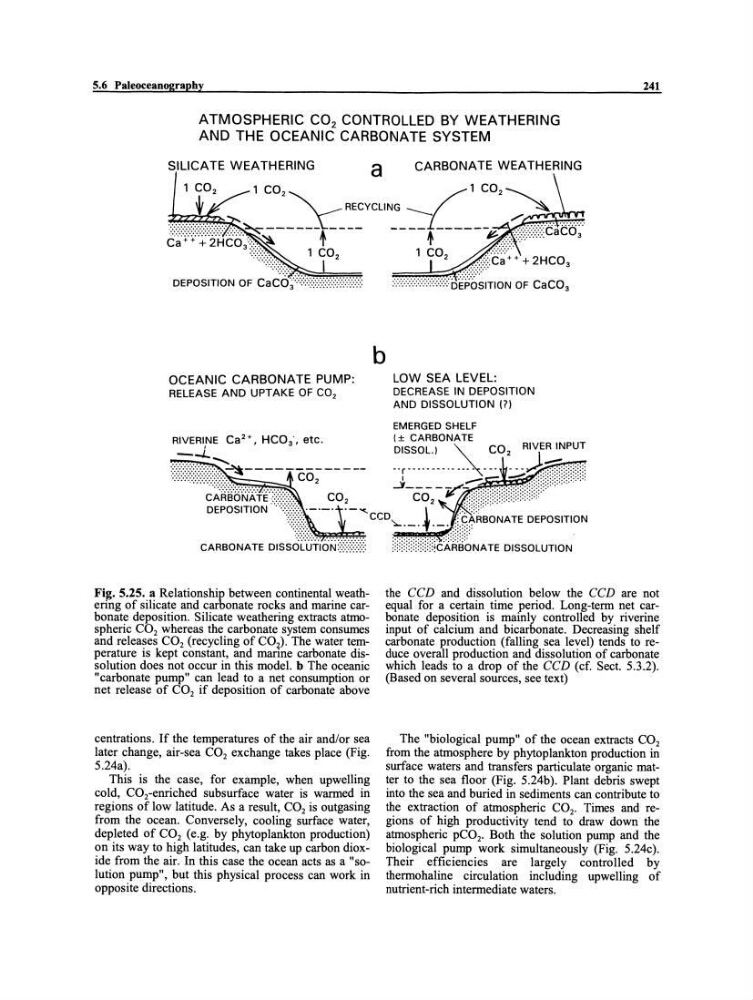
Fig. 5.25. a Relationship between continental weathering of silicate and carbonate rocks and marine carbonate deposition. Silicate weathering extracts atmospheric e02 whereas the carbonate system consumes
and releases CO2 (recycling of CO~). The water temperature is kept constant, and marme carbonate dissolution does not occur in this model. b The oceanic
"carbonate pump" can lead to a net consumption or
net release of e0 2 if deposition of carbonate above
centrations. If the temperatures of the air and/or sea
later change, air-sea e0 2 exchange takes place (Fig.
5.24a).
This is the case, for example, when upwelling
cold, e0 2 -enriched subsurface water is warmed in
regions of low latitude. As a result, e0 2 is outgasing
from the ocean. Conversely, cooling surface water,
depleted of e0 2 (e.g. by phytoplankton production)
on its way to high latitudes, can take up carbon dioxide from the air. In this case the ocean acts as a "solution pump", but this physical process can work in
opposite directions.
the CCD and dissolution below the CCD are not
equal for a certain time period. Long-term net carbonate deposition is mamly controlled by riverine
input of calcium and bicarbonate. Decreasing shelf
carbonate production (falling sea level) tends to reduce overall production and dissolution of carbonate
which leads to a drop of the CCD (cf. Sect. 5.3.2).
(Based on several sources, see text)
The "biological pump" of the ocean extracts e0 2
from the atmosphere by phytoplankton production in
surface waters and transfers particulate organic matter to the sea floor (Fig. 5.24b). Plant debris swept
into the sea and buried in sediments can contribute to
the extraction of atmospheric eo 2 • Times and regions of high productivity tend to draw down the
atmospheric peo 2 • Both the solution pump and the
biological pump work simultaneously (Fig. 5.24c).
Their efficiencies are largely controlled by
thermohaline circulation including upwelling of
nutrient-rich intermediate waters.
241
ATMOSPHERIC CO 2 CONTROLLED BY WEATHERING
AND THE OCEANIC CARBONATE SYSTEM
SILICATE WEATHERING
b
OCEANIC CARBONATE PUMP:
RELEASE AND UPT AKE OF CO 2
CARBONATE WEATHERING
LOW SEA LEVEL:
DECREASE IN DEPOSITION
AND DISSOLUTION (?)
EMERGED SHELF
RIVERINE Ca 2 +, HC0 3 ', etc.
(± CARBONATE
,
DISSOL.)
~ CO 2 RIVER INPUT
-~
I
::.: . . :.: . . :.: . . :.: . . :.: . . : : :
. . : : : . : : :
. . : : :
. . : : : . : : : . , : : : ' ~ : : " : '
. . .
: . . :- .. ~- - - - - -C-0 2
- - - - - -
- - r - - -- - -- - . - -- - - - - - - - - ~::;1::::::::::
c~~ä·ö~lTE">}:::::.. CO 2
.J CÖ2 - ~"Äur~~~w~~~U~~{~~:~:}:::::
DEPOSITION "'\}\."---- --'<-ceD
~
.i~~~~ONATE DEPOSITION
··:t~I:: . . . . . . . . . . . . . . : . : . : . : . : . : . : . : . ~:;:~:;::::::·:~:·:::H(
.
CARBONATE DISSOLUTION:::::::::::::::::
::::::::::::::::::~CARBONATE DISSOLUTION
Fig. 5.25. a Relationship between continental weathering of silicate and carbonate rocks and marine carbonate deposition. Silicate weathering extracts atmospheric e02 whereas the carbonate system consumes
and releases CO2 (recycling of CO~). The water temperature is kept constant, and marme carbonate dissolution does not occur in this model. b The oceanic
"carbonate pump" can lead to a net consumption or
net release of e0 2 if deposition of carbonate above
centrations. If the temperatures of the air and/or sea
later change, air-sea e0 2 exchange takes place (Fig.
5.24a).
This is the case, for example, when upwelling
cold, e0 2 -enriched subsurface water is warmed in
regions of low latitude. As a result, e0 2 is outgasing
from the ocean. Conversely, cooling surface water,
depleted of e0 2 (e.g. by phytoplankton production)
on its way to high latitudes, can take up carbon dioxide from the air. In this case the ocean acts as a "solution pump", but this physical process can work in
opposite directions.
the CCD and dissolution below the CCD are not
equal for a certain time period. Long-term net carbonate deposition is mamly controlled by riverine
input of calcium and bicarbonate. Decreasing shelf
carbonate production (falling sea level) tends to reduce overall production and dissolution of carbonate
which leads to a drop of the CCD (cf. Sect. 5.3.2).
(Based on several sources, see text)
The "biological pump" of the ocean extracts e0 2
from the atmosphere by phytoplankton production in
surface waters and transfers particulate organic matter to the sea floor (Fig. 5.24b). Plant debris swept
into the sea and buried in sediments can contribute to
the extraction of atmospheric eo 2 • Times and regions of high productivity tend to draw down the
atmospheric peo 2 • Both the solution pump and the
biological pump work simultaneously (Fig. 5.24c).
Their efficiencies are largely controlled by
thermohaline circulation including upwelling of
nutrient-rich intermediate waters.