

242
Chapter 5 Oceanic Sediments
FRACTIONATION OF STABLE ISOTOPES IN THE OCEAN
OXYGEN ISOTOPES
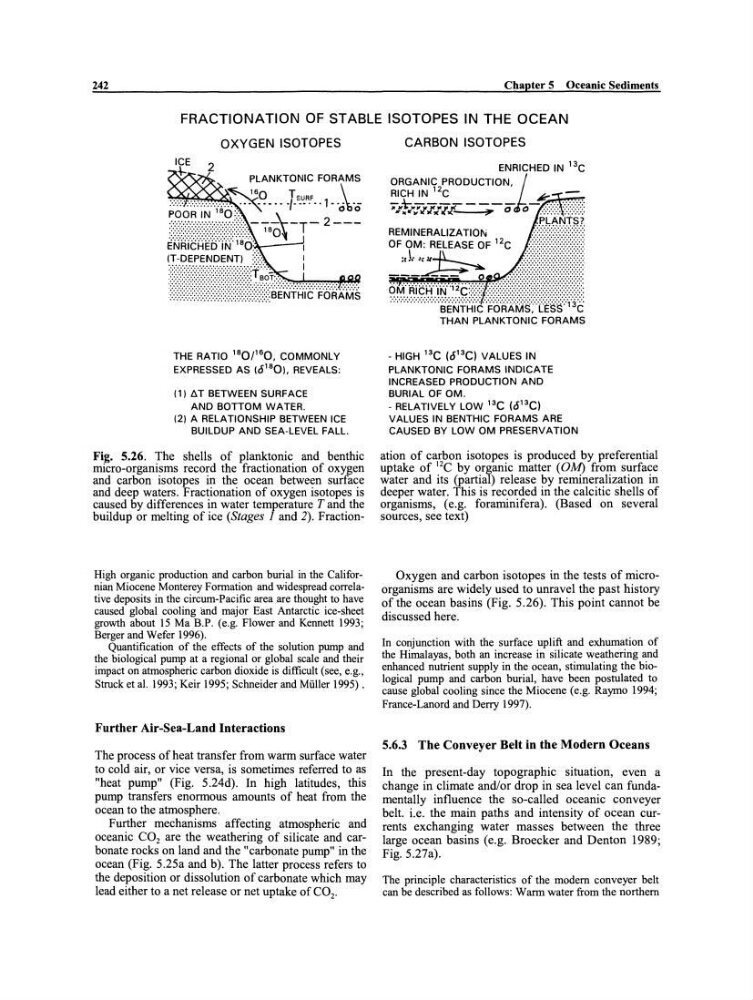
THE RATIO 180rSO, COMMONlV
EXPRESSED AS (0 18 0), REVEAlS:
(1) t.T BETWEEN SURFACE
AND BOTTOM WATER.
(2) A RELATIONSHIP BETWEEN ICE
BUllDUP AND SEA-lEVEl FAll.
Fig. 5.26. The shells of planktonic and benthic
micro-organisms record the fractionation of oxygen
and carbon isotopes in the ocean between surface
and deep waters. Fractionation of oxygen isotopes is
caused by differences in water temperature T and the
buildup or melting of ice (Stages 1 and 2). FractionHigh organic production and carbon burial in the Californian Miocene Monterey Formation and widespread correlative deposits in the circum-Pacific area are thought to have
caused global cooling imd major East Antarctic ice-sheet
growth about 15 Ma B.P. (e.g. Flower and Kennett 1993;
Berger and Wefer 1996).
Quantification of the effects of the solution pump and
the biological pump at a regional or global scale and their
impact on atmospheric carbon dioxide is difficult (see, e.g.,
Struck et al. 1993; Keir 1995; Schneider and Müller 1995) .
Further Air-Sea-Land Interactions
The process of heat transfer from warm surface water
to cold air, or vice versa, is sometimes referred to as
"heat pump" (Fig. 5.24d). In high latitudes, this
pump transfers enormous amounts of heat from the
ocean to the atmosphere.
Further mechanisrns affecting atmospheric and
oceanic CO2 are the weathering of silicate and carbonate rocks on land and the "carbonate pump" in the
ocean (Fig. 5.25a and b). The latter process refers to
the deposition or dissolution of carbonate which may
lead either to a net release or net uptake of CO 2 •
CARBON ISOTOPES
- HIGH 13C (0 13 C) VAlUES IN
PlANKTONIC FORAMS INDICATE
INCREASED PRODUCTION AND
BURIAl OF OM.
- RElATIVElV lOW 13C (0 13 C)
VAlUES IN BENTHIC FORAMS ARE
CAUSED BV lOW OM PRESERVATION
ation of carbon isotopes is produced by preferential
uptake of 12C by organic matter (DM) from surface
water and its (partial) release by remineralization in
deeper water. This is recorded in the calcitic shells of
organisms, (e.g. forarninifera). (Based on several
sources, see text)
Oxygen and carbon isotopes in the tests of microorganisms are widely used to unravel the past his tory
of the ocean basins (Fig. 5.26). This point cannot be
discussed here.
In conjunction with the surface uplift and exhumation of
the Hirnalayas, both an increase in silicate weathering and
enhanced nutrient supply in the ocean, stimulating the biological pump and carbon burial, have been postulated to
cause global cooling since the Miocene (e.g. Raymo 1994;
France-Lanord and Derry 1997).
5.6.3 The Conveyer BeIt in the Modern Oceans
In the present-day topographie situation, even a
change in climate andlor drop in sea level can fundamentally influence the so-called oceanic conveyer
belt. i.e. the main paths and intensity of ocean currents exchanging water masses between the three
large ocean basins (e.g. Broecker and Denton 1989;
Fig. 5.27a).
The principle characteristics of the modem conveyer belt
can be described as folIows: Warm water from the northem
Chapter 5 Oceanic Sediments
FRACTIONATION OF STABLE ISOTOPES IN THE OCEAN
OXYGEN ISOTOPES
THE RATIO 180rSO, COMMONlV
EXPRESSED AS (0 18 0), REVEAlS:
(1) t.T BETWEEN SURFACE
AND BOTTOM WATER.
(2) A RELATIONSHIP BETWEEN ICE
BUllDUP AND SEA-lEVEl FAll.
Fig. 5.26. The shells of planktonic and benthic
micro-organisms record the fractionation of oxygen
and carbon isotopes in the ocean between surface
and deep waters. Fractionation of oxygen isotopes is
caused by differences in water temperature T and the
buildup or melting of ice (Stages 1 and 2). FractionHigh organic production and carbon burial in the Californian Miocene Monterey Formation and widespread correlative deposits in the circum-Pacific area are thought to have
caused global cooling imd major East Antarctic ice-sheet
growth about 15 Ma B.P. (e.g. Flower and Kennett 1993;
Berger and Wefer 1996).
Quantification of the effects of the solution pump and
the biological pump at a regional or global scale and their
impact on atmospheric carbon dioxide is difficult (see, e.g.,
Struck et al. 1993; Keir 1995; Schneider and Müller 1995) .
Further Air-Sea-Land Interactions
The process of heat transfer from warm surface water
to cold air, or vice versa, is sometimes referred to as
"heat pump" (Fig. 5.24d). In high latitudes, this
pump transfers enormous amounts of heat from the
ocean to the atmosphere.
Further mechanisrns affecting atmospheric and
oceanic CO2 are the weathering of silicate and carbonate rocks on land and the "carbonate pump" in the
ocean (Fig. 5.25a and b). The latter process refers to
the deposition or dissolution of carbonate which may
lead either to a net release or net uptake of CO 2 •
CARBON ISOTOPES
- HIGH 13C (0 13 C) VAlUES IN
PlANKTONIC FORAMS INDICATE
INCREASED PRODUCTION AND
BURIAl OF OM.
- RElATIVElV lOW 13C (0 13 C)
VAlUES IN BENTHIC FORAMS ARE
CAUSED BV lOW OM PRESERVATION
ation of carbon isotopes is produced by preferential
uptake of 12C by organic matter (DM) from surface
water and its (partial) release by remineralization in
deeper water. This is recorded in the calcitic shells of
organisms, (e.g. forarninifera). (Based on several
sources, see text)
Oxygen and carbon isotopes in the tests of microorganisms are widely used to unravel the past his tory
of the ocean basins (Fig. 5.26). This point cannot be
discussed here.
In conjunction with the surface uplift and exhumation of
the Hirnalayas, both an increase in silicate weathering and
enhanced nutrient supply in the ocean, stimulating the biological pump and carbon burial, have been postulated to
cause global cooling since the Miocene (e.g. Raymo 1994;
France-Lanord and Derry 1997).
5.6.3 The Conveyer BeIt in the Modern Oceans
In the present-day topographie situation, even a
change in climate andlor drop in sea level can fundamentally influence the so-called oceanic conveyer
belt. i.e. the main paths and intensity of ocean currents exchanging water masses between the three
large ocean basins (e.g. Broecker and Denton 1989;
Fig. 5.27a).
The principle characteristics of the modem conveyer belt
can be described as folIows: Warm water from the northem