

162
H.Grann
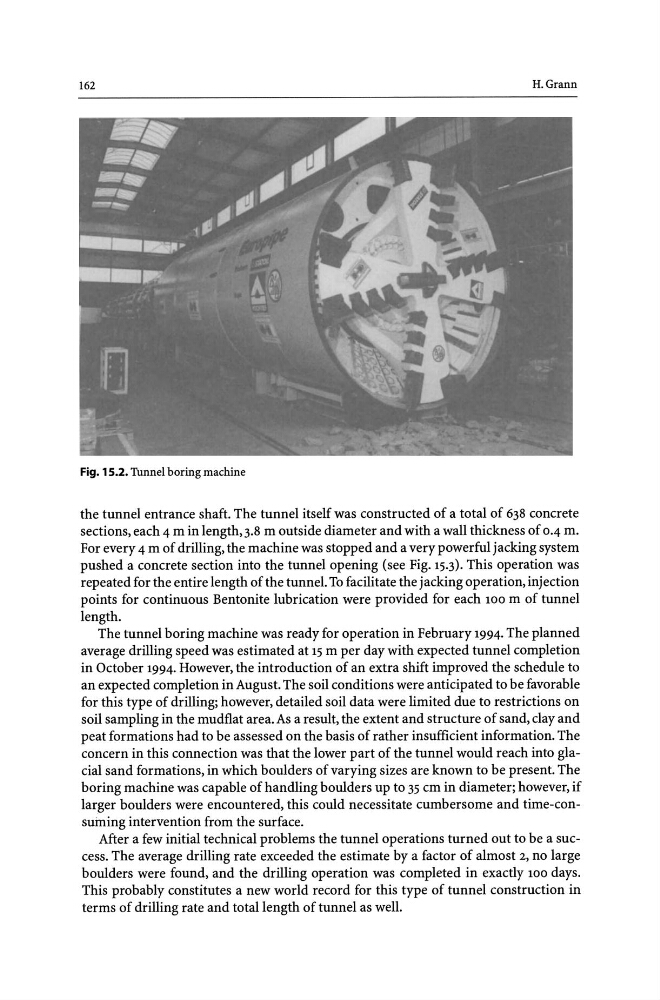
Fig. 1 S.2. Tunnel boring machine
the tunnel entrance shaft. The tunnel itself was constructed of a total of 638 concrete
sections, each 4 m in length, 3.8 m outside diameter and with a wall thickness of 0.4 m.
For every 4 m of drilling, the machine was stopped and a very powerful jacking system
pushed a concrete section into the tunnel opening (see Fig. 15.3). This operation was
repeated for the entire length of the tunnel. To facilitate the jacking operation, injection
points for continuous Bentonite lubrication were provided for each 100 m of tunnel
length.
The tunnel boring machine was ready for operation in February 1994. The planned
average drilling speed was estimated at 15 m per day with expected tunnel completion
in October 1994. However, the introduction of an extra shift improved the schedule to
an expected completion in August. The soil conditions were anticipated to be favorable
for this type of drilling; however, detailed soil data were limited due to restrictions on
soil sampling in the mudflat area. As a result, the extent and structure of sand, clay and
peat formations had to be assessed on the basis of rather insufficient information. The
concern in this connection was that the lower part of the tunnel would reach into glacial sand formations, in which boulders of varying sizes are known to be present. The
boring machine was capable of handling boulders up to 35 cm in diameter; however, if
larger boulders were encountered, this could necessitate cumbersome and time-consuming intervention from the surface.
After a few initial technical problems the tunnel operations turned out to be a success. The average drilling rate exceeded the estimate by a factor of almost 2, no large
boulders were found, and the drilling operation was completed in exactly 100 days.
This probably constitutes a new world record for this type of tunnel construction in
terms of drilling rate and total length of tunnel as well.
H.Grann
Fig. 1 S.2. Tunnel boring machine
the tunnel entrance shaft. The tunnel itself was constructed of a total of 638 concrete
sections, each 4 m in length, 3.8 m outside diameter and with a wall thickness of 0.4 m.
For every 4 m of drilling, the machine was stopped and a very powerful jacking system
pushed a concrete section into the tunnel opening (see Fig. 15.3). This operation was
repeated for the entire length of the tunnel. To facilitate the jacking operation, injection
points for continuous Bentonite lubrication were provided for each 100 m of tunnel
length.
The tunnel boring machine was ready for operation in February 1994. The planned
average drilling speed was estimated at 15 m per day with expected tunnel completion
in October 1994. However, the introduction of an extra shift improved the schedule to
an expected completion in August. The soil conditions were anticipated to be favorable
for this type of drilling; however, detailed soil data were limited due to restrictions on
soil sampling in the mudflat area. As a result, the extent and structure of sand, clay and
peat formations had to be assessed on the basis of rather insufficient information. The
concern in this connection was that the lower part of the tunnel would reach into glacial sand formations, in which boulders of varying sizes are known to be present. The
boring machine was capable of handling boulders up to 35 cm in diameter; however, if
larger boulders were encountered, this could necessitate cumbersome and time-consuming intervention from the surface.
After a few initial technical problems the tunnel operations turned out to be a success. The average drilling rate exceeded the estimate by a factor of almost 2, no large
boulders were found, and the drilling operation was completed in exactly 100 days.
This probably constitutes a new world record for this type of tunnel construction in
terms of drilling rate and total length of tunnel as well.