

, 3 Economics and Project Management in the Coastal Zone
149
the existing and likely continuing heavy usage pressures on coastal areas, a principle of
sustainable utilisation of resources is a reasonable guiding concept. The resource base
includes produced capital, human capital and natural capital assets such as raw materials, waste receptors, landscape and amenity assets.
The 'constant capital' condition for sustainable development can be interpreted in a
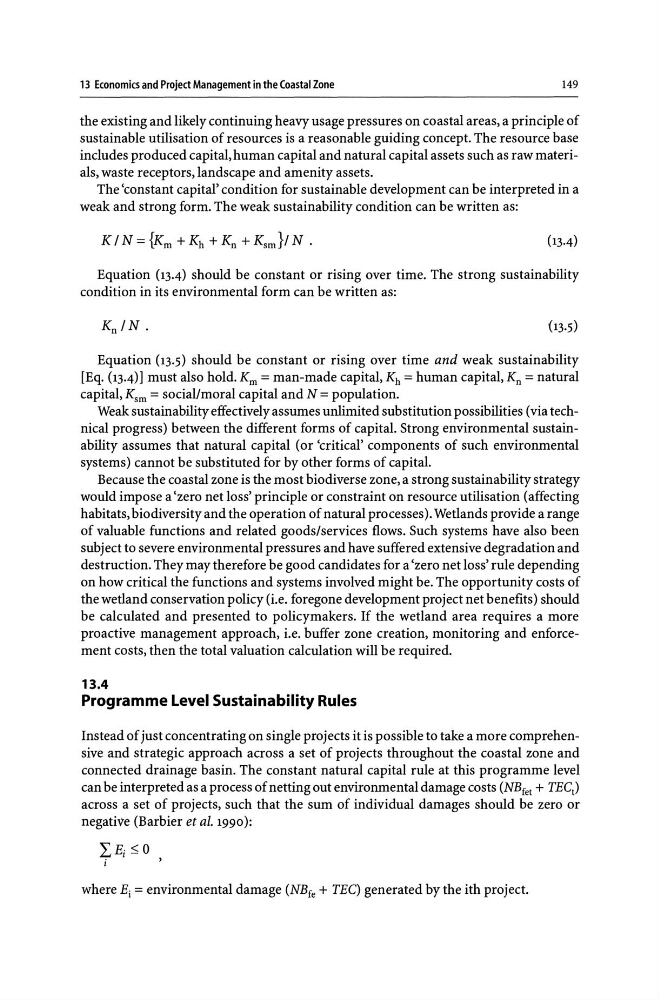
weak and strong form. The weak sustainability condition can be written as:
Equation (13.4) should be constant or rising over time. The strong sustainability
condition in its environmental form can be written as:
(13·5)
Equation (13.5) should be constant or rising over time and weak sustainability
[Eq. (13.4)] must also hold. Km = man-made capital, Kh = human capital, Kn = natural
capital, Ksm = social/moral capital and N = population.
Weak sustainability effectively assumes unlimited substitution possibilities (via technical progress) between the different forms of capital. Strong environmental sustainability assumes that natural capital (or 'critical' components of such environmental
systems) cannot be substituted for by other forms of capital.
Because the coastal zone is the most biodiverse zone, a strong sustainability strategy
would impose a 'zero net loss' principle or constraint on resource utilisation (affecting
habitats, biodiversity and the operation of natural processes). Wetlands provide a range
of valuable functions and related goods/services flows. Such systems have also been
subject to severe environmental pressures and have suffered extensive degradation and
destruction. They may therefore be good candidates for a 'zero net loss' rule depending
on how critical the functions and systems involved might be. The opportunity costs of
the wetland conservation policy (i.e. foregone development project net benefits) should
be calculated and presented to policymakers. If the wetland area requires a more
proactive management approach, i.e. buffer zone creation, monitoring and enforcement costs, then the total valuation calculation will be required.
13.4
Programme Level Sustainability Rules
Instead of just concentrating on single projects it is possible to take a more comprehensive and strategic approach across a set of projects throughout the coastal zone and
connected drainage basin. The constant natural capital rule at this programme level
can be interpreted as a process of netting out environmental damage costs (NB fet + TEG t )
across a set of projects, such that the sum of individual damages should be zero or
negative (Barbier et al. 1990):
LEi $0
i
where Ej = environmental damage (NB fe + TEG) generated by the ith project.
149
the existing and likely continuing heavy usage pressures on coastal areas, a principle of
sustainable utilisation of resources is a reasonable guiding concept. The resource base
includes produced capital, human capital and natural capital assets such as raw materials, waste receptors, landscape and amenity assets.
The 'constant capital' condition for sustainable development can be interpreted in a
weak and strong form. The weak sustainability condition can be written as:
Equation (13.4) should be constant or rising over time. The strong sustainability
condition in its environmental form can be written as:
(13·5)
Equation (13.5) should be constant or rising over time and weak sustainability
[Eq. (13.4)] must also hold. Km = man-made capital, Kh = human capital, Kn = natural
capital, Ksm = social/moral capital and N = population.
Weak sustainability effectively assumes unlimited substitution possibilities (via technical progress) between the different forms of capital. Strong environmental sustainability assumes that natural capital (or 'critical' components of such environmental
systems) cannot be substituted for by other forms of capital.
Because the coastal zone is the most biodiverse zone, a strong sustainability strategy
would impose a 'zero net loss' principle or constraint on resource utilisation (affecting
habitats, biodiversity and the operation of natural processes). Wetlands provide a range
of valuable functions and related goods/services flows. Such systems have also been
subject to severe environmental pressures and have suffered extensive degradation and
destruction. They may therefore be good candidates for a 'zero net loss' rule depending
on how critical the functions and systems involved might be. The opportunity costs of
the wetland conservation policy (i.e. foregone development project net benefits) should
be calculated and presented to policymakers. If the wetland area requires a more
proactive management approach, i.e. buffer zone creation, monitoring and enforcement costs, then the total valuation calculation will be required.
13.4
Programme Level Sustainability Rules
Instead of just concentrating on single projects it is possible to take a more comprehensive and strategic approach across a set of projects throughout the coastal zone and
connected drainage basin. The constant natural capital rule at this programme level
can be interpreted as a process of netting out environmental damage costs (NB fet + TEG t )
across a set of projects, such that the sum of individual damages should be zero or
negative (Barbier et al. 1990):
LEi $0
i
where Ej = environmental damage (NB fe + TEG) generated by the ith project.