

148
I
Mitigation Benefits
Enhancement Benefits
Preservation Benefits
Option Benefits
Existence Benefits
I
R.K. Turner
I
Total Use Values (TUV)
Total Non·Use Values (TNUV)
rl --------+1--------'1
Direct Use Values
Indirect Use Values
Option Values
I
(Functional Values)
I
e.g. fish
fI 'd
I
• insurance
fuelwood
e.g. 00 contro
value of
recreation
storm protection
preserving
rtf
cycling
.
f
transpo
waste assimilation
options or
navigation
sedimentation
use
habitat loss reduction
Quasi-option"
I
value of increased
information in the
future natural
laboratory
Valuation Methods
Market analysis:
Valuation Methods
Damage costs avoided
Preventive expenditures;
Value of changes in
productivity;
Valuation Methods
CVM
Other non-market
valuation methods
(TCM, CVM, HP)
(laC); (IS)
(Relocation costs)
(Replacement costs)
1
Existence Bequest
I
value derived from just
knowing a speccies or
system is conserved
• value of passin on
natural assets 'intact'
to future generations
• 'moral rt!source' value
motivations
Valuation Methods
CVM'
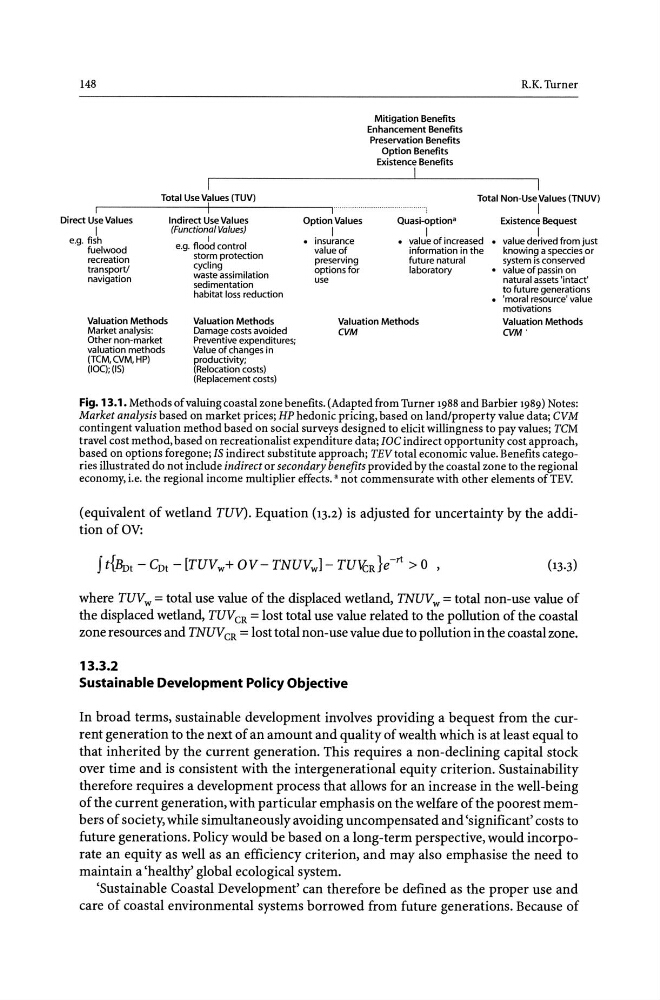
Fig. 13.1. Methods of valuing coastal zone benefits. (Adapted from Turner 1988 and Barbier 1989) Notes:
Market analysis based on market prices; HP hedonic pricing, based on land/property value data; CVM
contingent valuation method based on social surveys designed to elicit willingness to pay values; TCM
travel cost method, based on recreationalist expenditure data; lOG indirect opportunity cost approach,
based on options foregone; IS indirect substitute approach; TEV total economic value. Benefits categories illustrated do not include indirect or secondary benefits provided by the coastal zone to the regional
economy, i.e. the regional income multiplier effects. a not commensurate with other elements of TEV.
(equivalent of wetland TUV). Equation (13.2) is adjusted for uncertainty by the addition ofOV:
f t{B Dt - C Dt - [TUV w + 0 V - TNUV w ]- TUifR}e -rt > 0 ,
where TUV w = total use value of ilie displaced wetland, TNUV w = total non-use value of
ilie displaced wetland, TUV CR = lost total use value related to ilie pollution of ilie coastal
zone resources and TNUV CR = losttotal non-use value due to pollution in ilie coastal zone.
13.3.2
Sustainable Development Policy Objective
In broad terms, sustainable development involves providing a bequest from the current generation to the next of an amount and quality of wealth which is at least equal to
iliat inherited by ilie current generation. This requires a non-declining capital stock
over time and is consistent with ilie intergenerational equity criterion. Sustainability
therefore requires a development process that allows for an increase in ilie well-being
of the current generation, with particular emphasis on the welfare of ilie poorest members of society, while simultaneously avoiding uncompensated and 'significant' costs to
future generations. Policy would be based on a long-term perspective, would incorporate an equity as well as an efficiency criterion, and may also emphasise the need to
maintain a 'healthy' global ecological system.
'Sustainable Coastal Development' can ilierefore be defmed as the proper use and
care of coastal environmental systems borrowed from future generations. Because of
I
Mitigation Benefits
Enhancement Benefits
Preservation Benefits
Option Benefits
Existence Benefits
I
R.K. Turner
I
Total Use Values (TUV)
Total Non·Use Values (TNUV)
rl --------+1--------'1
Direct Use Values
Indirect Use Values
Option Values
I
(Functional Values)
I
e.g. fish
fI 'd
I
• insurance
fuelwood
e.g. 00 contro
value of
recreation
storm protection
preserving
rtf
cycling
.
f
transpo
waste assimilation
options or
navigation
sedimentation
use
habitat loss reduction
Quasi-option"
I
value of increased
information in the
future natural
laboratory
Valuation Methods
Market analysis:
Valuation Methods
Damage costs avoided
Preventive expenditures;
Value of changes in
productivity;
Valuation Methods
CVM
Other non-market
valuation methods
(TCM, CVM, HP)
(laC); (IS)
(Relocation costs)
(Replacement costs)
1
Existence Bequest
I
value derived from just
knowing a speccies or
system is conserved
• value of passin on
natural assets 'intact'
to future generations
• 'moral rt!source' value
motivations
Valuation Methods
CVM'
Fig. 13.1. Methods of valuing coastal zone benefits. (Adapted from Turner 1988 and Barbier 1989) Notes:
Market analysis based on market prices; HP hedonic pricing, based on land/property value data; CVM
contingent valuation method based on social surveys designed to elicit willingness to pay values; TCM
travel cost method, based on recreationalist expenditure data; lOG indirect opportunity cost approach,
based on options foregone; IS indirect substitute approach; TEV total economic value. Benefits categories illustrated do not include indirect or secondary benefits provided by the coastal zone to the regional
economy, i.e. the regional income multiplier effects. a not commensurate with other elements of TEV.
(equivalent of wetland TUV). Equation (13.2) is adjusted for uncertainty by the addition ofOV:
f t{B Dt - C Dt - [TUV w + 0 V - TNUV w ]- TUifR}e -rt > 0 ,
where TUV w = total use value of ilie displaced wetland, TNUV w = total non-use value of
ilie displaced wetland, TUV CR = lost total use value related to ilie pollution of ilie coastal
zone resources and TNUV CR = losttotal non-use value due to pollution in ilie coastal zone.
13.3.2
Sustainable Development Policy Objective
In broad terms, sustainable development involves providing a bequest from the current generation to the next of an amount and quality of wealth which is at least equal to
iliat inherited by ilie current generation. This requires a non-declining capital stock
over time and is consistent with ilie intergenerational equity criterion. Sustainability
therefore requires a development process that allows for an increase in ilie well-being
of the current generation, with particular emphasis on the welfare of ilie poorest members of society, while simultaneously avoiding uncompensated and 'significant' costs to
future generations. Policy would be based on a long-term perspective, would incorporate an equity as well as an efficiency criterion, and may also emphasise the need to
maintain a 'healthy' global ecological system.
'Sustainable Coastal Development' can ilierefore be defmed as the proper use and
care of coastal environmental systems borrowed from future generations. Because of