

150
R.K. Turner Economics and Project Management in the Coastal Zone
Under a strong sustainability rule, LEi is constrained to be non positive for each
period of time. If it is not feasible for Ei to be zero or negative for all projects, it may be
possible to include within any portfolio of projects one or more shadow projects. These
shadow projects aim to compensate for the environmental damage generated by the
existing/planned set of projects, and are not subject to normal cost-benefit rules. Thus,
the loss of a wetland at some particular location may be compensated for by wetland
relocation, creation or restoration investments elsewhere in the zone.
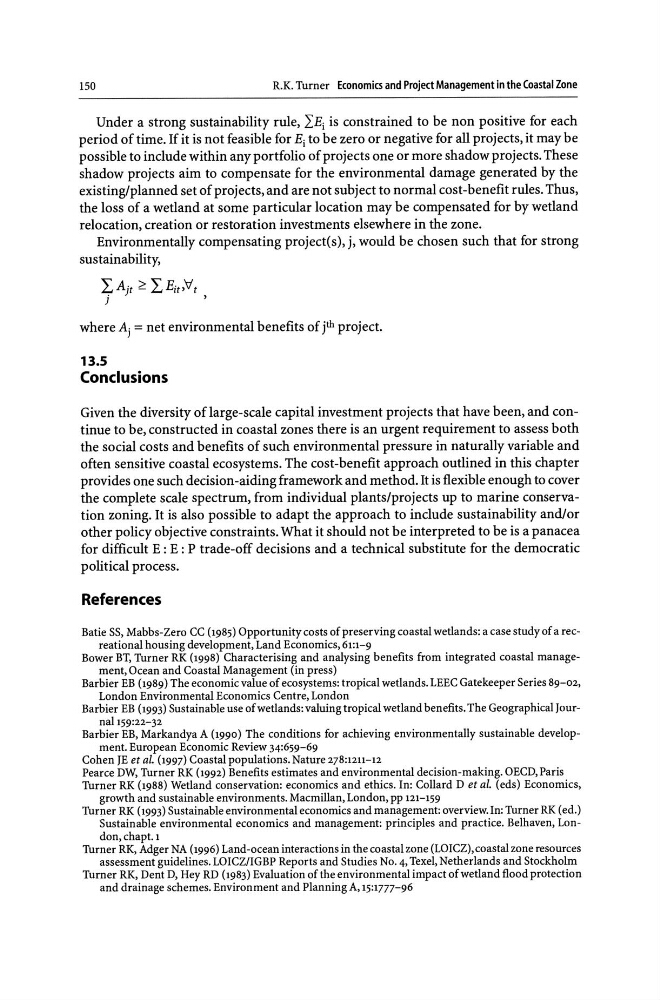
Environmentally compensating project(s), j, would be chosen such that for strong
sustainability,
~Ajt ~ ~Eit>Vt
j
,
where Aj = net environmental benefits of jth project.
13.S
Conclusions
Given the diversity of large-scale capital investment projects that have been, and continue to be, constructed in coastal zones there is an urgent requirement to assess both
the social costs and benefits of such environmental pressure in naturally variable and
often sensitive coastal ecosystems. The cost-benefit approach outlined in this chapter
provides one such decision-aiding framework and method. It is flexible enough to cover
the complete scale spectrum, from individual plants/projects up to marine conservation zoning. It is also possible to adapt the approach to include sustainability and/or
other policy objective constraints. What it should not be interpreted to be is a panacea
for difficult E : E : P trade-off decisions and a technical substitute for the democratic
political process.
References
Batie SS, Mabbs-Zero CC (1985) Opportunity costs of preserving coastal wetlands: a case study of a recreational housing development, Land Economics, 61:1-9
Bower BT, Turner RK (1998) Characterising and analysing benefits from integrated coastal management, Ocean and Coastal Management (in press)
Barbier EB (1989) The economic value of ecosystems: tropical wetlands. LEEC Gatekeeper Series 89-02,
London Environmental Economics Centre, London
Barbier EB (1993) Sustainable use of wetlands: valuing tropical wetland benefits. The Geographical Journal159:22-32
Barbier EB, Markandya A (1990) The conditions for achieving environmentally sustainable development. European Economic Review 34:659-69
Cohen JE et al. (1997) Coastal populations. Nature 278:1211-12
Pearce DW, Turner RK (1992) Benefits estimates and environmental decision-making. OECD, Paris
Turner RK (1988) Wetland conservation: economics and ethics. In: Collard D et al. (eds) Economics,
growth and sustainable environments. Macmillan, London, pp 121-159
Turner RK (1993) Sustainable environmental economics and management: overview. In: Turner RK (ed.)
Sustainable environmental economics and management: principles and practice. Belhaven, London, chapt. 1
Turner RK, Adger NA (1996) Land-ocean interactions in ilie coastal zone (LOICZ),coastal zone resources
assessment guidelines. LOICZ/IGBP Reports and Studies NO.4, Texel, Neilierlands and Stockholm
Turner RK, Dent D, Hey RD (1983) Evaluation of ilie environmental impact of wetland flood protection
and drainage schemes. Environment and Planning A, 15:1777-96
R.K. Turner Economics and Project Management in the Coastal Zone
Under a strong sustainability rule, LEi is constrained to be non positive for each
period of time. If it is not feasible for Ei to be zero or negative for all projects, it may be
possible to include within any portfolio of projects one or more shadow projects. These
shadow projects aim to compensate for the environmental damage generated by the
existing/planned set of projects, and are not subject to normal cost-benefit rules. Thus,
the loss of a wetland at some particular location may be compensated for by wetland
relocation, creation or restoration investments elsewhere in the zone.
Environmentally compensating project(s), j, would be chosen such that for strong
sustainability,
~Ajt ~ ~Eit>Vt
j
,
where Aj = net environmental benefits of jth project.
13.S
Conclusions
Given the diversity of large-scale capital investment projects that have been, and continue to be, constructed in coastal zones there is an urgent requirement to assess both
the social costs and benefits of such environmental pressure in naturally variable and
often sensitive coastal ecosystems. The cost-benefit approach outlined in this chapter
provides one such decision-aiding framework and method. It is flexible enough to cover
the complete scale spectrum, from individual plants/projects up to marine conservation zoning. It is also possible to adapt the approach to include sustainability and/or
other policy objective constraints. What it should not be interpreted to be is a panacea
for difficult E : E : P trade-off decisions and a technical substitute for the democratic
political process.
References
Batie SS, Mabbs-Zero CC (1985) Opportunity costs of preserving coastal wetlands: a case study of a recreational housing development, Land Economics, 61:1-9
Bower BT, Turner RK (1998) Characterising and analysing benefits from integrated coastal management, Ocean and Coastal Management (in press)
Barbier EB (1989) The economic value of ecosystems: tropical wetlands. LEEC Gatekeeper Series 89-02,
London Environmental Economics Centre, London
Barbier EB (1993) Sustainable use of wetlands: valuing tropical wetland benefits. The Geographical Journal159:22-32
Barbier EB, Markandya A (1990) The conditions for achieving environmentally sustainable development. European Economic Review 34:659-69
Cohen JE et al. (1997) Coastal populations. Nature 278:1211-12
Pearce DW, Turner RK (1992) Benefits estimates and environmental decision-making. OECD, Paris
Turner RK (1988) Wetland conservation: economics and ethics. In: Collard D et al. (eds) Economics,
growth and sustainable environments. Macmillan, London, pp 121-159
Turner RK (1993) Sustainable environmental economics and management: overview. In: Turner RK (ed.)
Sustainable environmental economics and management: principles and practice. Belhaven, London, chapt. 1
Turner RK, Adger NA (1996) Land-ocean interactions in ilie coastal zone (LOICZ),coastal zone resources
assessment guidelines. LOICZ/IGBP Reports and Studies NO.4, Texel, Neilierlands and Stockholm
Turner RK, Dent D, Hey RD (1983) Evaluation of ilie environmental impact of wetland flood protection
and drainage schemes. Environment and Planning A, 15:1777-96