

81
4 Characteristics and Formation Process
and the formation of mineral deposits can thus be observed. The most developed
basins are comparable to small ridges on which basalt is dominant and mineralisation processes are very close to those of ridges. In the youngest basins located near
the active volcanic arc, the dominant volcanic rocks are andesite and rhyolite, which
are inexistent on ridges.
Formation Mechanism
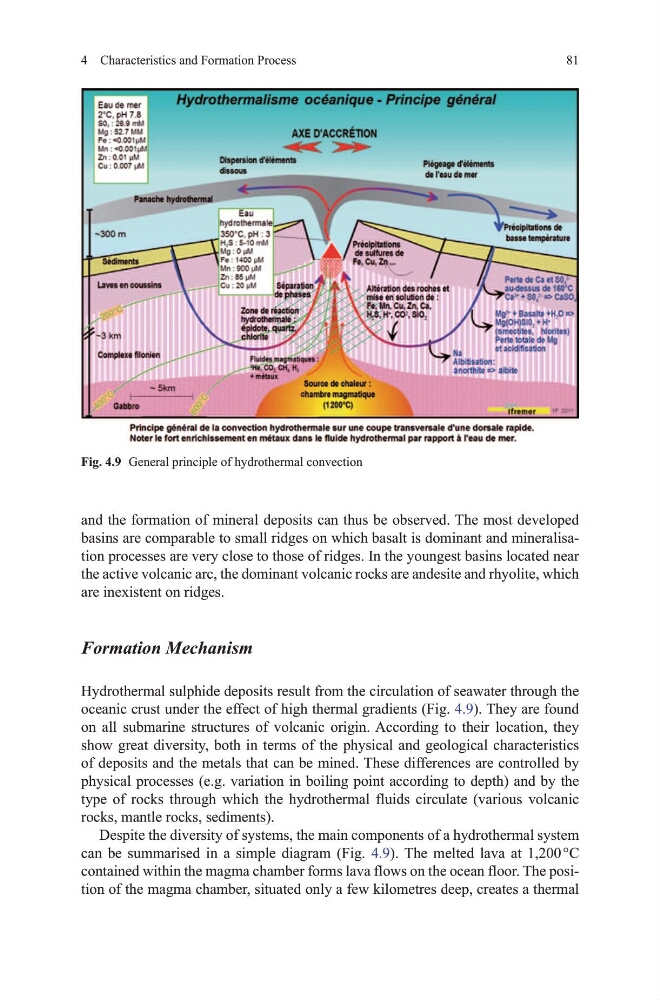
Hydrothermal sulphide deposits result from the circulation of seawater through the
oceanic crust under the effect of high thermal gradients (Fig. 4.9). They are found
on all submarine structures of volcanic origin. According to their location, they
show great diversity, both in terms of the physical and geological characteristics
of deposits and the metals that can be mined. These differences are controlled by
physical processes (e.g. variation in boiling point according to depth) and by the
type of rocks through which the hydrothermal fluids circulate (various volcanic
rocks, mantle rocks, sediments).
Despite the diversity of systems, the main components of a hydrothermal system
can be summarised in a simple diagram (Fig. 4.9). The melted lava at 1,200 °C
contained within the magma chamber forms lava flows on the ocean floor. The position of the magma chamber, situated only a few kilometres deep, creates a thermal
Fig. 4.9 General principle of hydrothermal convection
4 Characteristics and Formation Process
and the formation of mineral deposits can thus be observed. The most developed
basins are comparable to small ridges on which basalt is dominant and mineralisation processes are very close to those of ridges. In the youngest basins located near
the active volcanic arc, the dominant volcanic rocks are andesite and rhyolite, which
are inexistent on ridges.
Formation Mechanism
Hydrothermal sulphide deposits result from the circulation of seawater through the
oceanic crust under the effect of high thermal gradients (Fig. 4.9). They are found
on all submarine structures of volcanic origin. According to their location, they
show great diversity, both in terms of the physical and geological characteristics
of deposits and the metals that can be mined. These differences are controlled by
physical processes (e.g. variation in boiling point according to depth) and by the
type of rocks through which the hydrothermal fluids circulate (various volcanic
rocks, mantle rocks, sediments).
Despite the diversity of systems, the main components of a hydrothermal system
can be summarised in a simple diagram (Fig. 4.9). The melted lava at 1,200 °C
contained within the magma chamber forms lava flows on the ocean floor. The position of the magma chamber, situated only a few kilometres deep, creates a thermal
Fig. 4.9 General principle of hydrothermal convection