

80
Y. Fouquet
Back-Arc Basins and Volcanic Arcs Behind Large Oceanic Trenches Contrary to
ridges, which are the place where the oceanic crust is formed, volcanic back-arc
basins form in environments where plates are destroyed (subduction zones). In
the late 1980s, back-arc basins, behind oceanic trenches, attracted the attention of
metallogenists, due to the fact that the great majority of fossil deposits mined on
land are formed in this type of context. Due to their location close to continents,
they are preferentially incorporated into continents during plate collisions.
Back-arc basins can be considered as small volcanic ridges formed behind large
oceanic trenches. Seawater injection at lithospheric plate downwelling areas (subduction zones) causes rocks’ melting point to fall. Consequently, the pockets of lava
formed supply volcanic islands (volcanic arc), forming chains behind and parallel
to the trench. Tonga and the Mariana Islands are examples of islands formed by this
process. These contexts are favourable to the installation of hydrothermal convection cells and are home to several hydrothermal fields.
Back-arc basins’ major instability, as well as the high variability in the nature of
the volcanic rocks associated with them, have led to the discovery of extremely varied hydrothermal sites in terms of the composition of fluids and associated mineral
deposits. These basins are classified according to their degree of maturity. Young
basins can open up in the continental crust (Okinawa Trough) or island arc crust
(Lau Basin, Manus Basin). In the latter case, the influence of melted products from
the subduction zone is reflected in the composition of associated hydrothermal deposits. The impact of global phenomena, such as subduction, in local phenomena
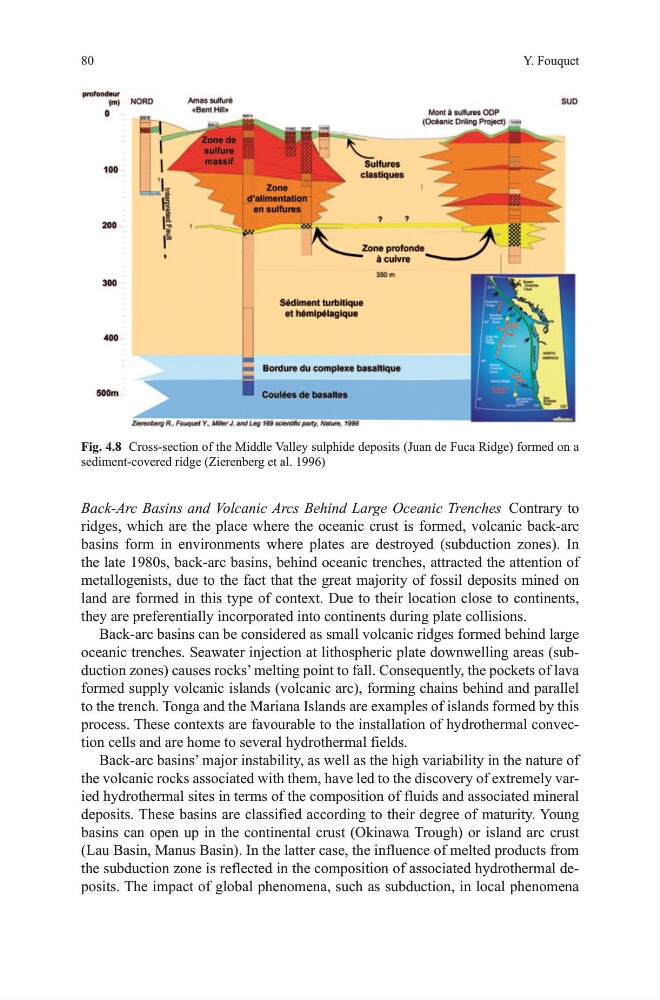
Fig. 4.8 Cross-section of the Middle Valley sulphide deposits (Juan de Fuca Ridge) formed on a
sediment-covered ridge (Zierenberg et al. 1996)
Y. Fouquet
Back-Arc Basins and Volcanic Arcs Behind Large Oceanic Trenches Contrary to
ridges, which are the place where the oceanic crust is formed, volcanic back-arc
basins form in environments where plates are destroyed (subduction zones). In
the late 1980s, back-arc basins, behind oceanic trenches, attracted the attention of
metallogenists, due to the fact that the great majority of fossil deposits mined on
land are formed in this type of context. Due to their location close to continents,
they are preferentially incorporated into continents during plate collisions.
Back-arc basins can be considered as small volcanic ridges formed behind large
oceanic trenches. Seawater injection at lithospheric plate downwelling areas (subduction zones) causes rocks’ melting point to fall. Consequently, the pockets of lava
formed supply volcanic islands (volcanic arc), forming chains behind and parallel
to the trench. Tonga and the Mariana Islands are examples of islands formed by this
process. These contexts are favourable to the installation of hydrothermal convection cells and are home to several hydrothermal fields.
Back-arc basins’ major instability, as well as the high variability in the nature of
the volcanic rocks associated with them, have led to the discovery of extremely varied hydrothermal sites in terms of the composition of fluids and associated mineral
deposits. These basins are classified according to their degree of maturity. Young
basins can open up in the continental crust (Okinawa Trough) or island arc crust
(Lau Basin, Manus Basin). In the latter case, the influence of melted products from
the subduction zone is reflected in the composition of associated hydrothermal deposits. The impact of global phenomena, such as subduction, in local phenomena
Fig. 4.8 Cross-section of the Middle Valley sulphide deposits (Juan de Fuca Ridge) formed on a
sediment-covered ridge (Zierenberg et al. 1996)