

82
Y. Fouquet
gradient of several hundred degrees per kilometre. Seawater, which is cold and
low in metals, penetrates along faults and cracks formed by divergent plates and is
greatly heated as it approaches the magma chamber. As soon as the temperature exceeds 160 °C, calcium sulphate precipitates in the form of anhydrite (CaSO 4 ). Seawater sulphates are also reduced to the form of hydrogen sulphide which remains
in solution. Intense reactions lead to strong weathering of the rocks through which
circulation occurs and result in a total loss of magnesium which is incorporated in
newly formed minerals.
One of the consequences of these reactions is acidification of the fluid, increasing
its capacity to dissolve the metals contained in rocks. The high salinity of seawater
also facilitates the dissolution of metals to form chloride complex solutions. This
generates acidic, reduced, hot (350 °C) fluids, devoid of magnesium and with high
metal contents. The low density of these fluids causes their upwelling and induces
hydrothermal convection which emerges in the form of hot vents in the most recent
fissures in the ridge. Sulphide deposits are formed on the ocean floor when these
hydrothermal fluids (350 °C) are rapidly cooled upon contact with seawater (2 °C).
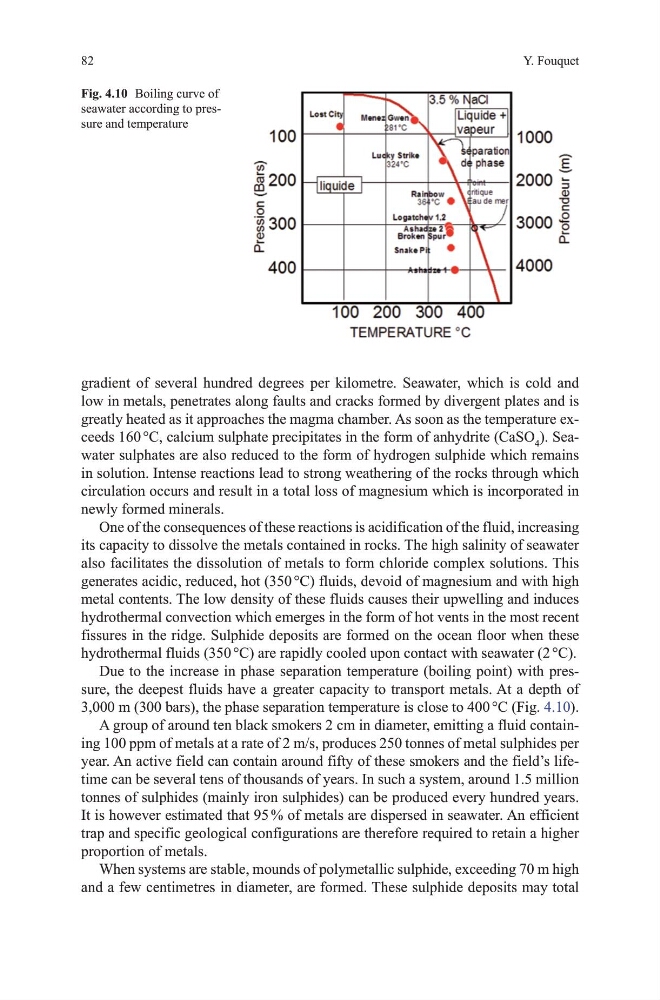
Due to the increase in phase separation temperature (boiling point) with pressure, the deepest fluids have a greater capacity to transport metals. At a depth of
3,000 m (300 bars), the phase separation temperature is close to 400 °C (Fig. 4.10).
A group of around ten black smokers 2 cm in diameter, emitting a fluid containing 100 ppm of metals at a rate of 2 m/s, produces 250 tonnes of metal sulphides per
year. An active field can contain around fifty of these smokers and the field’s lifetime can be several tens of thousands of years. In such a system, around 1.5 million
tonnes of sulphides (mainly iron sulphides) can be produced every hundred years.
It is however estimated that 95 % of metals are dispersed in seawater. An efficient
trap and specific geological configurations are therefore required to retain a higher
proportion of metals.
When systems are stable, mounds of polymetallic sulphide, exceeding 70 m high
and a few centimetres in diameter, are formed. These sulphide deposits may total
Fig. 4.10 Boiling curve of
seawater according to pressure and temperature
Y. Fouquet
gradient of several hundred degrees per kilometre. Seawater, which is cold and
low in metals, penetrates along faults and cracks formed by divergent plates and is
greatly heated as it approaches the magma chamber. As soon as the temperature exceeds 160 °C, calcium sulphate precipitates in the form of anhydrite (CaSO 4 ). Seawater sulphates are also reduced to the form of hydrogen sulphide which remains
in solution. Intense reactions lead to strong weathering of the rocks through which
circulation occurs and result in a total loss of magnesium which is incorporated in
newly formed minerals.
One of the consequences of these reactions is acidification of the fluid, increasing
its capacity to dissolve the metals contained in rocks. The high salinity of seawater
also facilitates the dissolution of metals to form chloride complex solutions. This
generates acidic, reduced, hot (350 °C) fluids, devoid of magnesium and with high
metal contents. The low density of these fluids causes their upwelling and induces
hydrothermal convection which emerges in the form of hot vents in the most recent
fissures in the ridge. Sulphide deposits are formed on the ocean floor when these
hydrothermal fluids (350 °C) are rapidly cooled upon contact with seawater (2 °C).
Due to the increase in phase separation temperature (boiling point) with pressure, the deepest fluids have a greater capacity to transport metals. At a depth of
3,000 m (300 bars), the phase separation temperature is close to 400 °C (Fig. 4.10).
A group of around ten black smokers 2 cm in diameter, emitting a fluid containing 100 ppm of metals at a rate of 2 m/s, produces 250 tonnes of metal sulphides per
year. An active field can contain around fifty of these smokers and the field’s lifetime can be several tens of thousands of years. In such a system, around 1.5 million
tonnes of sulphides (mainly iron sulphides) can be produced every hundred years.
It is however estimated that 95 % of metals are dispersed in seawater. An efficient
trap and specific geological configurations are therefore required to retain a higher
proportion of metals.
When systems are stable, mounds of polymetallic sulphide, exceeding 70 m high
and a few centimetres in diameter, are formed. These sulphide deposits may total
Fig. 4.10 Boiling curve of
seawater according to pressure and temperature