

130
Appendices
were determined, and divided into two types: type A, with base metals under probable economic tension (zinc, copper, manganese, cobalt, silver) and precious metals
with a high heritage value (gold and, to a lesser extent, silver); and type B, with
critical metals with a high technological potential and major supply risks (indium,
germanium, gallium, related to zinc, on hydrothermal sulphide sites), antimony (to
be investigated further), rare earths (in small proportions, back-up resource in the
face of known needs). Furthermore, platinum and platinum group metals on crust
sites (with uncertainty over substitution and usage—two hundred years of reserves
today) are a specific case, given the wealth of French EEZs.
Attractiveness Analysis by Deposit Type
Following this multi-criteria evaluation focusing on metals and their relationship
with deposits, a summary of the assets of different types of sites and deposits was
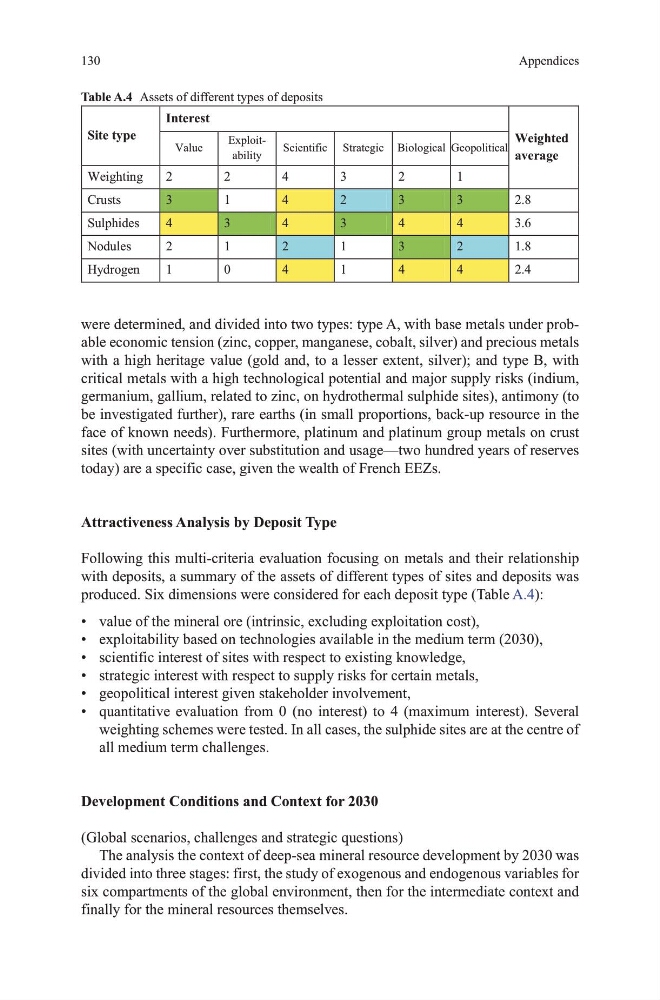
produced. Six dimensions were considered for each deposit type (Table A.4):
• value of the mineral ore (intrinsic, excluding exploitation cost),
• exploitability based on technologies available in the medium term (2030),
• scientific interest of sites with respect to existing knowledge,
• strategic interest with respect to supply risks for certain metals,
• geopolitical interest given stakeholder involvement,
• quantitative evaluation from 0 (no interest) to 4 (maximum interest). Several
weighting schemes were tested. In all cases, the sulphide sites are at the centre of
all medium term challenges.
Development Conditions and Context for 2030
(Global scenarios, challenges and strategic questions)
The analysis the context of deep-sea mineral resource development by 2030 was
divided into three stages: first, the study of exogenous and endogenous variables for
six compartments of the global environment, then for the intermediate context and
finally for the mineral resources themselves.
Table A.4 Assets of different types of deposits
Site type
Interest
Weighted
average
Value
Exploitability
Scientific Strategic Biological Geopolitical
Weighting
2
2
4
3
2
1
Crusts
3
1
4
2
3
3
2.8
Sulphides
4
3
4
3
4
4
3.6
Nodules
2
1
2
1
3
2
1.8
Hydrogen
1
0
4
1
4
4
2.4
Appendices
were determined, and divided into two types: type A, with base metals under probable economic tension (zinc, copper, manganese, cobalt, silver) and precious metals
with a high heritage value (gold and, to a lesser extent, silver); and type B, with
critical metals with a high technological potential and major supply risks (indium,
germanium, gallium, related to zinc, on hydrothermal sulphide sites), antimony (to
be investigated further), rare earths (in small proportions, back-up resource in the
face of known needs). Furthermore, platinum and platinum group metals on crust
sites (with uncertainty over substitution and usage—two hundred years of reserves
today) are a specific case, given the wealth of French EEZs.
Attractiveness Analysis by Deposit Type
Following this multi-criteria evaluation focusing on metals and their relationship
with deposits, a summary of the assets of different types of sites and deposits was
produced. Six dimensions were considered for each deposit type (Table A.4):
• value of the mineral ore (intrinsic, excluding exploitation cost),
• exploitability based on technologies available in the medium term (2030),
• scientific interest of sites with respect to existing knowledge,
• strategic interest with respect to supply risks for certain metals,
• geopolitical interest given stakeholder involvement,
• quantitative evaluation from 0 (no interest) to 4 (maximum interest). Several
weighting schemes were tested. In all cases, the sulphide sites are at the centre of
all medium term challenges.
Development Conditions and Context for 2030
(Global scenarios, challenges and strategic questions)
The analysis the context of deep-sea mineral resource development by 2030 was
divided into three stages: first, the study of exogenous and endogenous variables for
six compartments of the global environment, then for the intermediate context and
finally for the mineral resources themselves.
Table A.4 Assets of different types of deposits
Site type
Interest
Weighted
average
Value
Exploitability
Scientific Strategic Biological Geopolitical
Weighting
2
2
4
3
2
1
Crusts
3
1
4
2
3
3
2.8
Sulphides
4
3
4
3
4
4
3.6
Nodules
2
1
2
1
3
2
1.8
Hydrogen
1
0
4
1
4
4
2.4