

131
Appendices
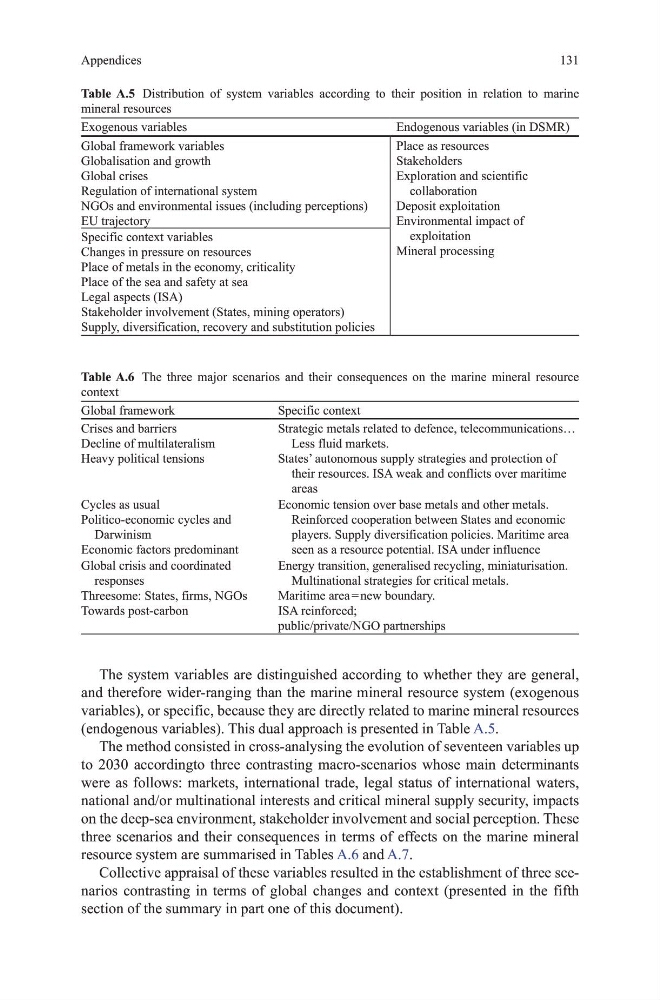
The system variables are distinguished according to whether they are general,
and therefore wider-ranging than the marine mineral resource system (exogenous
variables), or specific, because they are directly related to marine mineral resources
(endogenous variables). This dual approach is presented in Table A.5.
The method consisted in cross-analysing the evolution of seventeen variables up
to 2030 accordingto three contrasting macro-scenarios whose main determinants
were as follows: markets, international trade, legal status of international waters,
national and/or multinational interests and critical mineral supply security, impacts
on the deep-sea environment, stakeholder involvement and social perception. These
three scenarios and their consequences in terms of effects on the marine mineral
resource system are summarised in Tables A.6 and A.7.
Collective appraisal of these variables resulted in the establishment of three scenarios contrasting in terms of global changes and context (presented in the fifth
section of the summary in part one of this document).
Table A.5 Distribution of system variables according to their position in relation to marine
mineral resources
Exogenous variables
Endogenous variables (in DSMR)
Global framework variables
Globalisation and growth
Global crises
Regulation of international system
NGOs and environmental issues (including perceptions)
EU trajectory
Place as resources
Stakeholders
Exploration and scientific
collaboration
Deposit exploitation
Environmental impact of
exploitation
Mineral processing
Specific context variables
Changes in pressure on resources
Place of metals in the economy, criticality
Place of the sea and safety at sea
Legal aspects (ISA)
Stakeholder involvement (States, mining operators)
Supply, diversification, recovery and substitution policies
Table A.6 The three major scenarios and their consequences on the marine mineral resource
context
Global framework
Specific context
Crises and barriers
Decline of multilateralism
Heavy political tensions
Strategic metals related to defence, telecommunications…
Less fluid markets.
States’ autonomous supply strategies and protection of
their resources. ISA weak and conflicts over maritime
areas
Cycles as usual
Politico-economic cycles and
Darwinism
Economic factors predominant
Economic tension over base metals and other metals.
Reinforced cooperation between States and economic
players. Supply diversification policies. Maritime area
seen as a resource potential. ISA under influence
Global crisis and coordinated
responses
Threesome: States, firms, NGOs
Towards post-carbon
Energy transition, generalised recycling, miniaturisation.
Multinational strategies for critical metals.
Maritime area = new boundary.
ISA reinforced;
public/private/NGO partnerships
Appendices
The system variables are distinguished according to whether they are general,
and therefore wider-ranging than the marine mineral resource system (exogenous
variables), or specific, because they are directly related to marine mineral resources
(endogenous variables). This dual approach is presented in Table A.5.
The method consisted in cross-analysing the evolution of seventeen variables up
to 2030 accordingto three contrasting macro-scenarios whose main determinants
were as follows: markets, international trade, legal status of international waters,
national and/or multinational interests and critical mineral supply security, impacts
on the deep-sea environment, stakeholder involvement and social perception. These
three scenarios and their consequences in terms of effects on the marine mineral
resource system are summarised in Tables A.6 and A.7.
Collective appraisal of these variables resulted in the establishment of three scenarios contrasting in terms of global changes and context (presented in the fifth
section of the summary in part one of this document).
Table A.5 Distribution of system variables according to their position in relation to marine
mineral resources
Exogenous variables
Endogenous variables (in DSMR)
Global framework variables
Globalisation and growth
Global crises
Regulation of international system
NGOs and environmental issues (including perceptions)
EU trajectory
Place as resources
Stakeholders
Exploration and scientific
collaboration
Deposit exploitation
Environmental impact of
exploitation
Mineral processing
Specific context variables
Changes in pressure on resources
Place of metals in the economy, criticality
Place of the sea and safety at sea
Legal aspects (ISA)
Stakeholder involvement (States, mining operators)
Supply, diversification, recovery and substitution policies
Table A.6 The three major scenarios and their consequences on the marine mineral resource
context
Global framework
Specific context
Crises and barriers
Decline of multilateralism
Heavy political tensions
Strategic metals related to defence, telecommunications…
Less fluid markets.
States’ autonomous supply strategies and protection of
their resources. ISA weak and conflicts over maritime
areas
Cycles as usual
Politico-economic cycles and
Darwinism
Economic factors predominant
Economic tension over base metals and other metals.
Reinforced cooperation between States and economic
players. Supply diversification policies. Maritime area
seen as a resource potential. ISA under influence
Global crisis and coordinated
responses
Threesome: States, firms, NGOs
Towards post-carbon
Energy transition, generalised recycling, miniaturisation.
Multinational strategies for critical metals.
Maritime area = new boundary.
ISA reinforced;
public/private/NGO partnerships