

129
Appendices
investigation of specific aspects of marine mineral resources for each type of metal.
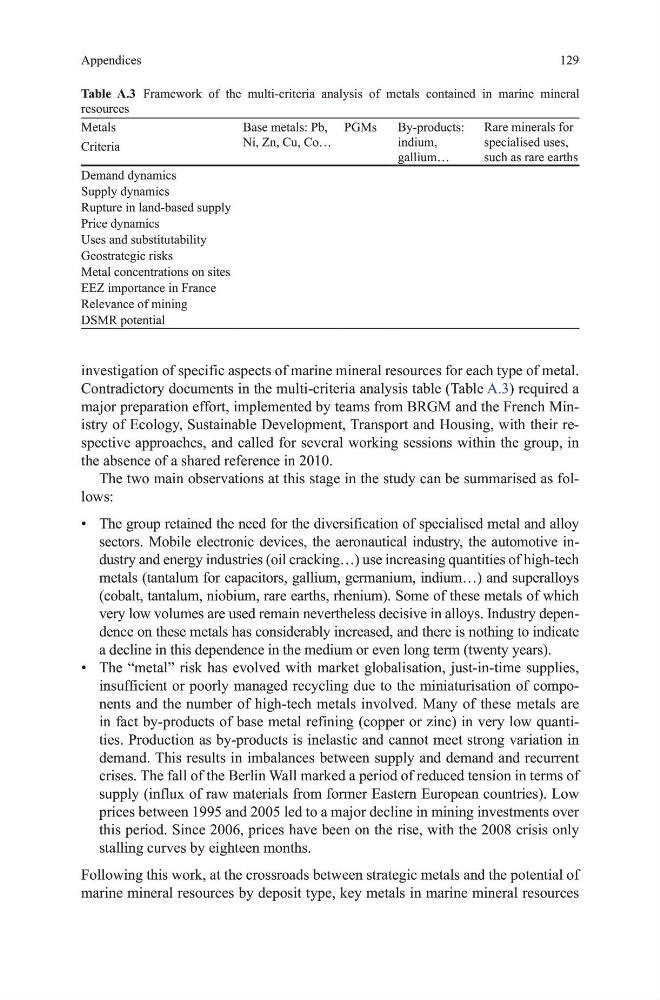
Contradictory documents in the multi-criteria analysis table (Table A.3) required a
major preparation effort, implemented by teams from BRGM and the French Ministry of Ecology, Sustainable Development, Transport and Housing, with their respective approaches, and called for several working sessions within the group, in
the absence of a shared reference in 2010.
The two main observations at this stage in the study can be summarised as follows:
• The group retained the need for the diversification of specialised metal and alloy
sectors. Mobile electronic devices, the aeronautical industry, the automotive industry and energy industries (oil cracking…) use increasing quantities of high-tech
metals (tantalum for capacitors, gallium, germanium, indium…) and superalloys
(cobalt, tantalum, niobium, rare earths, rhenium). Some of these metals of which
very low volumes are used remain nevertheless decisive in alloys. Industry dependence on these metals has considerably increased, and there is nothing to indicate
a decline in this dependence in the medium or even long term (twenty years).
• The “metal” risk has evolved with market globalisation, just-in-time supplies,
insufficient or poorly managed recycling due to the miniaturisation of components and the number of high-tech metals involved. Many of these metals are
in fact by-products of base metal refining (copper or zinc) in very low quantities. Production as by-products is inelastic and cannot meet strong variation in
demand. This results in imbalances between supply and demand and recurrent
crises. The fall of the Berlin Wall marked a period of reduced tension in terms of
supply (influx of raw materials from former Eastern European countries). Low
prices between 1995 and 2005 led to a major decline in mining investments over
this period. Since 2006, prices have been on the rise, with the 2008 crisis only
stalling curves by eighteen months.
Following this work, at the crossroads between strategic metals and the potential of
marine mineral resources by deposit type, key metals in marine mineral resources
Table A.3 Framework of the multi-criteria analysis of metals contained in marine mineral
resources
Metals
Criteria
Base metals: Pb,
Ni, Zn, Cu, Co…
PGMs
By-products:
indium,
gallium…
Rare minerals for
specialised uses,
such as rare earths
Demand dynamics
Supply dynamics
Rupture in land-based supply
Price dynamics
Uses and substitutability
Geostrategic risks
Metal concentrations on sites
EEZ importance in France
Relevance of mining
DSMR potential
Appendices
investigation of specific aspects of marine mineral resources for each type of metal.
Contradictory documents in the multi-criteria analysis table (Table A.3) required a
major preparation effort, implemented by teams from BRGM and the French Ministry of Ecology, Sustainable Development, Transport and Housing, with their respective approaches, and called for several working sessions within the group, in
the absence of a shared reference in 2010.
The two main observations at this stage in the study can be summarised as follows:
• The group retained the need for the diversification of specialised metal and alloy
sectors. Mobile electronic devices, the aeronautical industry, the automotive industry and energy industries (oil cracking…) use increasing quantities of high-tech
metals (tantalum for capacitors, gallium, germanium, indium…) and superalloys
(cobalt, tantalum, niobium, rare earths, rhenium). Some of these metals of which
very low volumes are used remain nevertheless decisive in alloys. Industry dependence on these metals has considerably increased, and there is nothing to indicate
a decline in this dependence in the medium or even long term (twenty years).
• The “metal” risk has evolved with market globalisation, just-in-time supplies,
insufficient or poorly managed recycling due to the miniaturisation of components and the number of high-tech metals involved. Many of these metals are
in fact by-products of base metal refining (copper or zinc) in very low quantities. Production as by-products is inelastic and cannot meet strong variation in
demand. This results in imbalances between supply and demand and recurrent
crises. The fall of the Berlin Wall marked a period of reduced tension in terms of
supply (influx of raw materials from former Eastern European countries). Low
prices between 1995 and 2005 led to a major decline in mining investments over
this period. Since 2006, prices have been on the rise, with the 2008 crisis only
stalling curves by eighteen months.
Following this work, at the crossroads between strategic metals and the potential of
marine mineral resources by deposit type, key metals in marine mineral resources
Table A.3 Framework of the multi-criteria analysis of metals contained in marine mineral
resources
Metals
Criteria
Base metals: Pb,
Ni, Zn, Cu, Co…
PGMs
By-products:
indium,
gallium…
Rare minerals for
specialised uses,
such as rare earths
Demand dynamics
Supply dynamics
Rupture in land-based supply
Price dynamics
Uses and substitutability
Geostrategic risks
Metal concentrations on sites
EEZ importance in France
Relevance of mining
DSMR potential