

22
L.-K. SOH, C. TSATSOULIS, AND B. HOLT
2.5
Preliminary Results of an Arctic Summer Time Series Study
In this section we describe initial results from an in-depth study of the floe size algorithm applied to two time series of ERS-l SAR images during the summer of 1992 in
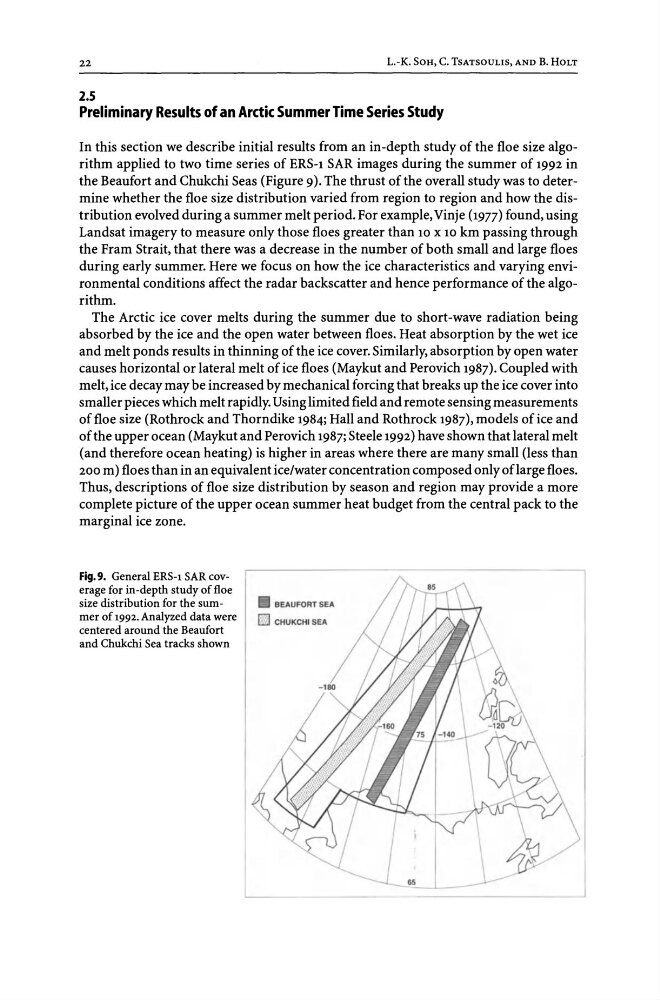
the Beaufort and Chukchi Seas (Figure 9). The thrust of the overall study was to determine whether the floe size distribution varied from region to region and how the distribution evolved during a summer melt period. For example, Vinje (1977) found, using
Landsat imagery to measure only those floes greater than 10 x 10 km passing through
the Fram Strait, that there was a decrease in the number of both small and large floes
during early summer. Here we focus on how the ice characteristics and varying environmental conditions affect the radar backscatter and hence performance of the algorithm.
The Arctic ice cover melts during the summer due to short-wave radiation being
absorbed by the ice and the open water between floes. Heat absorption by the wet ice
and melt ponds results in thinning of the ice cover. Similarly, absorption by open water
causes horizontal or lateral melt of ice floes (Maykut and Perovich 1987). Coupled with
melt, ice decay may be increased by mechanical forcing that breaks up the ice cover into
smaller pieces which melt rapidly. Using limited field and remote sensing measurements
of floe size (Rothrock and Thorndike 1984; Hall and Rothrock 1987), models of ice and
of the upper ocean (Maykut and Perovich 1987; Steele 1992) have shown that lateral melt
(and therefore ocean heating) is higher in areas where there are many small (less than
200 m) floes than in an equivalent ice/water concentration composed only oflarge floes.
Thus, descriptions of floe size distribution by season and region may provide a more
complete picture of the upper ocean summer heat budget from the central pack to the
marginal ice zone.
Fig.9. General ERS-l SAR coverage for in-depth study of floe
size distribution for the summer of 1992. Analyzed data were
centered around the Beaufort
and Chukchi Sea tracks shown
BEAUFORT SEA
ill! CHUKCHI SEA
L.-K. SOH, C. TSATSOULIS, AND B. HOLT
2.5
Preliminary Results of an Arctic Summer Time Series Study
In this section we describe initial results from an in-depth study of the floe size algorithm applied to two time series of ERS-l SAR images during the summer of 1992 in
the Beaufort and Chukchi Seas (Figure 9). The thrust of the overall study was to determine whether the floe size distribution varied from region to region and how the distribution evolved during a summer melt period. For example, Vinje (1977) found, using
Landsat imagery to measure only those floes greater than 10 x 10 km passing through
the Fram Strait, that there was a decrease in the number of both small and large floes
during early summer. Here we focus on how the ice characteristics and varying environmental conditions affect the radar backscatter and hence performance of the algorithm.
The Arctic ice cover melts during the summer due to short-wave radiation being
absorbed by the ice and the open water between floes. Heat absorption by the wet ice
and melt ponds results in thinning of the ice cover. Similarly, absorption by open water
causes horizontal or lateral melt of ice floes (Maykut and Perovich 1987). Coupled with
melt, ice decay may be increased by mechanical forcing that breaks up the ice cover into
smaller pieces which melt rapidly. Using limited field and remote sensing measurements
of floe size (Rothrock and Thorndike 1984; Hall and Rothrock 1987), models of ice and
of the upper ocean (Maykut and Perovich 1987; Steele 1992) have shown that lateral melt
(and therefore ocean heating) is higher in areas where there are many small (less than
200 m) floes than in an equivalent ice/water concentration composed only oflarge floes.
Thus, descriptions of floe size distribution by season and region may provide a more
complete picture of the upper ocean summer heat budget from the central pack to the
marginal ice zone.
Fig.9. General ERS-l SAR coverage for in-depth study of floe
size distribution for the summer of 1992. Analyzed data were
centered around the Beaufort
and Chukchi Sea tracks shown
BEAUFORT SEA
ill! CHUKCHI SEA