

46
2 Mathematical Simulation of Wave Propagation at Global Distances
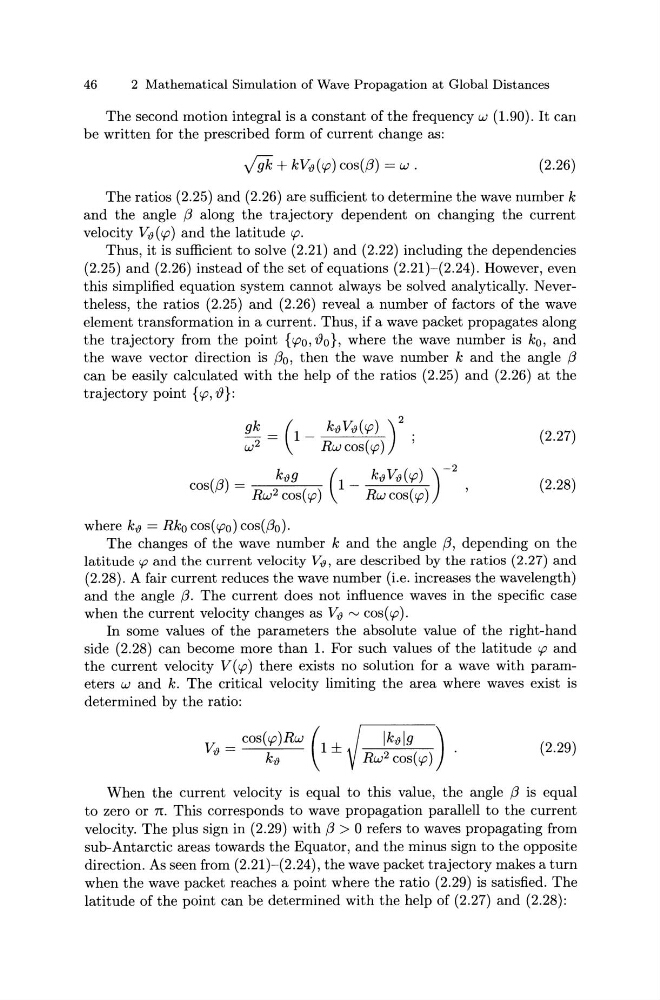
The second motion integral is a constant of the frequency w (1.90). It can
be written for the prescribed form of current change as:
J9k + kV.?(cp) cos(f3) = w.
(2.26)
The ratios (2.25) and (2.26) are sufficient to determine the wave number k
and the angle f3 along the trajectory dependent on changing the current
velocity V.? ( cp) and the latitude cp.
Thus, it is sufficient to solve (2.21) and (2.22) including the dependencies
(2.25) and (2.26) instead of the set of equations (2.21)-(2.24). However, even
this simplified equation system cannot always be solved analytically. Nevertheless, the ratios (2.25) and (2.26) reveal a number of factors of the wave
element transformation in a current. Thus, if a wave packet propagates along
the trajectory from the point { cp0 , 190 }, where the wave number is k0 , and
the wave vector direction is {30 , then the wave number k and the angle f3
can be easily calculated with the help of the ratios (2.25) and (2.26) at the
trajectory point { cp, 19}:
gk _ ( 1 _ k.? V.? ( cp) )
2 •
w2 -
Rwcos(cp)
'
(2.27)
cos(f3)k.?g
(1- k.?V.?(cp) )-2
- Rw 2 cos( cp)
Rw cos( cp)
'
(2.28)
where k.? = Rko cos( 'Po) cos(f3o).
The changes of the wave number k and the angle f3, depending on the
latitude (2.28). A fair current reduces the wave number (i.e. increases the wavelength)
and the angle {3. The current does not influence waves in the specific case
when the current velocity changes as V.? "' cos( cp).
In some values of the parameters the absolute value of the right-hand
side (2.28) can become more than 1. For such values of the latitude cp and
the current velocity V(cp) there exists no solution for a wave with parameters w and k. The critical velocity limiting the area where waves exist is
determined by the ratio:
V.? = cos( cp )Rw ( 1 ±
k,J
(2.29)
When the current velocity is equal to this value, the angle f3 is equal
to zero or rr. This corresponds to wave propagation parallell to the current
velocity. The plus sign in (2.29) with f3 > 0 refers to waves propagating from
sub-Antarctic areas towards the Equator, and the minus sign to the opposite
direction. As seen from (2.21)-(2.24), the wave packet trajectory makes a turn
when the wave packet reaches a point where the ratio (2.29) is satisfied. The
latitude of the point can be determined with the help of (2.27) and (2.28):
2 Mathematical Simulation of Wave Propagation at Global Distances
The second motion integral is a constant of the frequency w (1.90). It can
be written for the prescribed form of current change as:
J9k + kV.?(cp) cos(f3) = w.
(2.26)
The ratios (2.25) and (2.26) are sufficient to determine the wave number k
and the angle f3 along the trajectory dependent on changing the current
velocity V.? ( cp) and the latitude cp.
Thus, it is sufficient to solve (2.21) and (2.22) including the dependencies
(2.25) and (2.26) instead of the set of equations (2.21)-(2.24). However, even
this simplified equation system cannot always be solved analytically. Nevertheless, the ratios (2.25) and (2.26) reveal a number of factors of the wave
element transformation in a current. Thus, if a wave packet propagates along
the trajectory from the point { cp0 , 190 }, where the wave number is k0 , and
the wave vector direction is {30 , then the wave number k and the angle f3
can be easily calculated with the help of the ratios (2.25) and (2.26) at the
trajectory point { cp, 19}:
gk _ ( 1 _ k.? V.? ( cp) )
2 •
w2 -
Rwcos(cp)
'
(2.27)
cos(f3)k.?g
(1- k.?V.?(cp) )-2
- Rw 2 cos( cp)
Rw cos( cp)
'
(2.28)
where k.? = Rko cos( 'Po) cos(f3o).
The changes of the wave number k and the angle f3, depending on the
latitude (2.28). A fair current reduces the wave number (i.e. increases the wavelength)
and the angle {3. The current does not influence waves in the specific case
when the current velocity changes as V.? "' cos( cp).
In some values of the parameters the absolute value of the right-hand
side (2.28) can become more than 1. For such values of the latitude cp and
the current velocity V(cp) there exists no solution for a wave with parameters w and k. The critical velocity limiting the area where waves exist is
determined by the ratio:
V.? = cos( cp )Rw ( 1 ±
k,J
(2.29)
When the current velocity is equal to this value, the angle f3 is equal
to zero or rr. This corresponds to wave propagation parallell to the current
velocity. The plus sign in (2.29) with f3 > 0 refers to waves propagating from
sub-Antarctic areas towards the Equator, and the minus sign to the opposite
direction. As seen from (2.21)-(2.24), the wave packet trajectory makes a turn
when the wave packet reaches a point where the ratio (2.29) is satisfied. The
latitude of the point can be determined with the help of (2.27) and (2.28):