

2.4 The Influence of Current on the Evolution of Waves at the Global Scale
45
maps. It was also pointed out that there were waves observed at places completely in the shadow zone (Munk et al., 1963). An interesting explanation of
the problem concerning wave refraction in a current was given by K. Kenyon
(1981). He calculated analytically wave propagation rays with current velocity
component Vy(x), linearly dependent on the coordinate x. Kenyon described
these phenomena of wave refraction in a current and offered explanation of
the cause of such anomalies by the Antarctic subpolar current. However, he
solved the problem in a plane coordinate system, without taking into account
global scales of the current.
It is quite clear that in order to define the wave action spectral density
in the most general case, it is necessary to solve (1.84) together with the
ray equations (1.86)-(1.90) written with the help of spherical variables. The
equations can be solved numerically. However, the influence of the current
global scale on waves can be estimated analytically in elementary situations
as well.
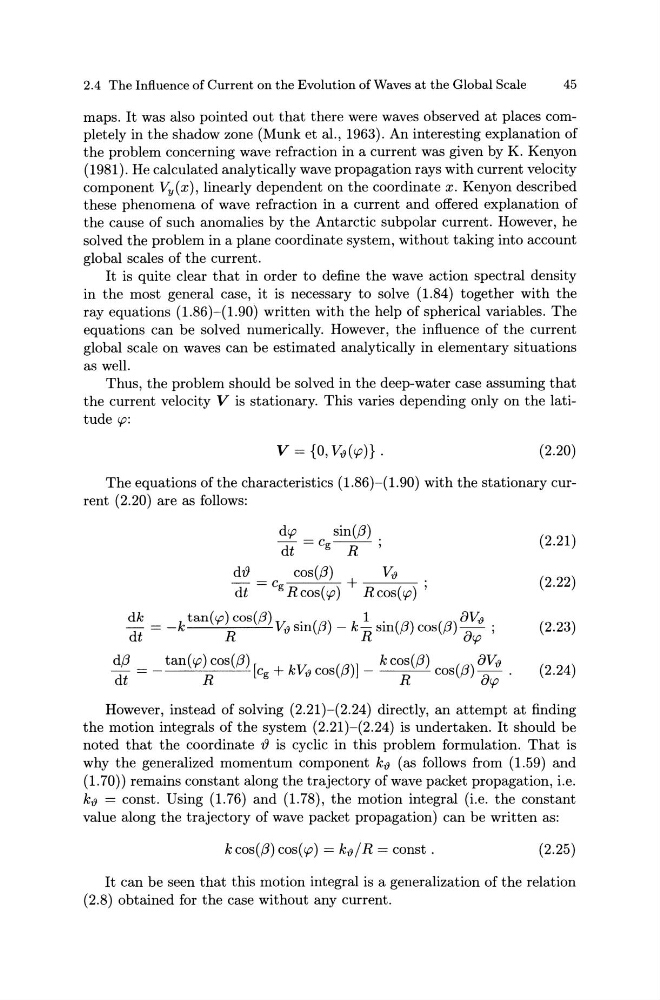
Thus, the problem should be solved in the deep-water case assuming that
the current velocity V is stationary. This varies depending only on the latitude cp:
V = {0, V11(cp)}.
(2.20)
The equations of the characteristics (1.86)-(1.90) with the stationary current (2.20) are as follows:
dcp
sin(/3)
dt=Cg~;
(2.21)
diJ
cos(/3)
v.?
- - c
+
.
dt - g Rcos(cp)
Rcos(cp) '
(2.22)
dk -
k tan( t.p) cos(,B) v. 0 (!3) k 1 0 (!3) (!3) av" 0
- - -
11sm
- -sm
cos
- -
dt
R
R
ocp '
(2.23)
d,B - -tan( cp) cos(/3) [
kV.
(/3)] - k cos(,B)
(/3) av.?
dt -
R
Cg + 11 cos
R
cos
fJcp 0
(2.24)
However, instead of solving (2.21)-(2.24) directly, an attempt at finding
the motion integrals of the system (2.21)-(2.24) is undertaken. It should be
noted that the coordinate iJ is cyclic in this problem formulation. That is
why the generalized momentum component ku (as follows from (1.59) and
(1. 70)) remains constant along the trajectory of wave packet propagation, i.e.
ku = canst. Using (1.76) and (1.78), the motion integral (i.e. the constant
value along the trajectory of wave packet propagation) can be written as:
kcos(/3) cos(cp) = ku/R =canst.
(2.25)
It can be seen that this motion integral is a generalization of the relation
(2.8) obtained for the case without any current.
45
maps. It was also pointed out that there were waves observed at places completely in the shadow zone (Munk et al., 1963). An interesting explanation of
the problem concerning wave refraction in a current was given by K. Kenyon
(1981). He calculated analytically wave propagation rays with current velocity
component Vy(x), linearly dependent on the coordinate x. Kenyon described
these phenomena of wave refraction in a current and offered explanation of
the cause of such anomalies by the Antarctic subpolar current. However, he
solved the problem in a plane coordinate system, without taking into account
global scales of the current.
It is quite clear that in order to define the wave action spectral density
in the most general case, it is necessary to solve (1.84) together with the
ray equations (1.86)-(1.90) written with the help of spherical variables. The
equations can be solved numerically. However, the influence of the current
global scale on waves can be estimated analytically in elementary situations
as well.
Thus, the problem should be solved in the deep-water case assuming that
the current velocity V is stationary. This varies depending only on the latitude cp:
V = {0, V11(cp)}.
(2.20)
The equations of the characteristics (1.86)-(1.90) with the stationary current (2.20) are as follows:
dcp
sin(/3)
dt=Cg~;
(2.21)
diJ
cos(/3)
v.?
- - c
+
.
dt - g Rcos(cp)
Rcos(cp) '
(2.22)
dk -
k tan( t.p) cos(,B) v. 0 (!3) k 1 0 (!3) (!3) av" 0
- - -
11sm
- -sm
cos
- -
dt
R
R
ocp '
(2.23)
d,B - -tan( cp) cos(/3) [
kV.
(/3)] - k cos(,B)
(/3) av.?
dt -
R
Cg + 11 cos
R
cos
fJcp 0
(2.24)
However, instead of solving (2.21)-(2.24) directly, an attempt at finding
the motion integrals of the system (2.21)-(2.24) is undertaken. It should be
noted that the coordinate iJ is cyclic in this problem formulation. That is
why the generalized momentum component ku (as follows from (1.59) and
(1. 70)) remains constant along the trajectory of wave packet propagation, i.e.
ku = canst. Using (1.76) and (1.78), the motion integral (i.e. the constant
value along the trajectory of wave packet propagation) can be written as:
kcos(/3) cos(cp) = ku/R =canst.
(2.25)
It can be seen that this motion integral is a generalization of the relation
(2.8) obtained for the case without any current.