

2.3 Swell Propagation Simulation by Characteristics Method
43
comparable to the source size. This can be less than that in the plane problem.
This effect is increased for a larger source size comparable with the Earth's
radius. Thus, for small distances from the source, the wave energy is spread
to a greater degree in various directions on the sphere, than in the plane.
With increasing distance, a point appears on the sphere with the wave height
being the same as in the plane, whereas the greater the size is, the further
this point is from the source. The wave heights on a spherical surface become
larger than on a plane surface with an increase in distance. The increase in
wave height is explained by the fact that the spectral components leaving the
source and propagating along the great circle arcs gather at a diametrically
opposite point, where their trajectories intersect.
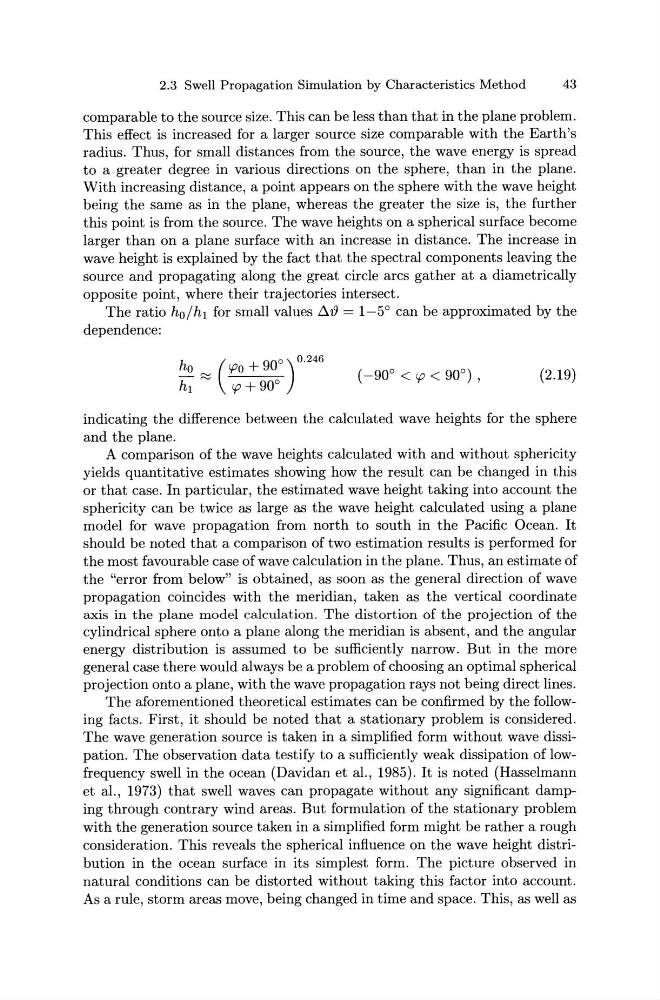
The ratio h0 jh1 for small values f:l{} = 1-5° can be approximated by the
dependence:
(2.19)
indicating the difference between the calculated wave heights for the sphere
and the plane.
A comparison of the wave heights calculated with and without sphericity
yields quantitative estimates showing how the result can be changed in this
or that case. In particular, the estimated wave height taking into account the
sphericity can be twice as large as the wave height calculated using a plane
model for wave propagation from north to south in the Pacific Ocean. It
should be noted that a comparison of two estimation results is performed for
the most favourable case of wave calculation in the plane. Thus, an estimate of
the "error from below" is obtained, as soon as the general direction of wave
propagation coincides with the meridian, taken as the vertical coordinate
axis in the plane model calculation. The distortion of the projection of the
cylindrical sphere onto a plane along the meridian is absent, and the angular
energy distribution is assumed to be sufficiently narrow. But in the more
general case there would always be a problem of choosing an optimal spherical
projection onto a plane, with the wave propagation rays not being direct lines.
The aforementioned theoretical estimates can be confirmed by the following facts. First, it should be noted that a stationary problem is considered.
The wave generation source is taken in a simplified form without wave dissipation. The observation data testify to a sufficiently weak dissipation of lowfrequency swell in the ocean (Davidan et al., 1985). It is noted (Hasselmann
et al., 1973) that swell waves can propagate without any significant damping through contrary wind areas. But formulation of the stationary problem
with the generation source taken in a simplified form might be rather a rough
consideration. This reveals the spherical influence on the wave height distribution in the ocean surface in its simplest form. The picture observed in
natural conditions can be distorted without taking this factor into account.
As a rule, storm areas move, being changed in time and space. This, as well as
43
comparable to the source size. This can be less than that in the plane problem.
This effect is increased for a larger source size comparable with the Earth's
radius. Thus, for small distances from the source, the wave energy is spread
to a greater degree in various directions on the sphere, than in the plane.
With increasing distance, a point appears on the sphere with the wave height
being the same as in the plane, whereas the greater the size is, the further
this point is from the source. The wave heights on a spherical surface become
larger than on a plane surface with an increase in distance. The increase in
wave height is explained by the fact that the spectral components leaving the
source and propagating along the great circle arcs gather at a diametrically
opposite point, where their trajectories intersect.
The ratio h0 jh1 for small values f:l{} = 1-5° can be approximated by the
dependence:
(2.19)
indicating the difference between the calculated wave heights for the sphere
and the plane.
A comparison of the wave heights calculated with and without sphericity
yields quantitative estimates showing how the result can be changed in this
or that case. In particular, the estimated wave height taking into account the
sphericity can be twice as large as the wave height calculated using a plane
model for wave propagation from north to south in the Pacific Ocean. It
should be noted that a comparison of two estimation results is performed for
the most favourable case of wave calculation in the plane. Thus, an estimate of
the "error from below" is obtained, as soon as the general direction of wave
propagation coincides with the meridian, taken as the vertical coordinate
axis in the plane model calculation. The distortion of the projection of the
cylindrical sphere onto a plane along the meridian is absent, and the angular
energy distribution is assumed to be sufficiently narrow. But in the more
general case there would always be a problem of choosing an optimal spherical
projection onto a plane, with the wave propagation rays not being direct lines.
The aforementioned theoretical estimates can be confirmed by the following facts. First, it should be noted that a stationary problem is considered.
The wave generation source is taken in a simplified form without wave dissipation. The observation data testify to a sufficiently weak dissipation of lowfrequency swell in the ocean (Davidan et al., 1985). It is noted (Hasselmann
et al., 1973) that swell waves can propagate without any significant damping through contrary wind areas. But formulation of the stationary problem
with the generation source taken in a simplified form might be rather a rough
consideration. This reveals the spherical influence on the wave height distribution in the ocean surface in its simplest form. The picture observed in
natural conditions can be distorted without taking this factor into account.
As a rule, storm areas move, being changed in time and space. This, as well as