

42
2 Mathematical Simulation of Wave Propagation at Global Distances
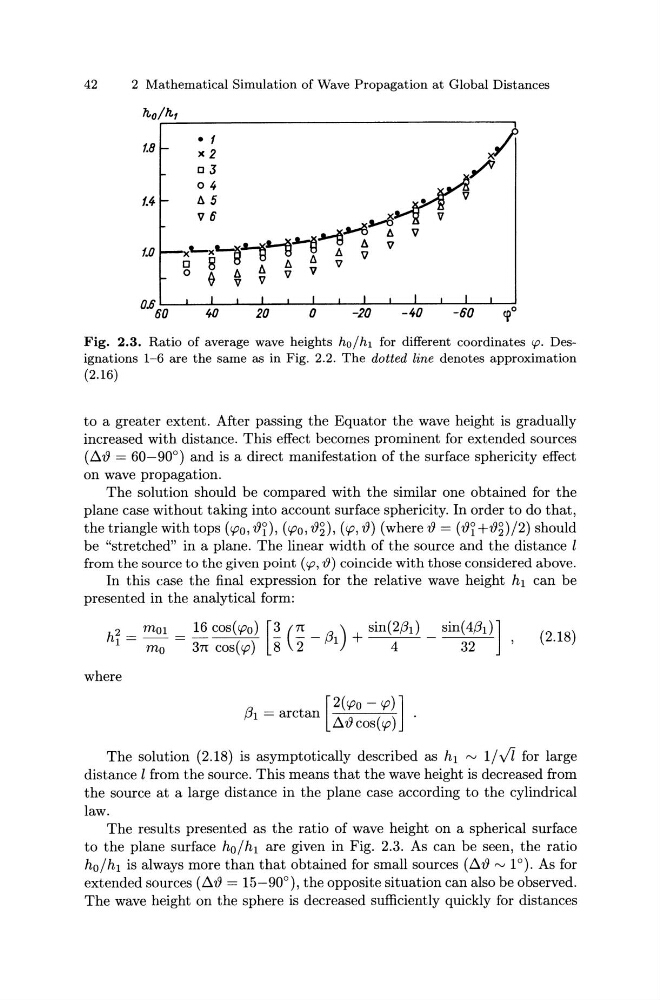
Fig. 2.3. Ratio of average wave heights ho/h1 for different coordinates c.p. Designations 1-6 are the same as in Fig. 2.2. The dotted line denotes approximation
(2.16)
to a greater extent. After passing the Equator the wave height is gradually
increased with distance. This effect becomes prominent for extended sources
(.::l'!9 = 60-90°) and is a direct manifestation of the surface sphericity effect
on wave propagation.
The solution should be compared with the similar one obtained for the
plane case without taking into account surface sphericity. In order to do that,
the triangle with tops ( cpo, '!91), ( cpo, '!92), ( cp, '!9) (where ' !9 = ( ' !9]' +'!92)/2) should
be "stretched" in a plane. The linear width of the source and the distance l
from the source to the given point ( c.p, fJ) coincide with those considered above.
In this case the final expression for the relative wave height h1 can be
presented in the analytical form:
h2 = mo1 = 16 cos(cpo) [~ (!!__!h) + sin(2j31) _ sin(4j31)] ,
1
m 0
3n cos(cp) 8 2
4
32
(2.18)
where
[ 2(cpo-cp)J
j3 1 =arctan il'l?cos(cp) .
The solution (2.18) is asymptotically described as h1 "' 1/v'z for large
distance l from the source. This means that the wave height is decreased from
the source at a large distance in the plane case according to the cylindrical
law.
The results presented as the ratio of wave height on a spherical surface
to the plane surface h0 /h1 are given in Fig. 2.3. As can be seen, the ratio
h0 /h 1 is always more than that obtained for small sources (.::l'!9"' 1°). As for
extended sources (.::l'!9 = 15-90°), the opposite situation can also be observed.
The wave height on the sphere is decreased sufficiently quickly for distances
2 Mathematical Simulation of Wave Propagation at Global Distances
Fig. 2.3. Ratio of average wave heights ho/h1 for different coordinates c.p. Designations 1-6 are the same as in Fig. 2.2. The dotted line denotes approximation
(2.16)
to a greater extent. After passing the Equator the wave height is gradually
increased with distance. This effect becomes prominent for extended sources
(.::l'!9 = 60-90°) and is a direct manifestation of the surface sphericity effect
on wave propagation.
The solution should be compared with the similar one obtained for the
plane case without taking into account surface sphericity. In order to do that,
the triangle with tops ( cpo, '!91), ( cpo, '!92), ( cp, '!9) (where ' !9 = ( ' !9]' +'!92)/2) should
be "stretched" in a plane. The linear width of the source and the distance l
from the source to the given point ( c.p, fJ) coincide with those considered above.
In this case the final expression for the relative wave height h1 can be
presented in the analytical form:
h2 = mo1 = 16 cos(cpo) [~ (!!__!h) + sin(2j31) _ sin(4j31)] ,
1
m 0
3n cos(cp) 8 2
4
32
(2.18)
where
[ 2(cpo-cp)J
j3 1 =arctan il'l?cos(cp) .
The solution (2.18) is asymptotically described as h1 "' 1/v'z for large
distance l from the source. This means that the wave height is decreased from
the source at a large distance in the plane case according to the cylindrical
law.
The results presented as the ratio of wave height on a spherical surface
to the plane surface h0 /h1 are given in Fig. 2.3. As can be seen, the ratio
h0 /h 1 is always more than that obtained for small sources (.::l'!9"' 1°). As for
extended sources (.::l'!9 = 15-90°), the opposite situation can also be observed.
The wave height on the sphere is decreased sufficiently quickly for distances