

1.6 General Problem Formulation
29
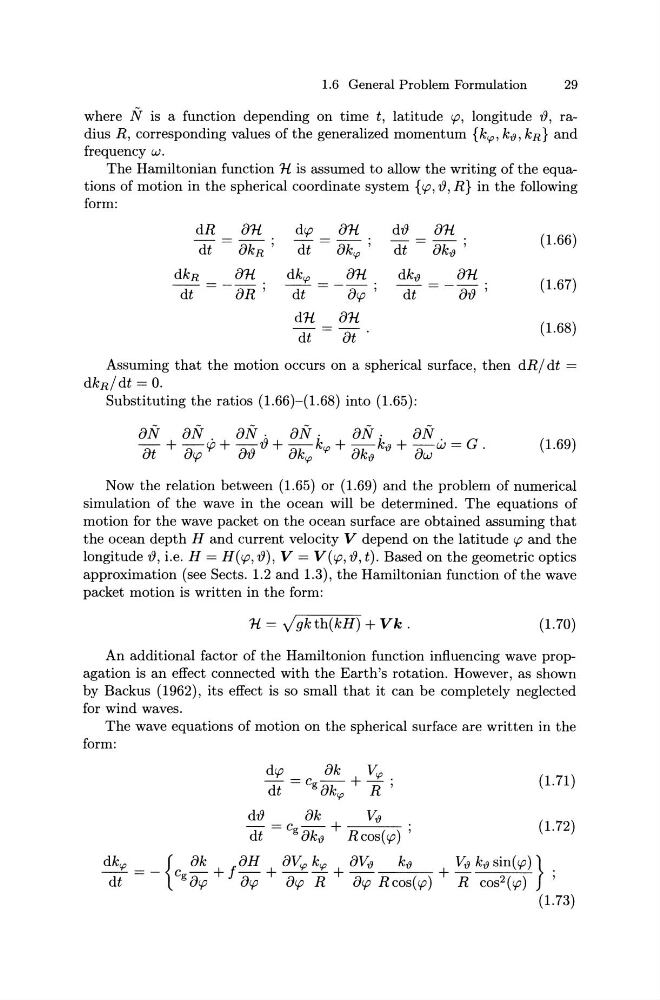
where N is a function depending on time t, latitude cp, longitude {), radius R, corresponding values of the generalized momentum {k"', k.a, kR} and
frequency w.
The Hamiltonian function 1i is assumed to allow the writing of the equations of motion in the spherical coordinate system { cp, {), R} in the following
form:
dR
81i
dcp
81i
d{)
81i
(1.66)
dt
8kR
;
dt
8k'P ' dt
8k{}
;
dkR
81i
dk'P - 81i
dk{}
81i
(1.67)
dt
8R'
dt
8cp
;
dt
- 8{) ;
d1i
81i
(1.68)
dt
at
Assuming that the motion occurs on a spherical surface, then dR/ dt =
dkR/dt = 0.
Substituting the ratios (1.66)-(1.68) into (1.65):
af\r af\r . af\r . aflr .
aflr . aflr .
"""1ft + 8cp cp + 8{) {) + 8k"' k"' + 8kiJ kiJ + 8w w = G .
(1.69)
Now the relation between (1.65) or (1.69) and the problem of numerical
simulation of the wave in the ocean will be determined. The equations of
motion for the wave packet on the ocean surface are obtained assuming that
the ocean depth H and current velocity V depend on the latitude cp and the
longitude{), i.e. H = H(cp, iJ), V = V(cp, {), t). Based on the geometric optics
approximation (see Sects. 1.2 and 1.3), the Hamiltonian function of the wave
packet motion is written in the form:
1i = y'gkth(kH) + Vk.
(1.70)
An additional factor of the Hamiltonian function influencing wave propagation is an effect connected with the Earth's rotation. However, as shown
by Backus (1962), its effect is so small that it can be completely neglected
for wind waves.
The wave equations of motion on the spherical surface are written in the
form:
dcp _
ak
v"' .
dt- cgak + Ii'
(Ln)
'P
diJ
ak
v{}
dt = cgak{} + Rcos(cp)
(1. 72 )
dk"' = _ {c 8k + 1 aH + av"' k"' + av{} k{} + v{} k{} sin(cp)} .
dt
g8cp
8cp
8cp R
8cp Rcos(cp)
R cos2(cp)
'
(1. 73)
29
where N is a function depending on time t, latitude cp, longitude {), radius R, corresponding values of the generalized momentum {k"', k.a, kR} and
frequency w.
The Hamiltonian function 1i is assumed to allow the writing of the equations of motion in the spherical coordinate system { cp, {), R} in the following
form:
dR
81i
dcp
81i
d{)
81i
(1.66)
dt
8kR
;
dt
8k'P ' dt
8k{}
;
dkR
81i
dk'P - 81i
dk{}
81i
(1.67)
dt
8R'
dt
8cp
;
dt
- 8{) ;
d1i
81i
(1.68)
dt
at
Assuming that the motion occurs on a spherical surface, then dR/ dt =
dkR/dt = 0.
Substituting the ratios (1.66)-(1.68) into (1.65):
af\r af\r . af\r . aflr .
aflr . aflr .
"""1ft + 8cp cp + 8{) {) + 8k"' k"' + 8kiJ kiJ + 8w w = G .
(1.69)
Now the relation between (1.65) or (1.69) and the problem of numerical
simulation of the wave in the ocean will be determined. The equations of
motion for the wave packet on the ocean surface are obtained assuming that
the ocean depth H and current velocity V depend on the latitude cp and the
longitude{), i.e. H = H(cp, iJ), V = V(cp, {), t). Based on the geometric optics
approximation (see Sects. 1.2 and 1.3), the Hamiltonian function of the wave
packet motion is written in the form:
1i = y'gkth(kH) + Vk.
(1.70)
An additional factor of the Hamiltonian function influencing wave propagation is an effect connected with the Earth's rotation. However, as shown
by Backus (1962), its effect is so small that it can be completely neglected
for wind waves.
The wave equations of motion on the spherical surface are written in the
form:
dcp _
ak
v"' .
dt- cgak + Ii'
(Ln)
'P
diJ
ak
v{}
dt = cgak{} + Rcos(cp)
(1. 72 )
dk"' = _ {c 8k + 1 aH + av"' k"' + av{} k{} + v{} k{} sin(cp)} .
dt
g8cp
8cp
8cp R
8cp Rcos(cp)
R cos2(cp)
'
(1. 73)