

28
1 General Problem Formulation
does not allow one to obtain correctly a different comprehensive type of physical mechanism for forming wind wave spectra. This is referred to dissipation
connected with wave breaking.
It should be pointed out that the interpretation of the kinetic equation as
the interaction ofrandom wave fields became wellknown after K. Hasselmann's
publications (1960, 1966, 1979). Using the method of Feymann diagrams the
description of the non-linear interaction is generalised (taking into account
the non-conservative interaction of wave fields and external fields) by means
of the methods of theoretical physics for the wind wave case. The function in
the right side of (1.54) describes the different physical mechanisms forming
the wind wave spectrum. At present the right side of (1.54) is called "a source
function". It is written as the sum of different approximations to the physical
mechanism:
(1.64)
According to wind wave theory, the source function should be assumed
to include, at least, the following components (Davidan et al., 1985): G 1 is
the mechanism describing the wind-to-wave energy flux due to the influence
of the turbulent pressure variation field; G 2 , G3 , G4 are the energy flux to
waves due to wave interaction (G2 -linear, G3 - non-linear) with averaged air
flow and atmospheric turbulence (G4 ); G5 is the energy exchange due to the
wave interaction with water turbulence; G6 is the energy dissipation due to
bottom friction; G7 is the energy dissipation due to wave breaking; G8 is the
non-linear energy transfer in the wind wave spectrum. The list of possible
mechanisms forming the wind wave spectrum, including, for example, the
interaction between waves and the ice cover Gg could be extended. These
are the main components of the source function; they are still insufficiently
studied.
1.6 General Problem Formulation for Determining
the Wave Action Spectral Density in the Ocean
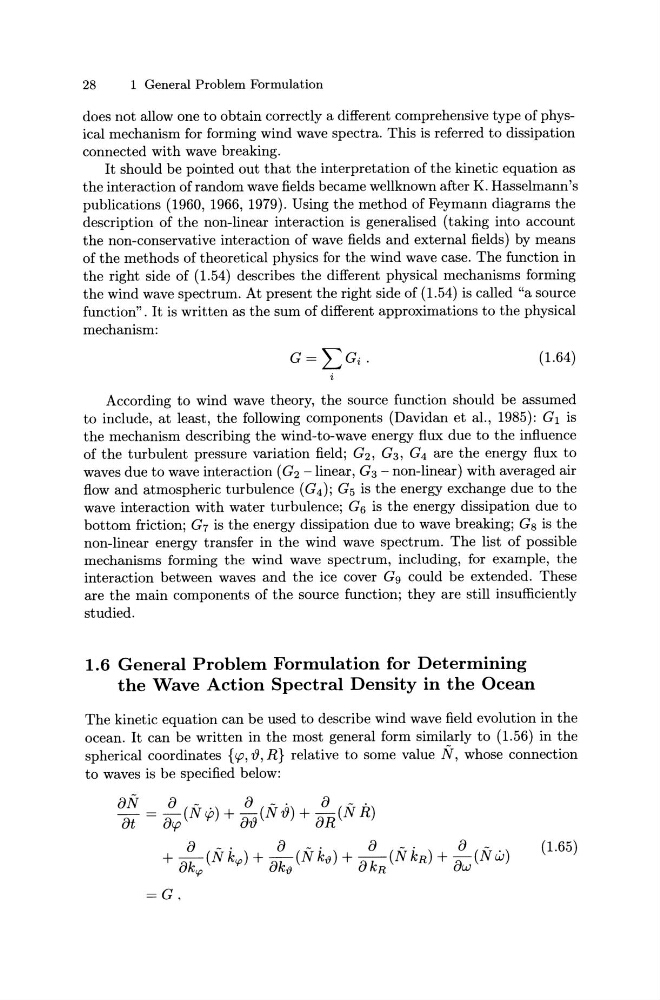
The kinetic equation can be used to describe wind wave field evolution in the
ocean. It can be written in the most general form similarly to (1.56) in the
spherical coordinates {
8N
8 -
8 - .
8 - .
7ft= 8
8 -·
8 -·
8 -
+ 8 k'P(Nk'P)+ 8 k1'J(Nko)+ 8 kR(NkR)+ 8 )Nw)
(1.65)
=G,
1 General Problem Formulation
does not allow one to obtain correctly a different comprehensive type of physical mechanism for forming wind wave spectra. This is referred to dissipation
connected with wave breaking.
It should be pointed out that the interpretation of the kinetic equation as
the interaction ofrandom wave fields became wellknown after K. Hasselmann's
publications (1960, 1966, 1979). Using the method of Feymann diagrams the
description of the non-linear interaction is generalised (taking into account
the non-conservative interaction of wave fields and external fields) by means
of the methods of theoretical physics for the wind wave case. The function in
the right side of (1.54) describes the different physical mechanisms forming
the wind wave spectrum. At present the right side of (1.54) is called "a source
function". It is written as the sum of different approximations to the physical
mechanism:
(1.64)
According to wind wave theory, the source function should be assumed
to include, at least, the following components (Davidan et al., 1985): G 1 is
the mechanism describing the wind-to-wave energy flux due to the influence
of the turbulent pressure variation field; G 2 , G3 , G4 are the energy flux to
waves due to wave interaction (G2 -linear, G3 - non-linear) with averaged air
flow and atmospheric turbulence (G4 ); G5 is the energy exchange due to the
wave interaction with water turbulence; G6 is the energy dissipation due to
bottom friction; G7 is the energy dissipation due to wave breaking; G8 is the
non-linear energy transfer in the wind wave spectrum. The list of possible
mechanisms forming the wind wave spectrum, including, for example, the
interaction between waves and the ice cover Gg could be extended. These
are the main components of the source function; they are still insufficiently
studied.
1.6 General Problem Formulation for Determining
the Wave Action Spectral Density in the Ocean
The kinetic equation can be used to describe wind wave field evolution in the
ocean. It can be written in the most general form similarly to (1.56) in the
spherical coordinates {
8N
8 -
8 - .
8 - .
7ft= 8
8 -·
8 -·
8 -
+ 8 k'P(Nk'P)+ 8 k1'J(Nko)+ 8 kR(NkR)+ 8 )Nw)
(1.65)
=G,