

322
7 Wave Transformation in Ice-Covered Water
(7.27)
Thus, with increasing value L, the power of the cosine function is increased
and the energy angular distribution becomes narrower.
It follows from the ratio (7.22), when the dissipation is neglected, that
the spectrum S ( w, (3, x) is not dependent on the ice thickness gradient,
but is determined only by its value. In this case the spectral density ratio
S(w,(3,x)IS0 (w,(30 ) is increased with increasing Land at the special point
where L(x) = gp2/w 2 p3 , it becomes infinitely large. Actually, this never happens due to wave energy dissipation.
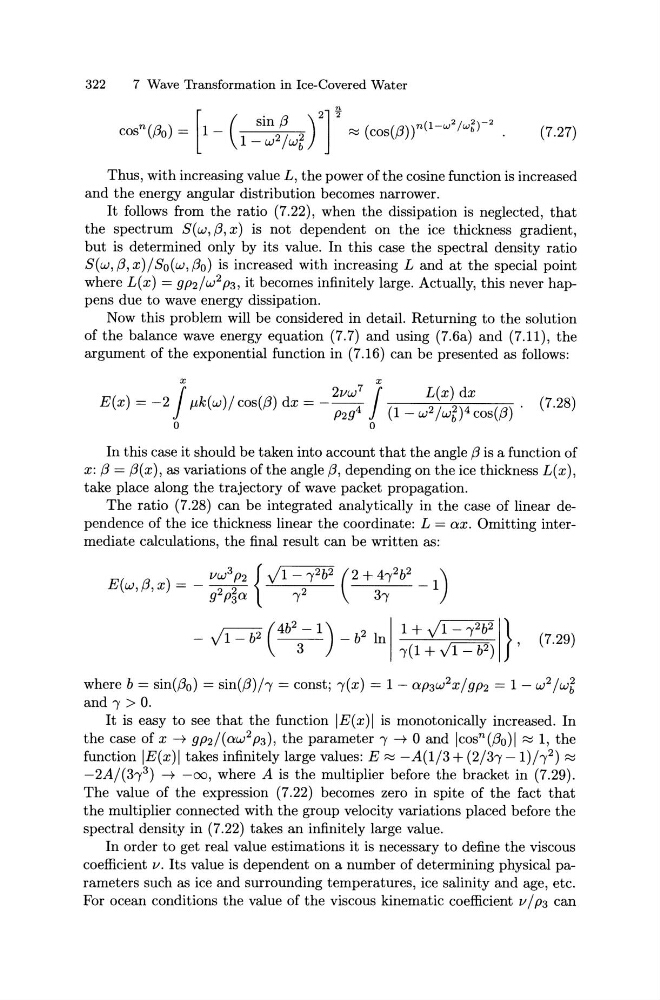
Now this problem will be considered in detail. Returning to the solution
of the balance wave energy equation (7.7) and using (7.6a) and (7.11), the
argument of the exponential function in (7.16) can be presented as follows:
X
X
J
2vw 7 J L(x) dx
E(x) = -2 J-Lk(w)l cos(f3) dx = - - 4
(
2 l 2 ) 4
((3) ·
P29
1 - w wb cos
0
0
(7.28)
In this case it should be taken into account that the angle (3 is a function of
x: (3 = (3(x), as variations of the angle (3, depending on the ice thickness L(x),
take place along the trajectory of wave packet propagation.
The ratio (7.28) can be integrated analytically in the case of linear dependence of the ice thickness linear the coordinate: L = o:x. Omitting intermediate calculations, the final result can be written as:
where b = sin(f3o) = sin(f3)/r = const; 1(x) = 1- o:p3w 2 xlgp2 = 1- w 2 lw~
and 1 > 0.
It is easy to see that the function IE ( x) I is monotonically increased. In
the case of x --+ g P2 I ( o:w 2 P3), the parameter 1 --+ 0 and I cosn (f3o) I ~ 1, the
function IE(x)l takes infinitely large values: E ~ -A(113 + (2l31-1)/r 2 ) ~
-2AI(31 3 ) --+ -oo, where A is the multiplier before the bracket in (7.29).
The value of the expression (7.22) becomes zero in spite of the fact that
the multiplier connected with the group velocity variations placed before the
spectral density in (7.22) takes an infinitely large value.
In order to get real value estimations it is necessary to define the viscous
coefficient v. Its value is dependent on a number of determining physical parameters such as ice and surrounding temperatures, ice salinity and age, etc.
For ocean conditions the value of the viscous kinematic coefficient vI p3 can
7 Wave Transformation in Ice-Covered Water
(7.27)
Thus, with increasing value L, the power of the cosine function is increased
and the energy angular distribution becomes narrower.
It follows from the ratio (7.22), when the dissipation is neglected, that
the spectrum S ( w, (3, x) is not dependent on the ice thickness gradient,
but is determined only by its value. In this case the spectral density ratio
S(w,(3,x)IS0 (w,(30 ) is increased with increasing Land at the special point
where L(x) = gp2/w 2 p3 , it becomes infinitely large. Actually, this never happens due to wave energy dissipation.
Now this problem will be considered in detail. Returning to the solution
of the balance wave energy equation (7.7) and using (7.6a) and (7.11), the
argument of the exponential function in (7.16) can be presented as follows:
X
X
J
2vw 7 J L(x) dx
E(x) = -2 J-Lk(w)l cos(f3) dx = - - 4
(
2 l 2 ) 4
((3) ·
P29
1 - w wb cos
0
0
(7.28)
In this case it should be taken into account that the angle (3 is a function of
x: (3 = (3(x), as variations of the angle (3, depending on the ice thickness L(x),
take place along the trajectory of wave packet propagation.
The ratio (7.28) can be integrated analytically in the case of linear dependence of the ice thickness linear the coordinate: L = o:x. Omitting intermediate calculations, the final result can be written as:
where b = sin(f3o) = sin(f3)/r = const; 1(x) = 1- o:p3w 2 xlgp2 = 1- w 2 lw~
and 1 > 0.
It is easy to see that the function IE ( x) I is monotonically increased. In
the case of x --+ g P2 I ( o:w 2 P3), the parameter 1 --+ 0 and I cosn (f3o) I ~ 1, the
function IE(x)l takes infinitely large values: E ~ -A(113 + (2l31-1)/r 2 ) ~
-2AI(31 3 ) --+ -oo, where A is the multiplier before the bracket in (7.29).
The value of the expression (7.22) becomes zero in spite of the fact that
the multiplier connected with the group velocity variations placed before the
spectral density in (7.22) takes an infinitely large value.
In order to get real value estimations it is necessary to define the viscous
coefficient v. Its value is dependent on a number of determining physical parameters such as ice and surrounding temperatures, ice salinity and age, etc.
For ocean conditions the value of the viscous kinematic coefficient vI p3 can