

6.5 Numerical Model of Wind Wave Transformation in a Coastal Area
301
V, m s· 1
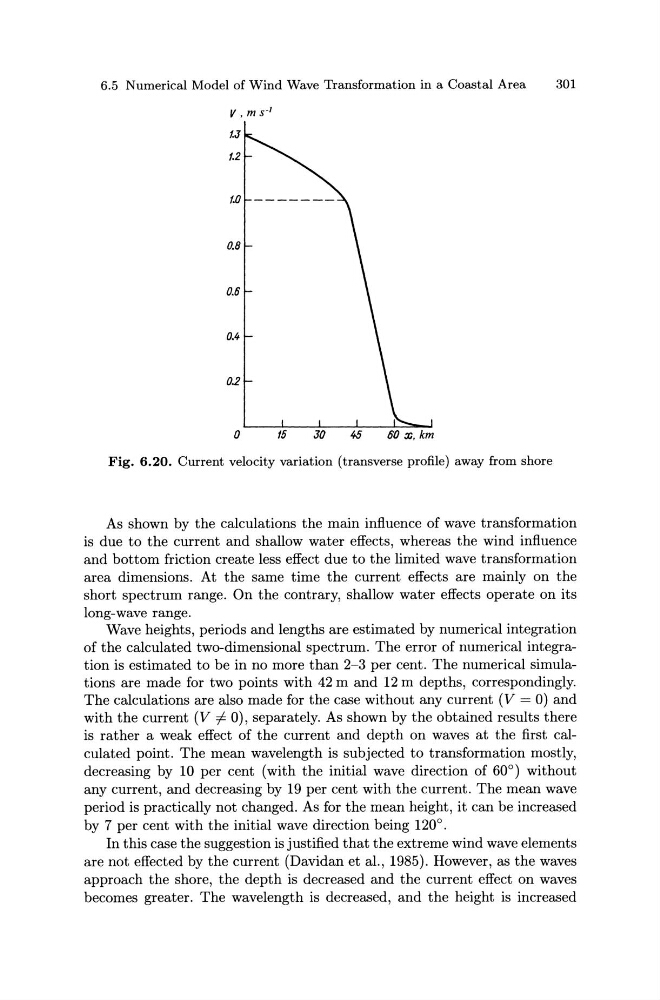
Fig. 6.20. Current velocity variation (transverse profile) away from shore
As shown by the calculations the main influence of wave transformation
is due to the current and shallow water effects, whereas the wind influence
and bottom friction create less effect due to the limited wave transformation
area dimensions. At the same time the current effects are mainly on the
short spectrum range. On the contrary, shallow water effects operate on its
long-wave range.
Wave heights, periods and lengths are estimated by numerical integration
of the calculated two-dimensional spectrum. The error of numerical integration is estimated to be in no more than 2~3 per cent. The numerical simulations are made for two points with 42 m and 12 m depths, correspondingly.
The calculations are also made for the case without any current (V = 0) and
with the current (V -1- 0), separately. As shown by the obtained results there
is rather a weak effect of the current and depth on waves at the first calculated point. The mean wavelength is subjected to transformation mostly,
decreasing by 10 per cent (with the initial wave direction of 60°) without
any current, and decreasing by 19 per cent with the current. The mean wave
period is practically not changed. As for the mean height, it can be increased
by 7 per cent with the initial wave direction being 120°.
In this case the suggestion is justified that the extreme wind wave elements
are not effected by the current (Davidan et al., 1985). However, as the waves
approach the shore, the depth is decreased and the current effect on waves
becomes greater. The wavelength is decreased, and the height is increased
301
V, m s· 1
Fig. 6.20. Current velocity variation (transverse profile) away from shore
As shown by the calculations the main influence of wave transformation
is due to the current and shallow water effects, whereas the wind influence
and bottom friction create less effect due to the limited wave transformation
area dimensions. At the same time the current effects are mainly on the
short spectrum range. On the contrary, shallow water effects operate on its
long-wave range.
Wave heights, periods and lengths are estimated by numerical integration
of the calculated two-dimensional spectrum. The error of numerical integration is estimated to be in no more than 2~3 per cent. The numerical simulations are made for two points with 42 m and 12 m depths, correspondingly.
The calculations are also made for the case without any current (V = 0) and
with the current (V -1- 0), separately. As shown by the obtained results there
is rather a weak effect of the current and depth on waves at the first calculated point. The mean wavelength is subjected to transformation mostly,
decreasing by 10 per cent (with the initial wave direction of 60°) without
any current, and decreasing by 19 per cent with the current. The mean wave
period is practically not changed. As for the mean height, it can be increased
by 7 per cent with the initial wave direction being 120°.
In this case the suggestion is justified that the extreme wind wave elements
are not effected by the current (Davidan et al., 1985). However, as the waves
approach the shore, the depth is decreased and the current effect on waves
becomes greater. The wavelength is decreased, and the height is increased